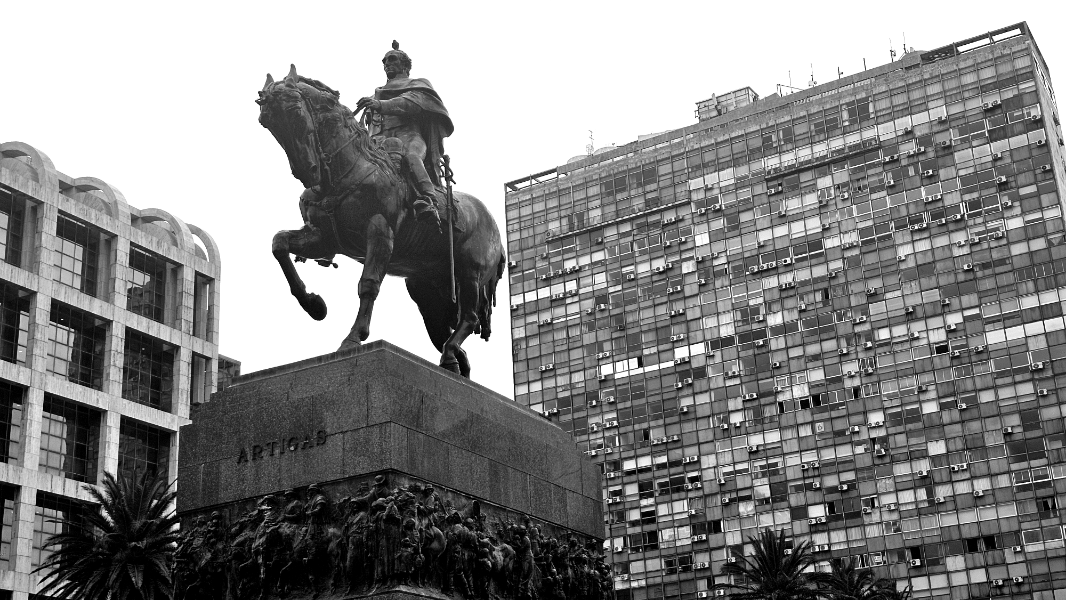
To understand the Federal League, one must first understand the world that broke apart in 1808. For nearly three centuries the Spanish Empire had ruled most of South America through viceroyalties, and the Viceroyalty of the Río de la Plata, created in 1776, stretched over roughly what is today Argentina, Bolivia, Paraguay, Uruguay, and parts of Brazil, with Buenos Aires as its capital.
Then Napoleon shattered the mother country. In 1808 his armies invaded Spain, forced King Ferdinand VII to abdicate, and placed Napoleon’s own brother Joseph Bonaparte on the Spanish throne. The empire suddenly had no legitimate king. Juntas claiming to rule in Ferdinand’s name sprang up across Spain, and when the Supreme Central Junta that claimed to coordinate them fell to the French in 1810, the colonists faced a question they had never before been allowed to ask: if the king was gone, who had the right to govern? The answer came in Buenos Aires in the Revolución de Mayo (May Revolution) of May 1810, when the citizens deposed the viceroy, Baltasar Hidalgo de Cisneros, and set up a local government, the Primera Junta (First Junta).
Spain’s American subjects had watched the British try and fail to invade the River Plate in 1806 and 1807, and militias of local born men had beaten them back; now those same men began to believe they could govern themselves. Throughout the former viceroyalty, the next decade would be a struggle over what independence should mean, and no figure shaped that argument more than Artigas.
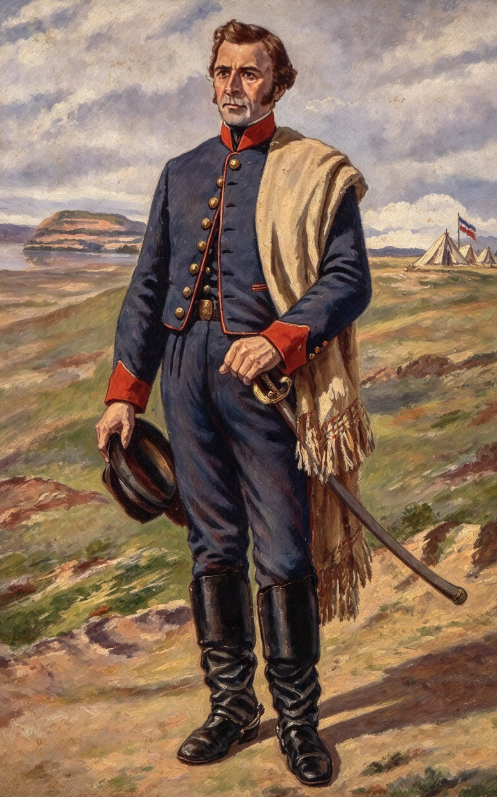
José Gervasio Artigas was born in Montevideo on June 19, 1764, into a well established colonial family. In 1797, at the age of thirty three, he enlisted as a common soldier in the Cuerpo de Blandengues (Blandengues Corps), a frontier militia raised to police the borders and cattle ranches of the countryside, and he spent years fighting smugglers and raiders on the plains north of Montevideo. That life made him something most creole officers were not: a man at home among the gauchos, the rural poor, and the native peoples of the interior, and he would draw on that trust for the rest of his career.
His early life explains the man he became. His family was one of the founding families of Montevideo: his grandparents, Juan Antonio Artigas Ordobas and Ignacia Xaviera Carrasco, were among the city’s first settlers, having come from Zaragoza, Buenos Aires, and Tenerife and having fought in the War of the Spanish Succession before emigrating to escape poverty. His father, Martín José Artigas, was a landowner, a captain of the militia, and an official of the king, and the family ranked among the wealthiest in the city. José Gervasio was the third of six children. His parents sent him to the Colegio de San Bernardino (San Bernardino School) for religious studies, but he refused to submit to its strict discipline, and it was there that he formed his lifelong friendship with Fernando Otorgues.
At about twelve years old he left school for the countryside, working the family estancias (cattle ranches) at Sauce and Casupá during the summers, and there, among gauchos and Indians, his outlook was permanently shaped. Coming of age, he drifted into cattle smuggling, which was less a crime in the frontier economy than a way of life, but it made him a wanted man, and a reward was posted for his death by the ranchers and officials of Montevideo. So when the viceroy organized a company of Blandengues at Maldonado in 1797 to patrol the border and suppress smuggling, the deal offered to men like Artigas was simple: enlist and be pardoned. He accepted a lieutenant’s commission in the very force that had been hunting him, and spent the following decade fighting bandits, smugglers, and Portuguese raiders on the frontier. It was the perfect apprenticeship. He learned the plains, the rivers, and every ford and hiding place between the Uruguay and the sea, and he earned the trust of the horsemen who would later follow him into war.
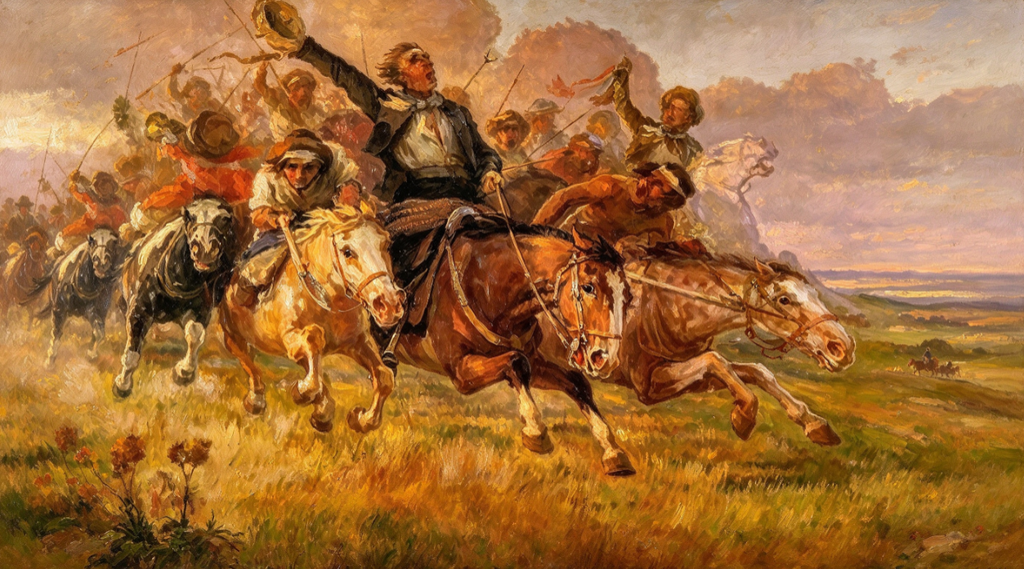
No caudillo builds a revolution alone, and Artigas was served by a remarkable generation of lieutenants. Fernando Otorgues, his friend from schooldays, became his second in command, the man to whom Montevideo was handed in 1815 when the Buenos Aires director was forced to evacuate the city. Juan Antonio Lavalleja and Manuel Oribe, two young officers who learned war in Artigas’s ranks, would both go on to be presidents of an independent Uruguay, and Lavalleja would lead the famous Thirty Three Orientals who raised the country’s final revolt against Brazil in 1825. Andrés Latorre commanded with stubborn skill in the long rural war against the Portuguese, and Blas Basualdo led the tough lancers of the north. Pedro Campbell, an Irishman, carried Artigas’s cause through Corrientes. The most striking of all was Andrés Guazurary, known as Andresito, a Guarani born in Misiones whom Artigas treated as a son, and who governed the Misiones towns for the league and led their forces in the north. It was Andresito who embodied the league’s promise that Indians as well as creoles would be citizens. Alongside the soldiers stood figures like Dámaso Antonio Larrañaga, a priest and naturalist who represented the league’s educated support, while Fructuoso Rivera, another of Artigas’s early commanders, fought well for him, winning the decisive Battle of Guayabos in January 1815, before passing to the Portuguese and later the Brazilians after the cause was lost. On the wider stage of the league itself stood the two governors who gave it reach beyond the Oriental province: Francisco Ramírez of Entre Ríos and Estanislao López of Santa Fe, brilliant cavalry leaders in their own right, though their loyalty, as it turned out, lasted only as long as the league’s fortunes.
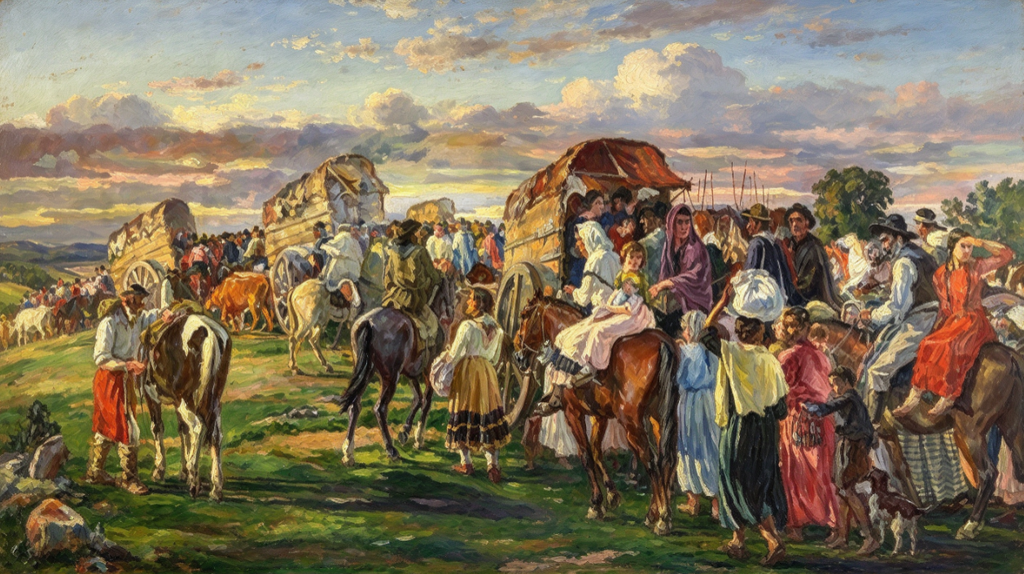
When the revolution against Spanish rule began, Artigas sided with the Primera Junta in Buenos Aires, leaving Montevideo in February 1811 to offer it his military services. He raised an army in the countryside, and on May 18, 1811 he defeated a Spanish royalist force at the Battle of Las Piedras, the victory that made his name. He then laid siege to Montevideo, still held by the Spanish, but the siege collapsed when the Portuguese army of Brazil invaded from the north in support of Spain. Rather than submit, Artigas led a mass emigration of thousands of rural families out of the Banda Oriental (Eastern Strip, the territory east of the Uruguay River that became Uruguay), a episode remembered as the Éxodo del Pueblo Oriental (Exodus of the Eastern/Oriental People), and the sight of an entire people following one man gave him a moral authority no title could confer.
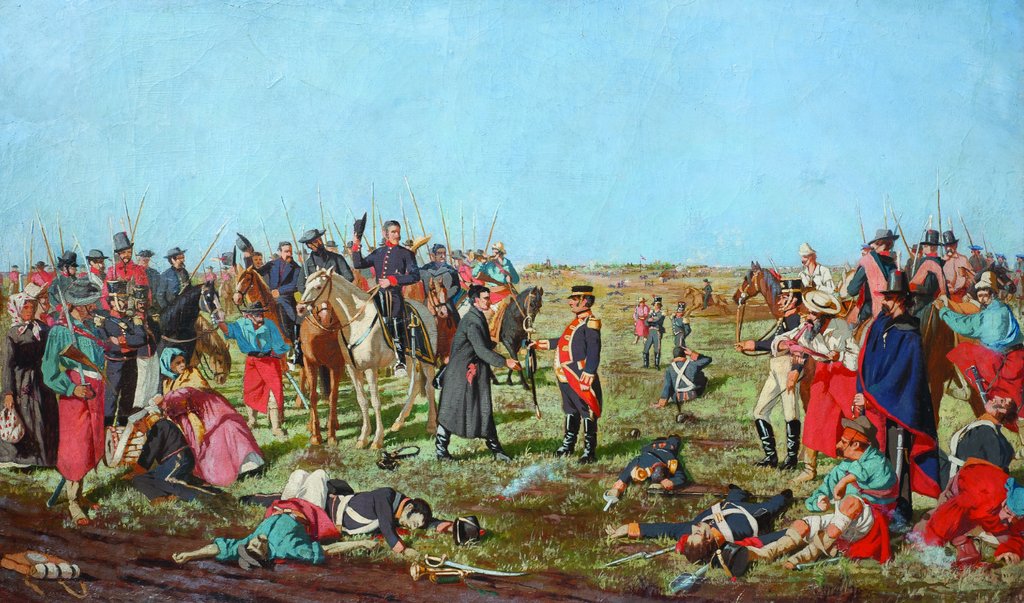
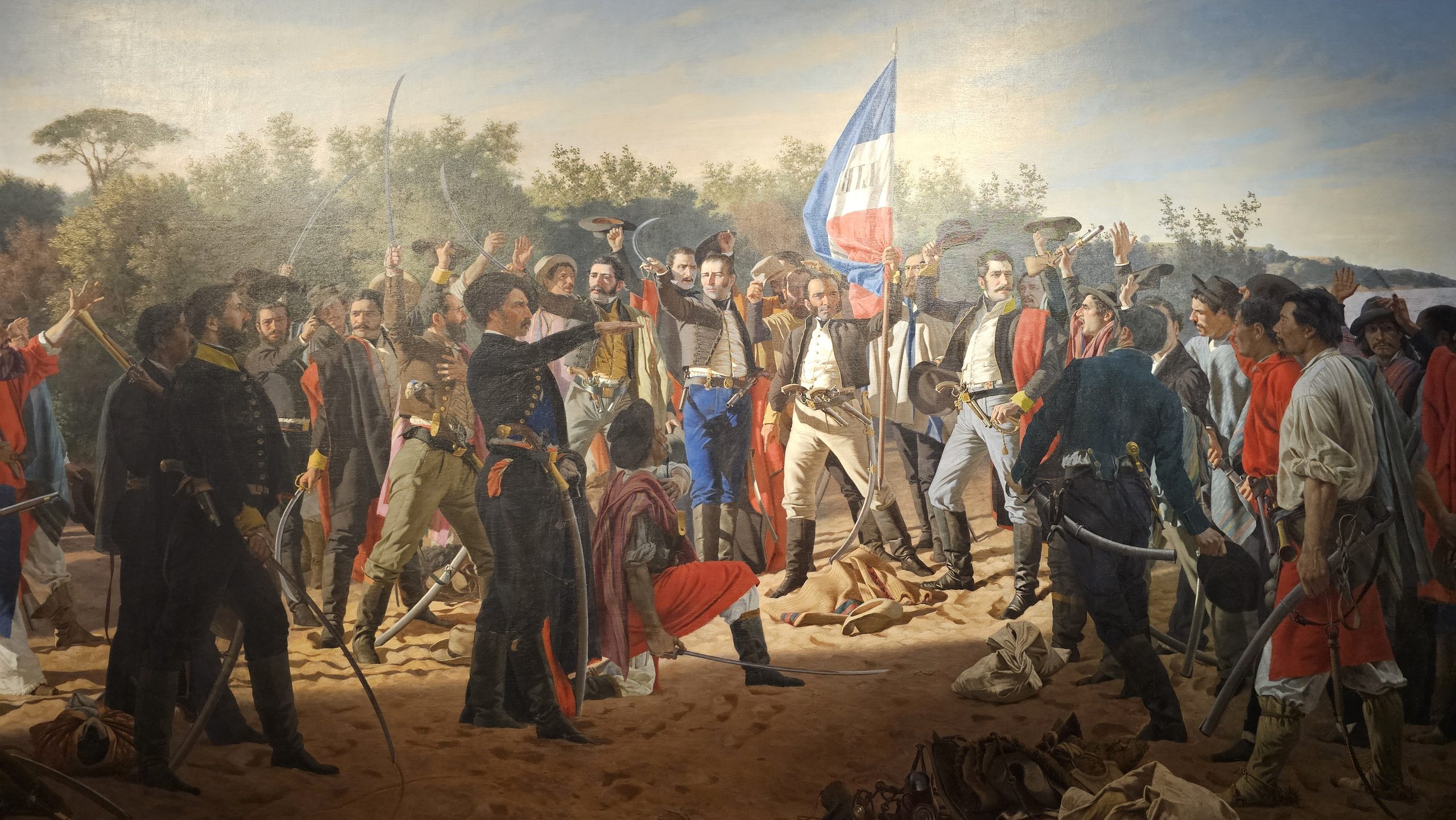
His break with Buenos Aires came over the question of what kind of country the revolution should build. The port city’s leaders, later nicknamed the unitarios (Unitarians), wanted a strong central government with Buenos Aires at its head, holding the customhouse revenue and giving orders to the interior. Artigas believed the opposite: that each province should govern its own internal affairs, keep its own arms, and join the others only through pacts freely made. When the deputies from the Banda Oriental arrived at the Assembly of Year XIII in Buenos Aires, they carried the Instrucciones del Año XIII (Instructions of the Year Thirteen) drafted under Artigas’s direction, demanding a federal system with the provinces as its base, and when the assembly refused to seat them, he walked away from Buenos Aires for good. Over the next two years his lieutenants carried federal revolution through the rivers provinces: Entre Ríos and Corrientes, then Santa Fe, and Misiones, with Córdoba as an ally. By 1815 the alliance was known as the Liga Federal (Federal League) or the Liga de los Pueblos Libres (League of the Free Peoples), and its members had given Artigas the title he prized most: Protector de los Pueblos Libres (Protector of the Free Peoples).
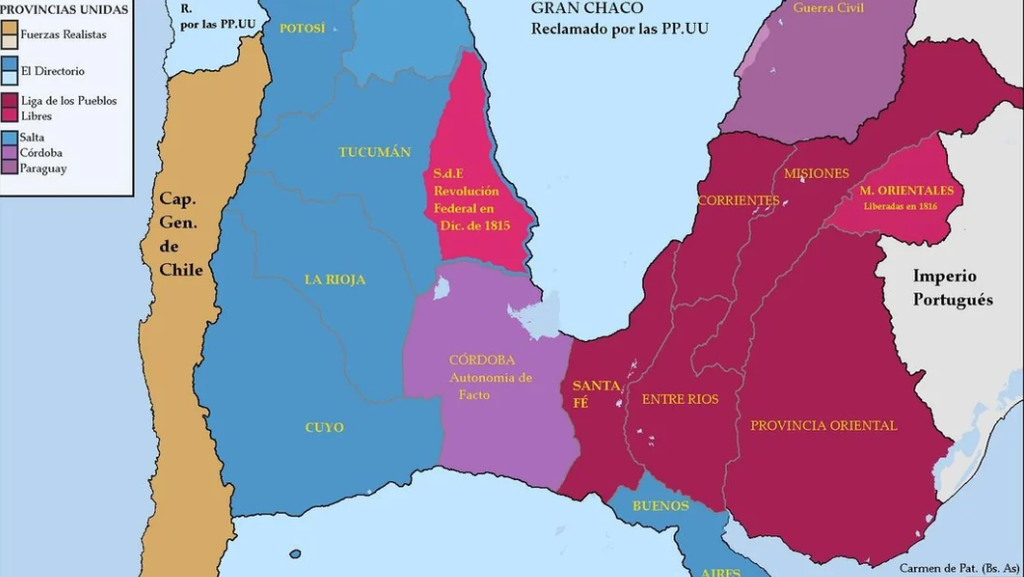
Artigas was not trying to found a separate country, but to define the shape of the whole. The league’s provinces sent delegates to the Congress of Tucumán, which declared the independence of the United Provinces of South America in July 1816, and the flag Artigas had adopted, Belgrano’s blue and white flag with a red diagonal stripe added, red being the color of federalism in the region, still flies in Uruguay today as the Flag of Artigas. His social program was radical for its time. His 1815 Reglamento Provisorio (Provisional Regulation) authorized the confiscation of land from bad Europeans and worse Americans and its redistribution among the rural poor, under the principle that the most unfortunate should be the most privileged. He promoted free education without regard to class or ethnic origin, and attempted to establish autonomous indigenous settlements in Misiones governed by their own inhabitants. He was, in essence, running a confederal and socially revolutionary state in the middle of a war for independence, and this frightened both of the league’s great enemies: Buenos Aires, because of its federalism, and the Portuguese, because of its republicanism.
The league’s end came from outside. In August 1816 the United Kingdom of Portugal, Brazil and the Algarves invaded the Banda Oriental with a large army under Carlos Frederico Lecor, determined to destroy Artigas and annex the province. The Portuguese took Montevideo in January 1817, and the war dragged on for three years in the countryside, with Artigas fighting on while Buenos Aires stood passively by. Infuriated, he declared war on the central government even as his armies were being bled by the Portuguese. Then came the double collapse. In January 1820 his forces were decisively beaten at the Battle of Tacuarembó, and weeks later his own lieutenants, Francisco Ramírez of Entre Ríos and Estanislao López of Santa Fe, rose against him, defeated him at La Bajada, and shattered the league from within. The man who had bestrode a region larger than most European states was left with no army and no territory. In September 1820 he crossed into Paraguay with a small band of followers, and there he stayed.
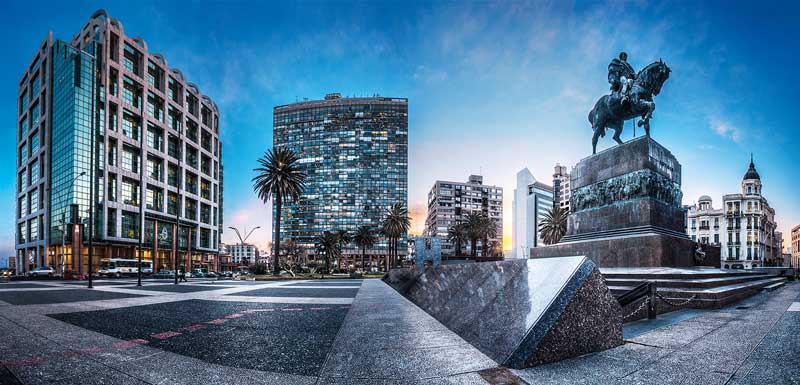
His last thirty years were a deliberate silence. The Paraguayan dictator José Gaspar Rodríguez Francia, wary of the famous exile, confined him to distant settlements far from the capital, and Artigas, refusing every invitation to return and be used as a symbol in other men’s politics, lived as a small farmer near Ibiray outside Asunción, raising cattle and trading hides, wearing the plain clothes of the countryside he had always loved. He refused pensions offered from Montevideo. He died there on September 23, 1850, at the age of eighty six. By then the Banda Oriental had become the independent Oriental Republic of Uruguay, whose very constitution reflected his federal ideas, and both banks of the Plata were building states out of the wreckage of his league. Today Uruguay honors Artigas as its Father of the Nation, his remains lie in a mausoleum in the heart of Montevideo under an eternal flame, and his face and flag are national symbols. Yet his deepest legacy is an idea: that a free country must be a pact among its peoples rather than a command from its capital, an argument the Federal League made in blood between 1815 and 1820 and that the River Plate region has never stopped having.