A Historical Fiction on the Rise of the Gaucho,
The First Peoples of the Pampa: Before the Black Robes Came
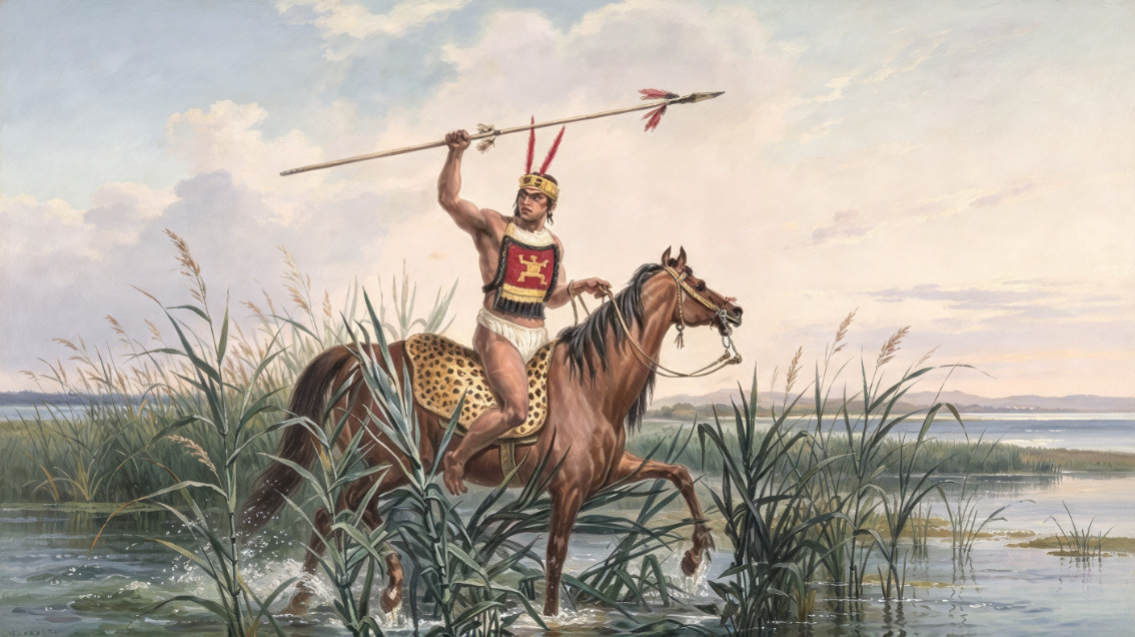
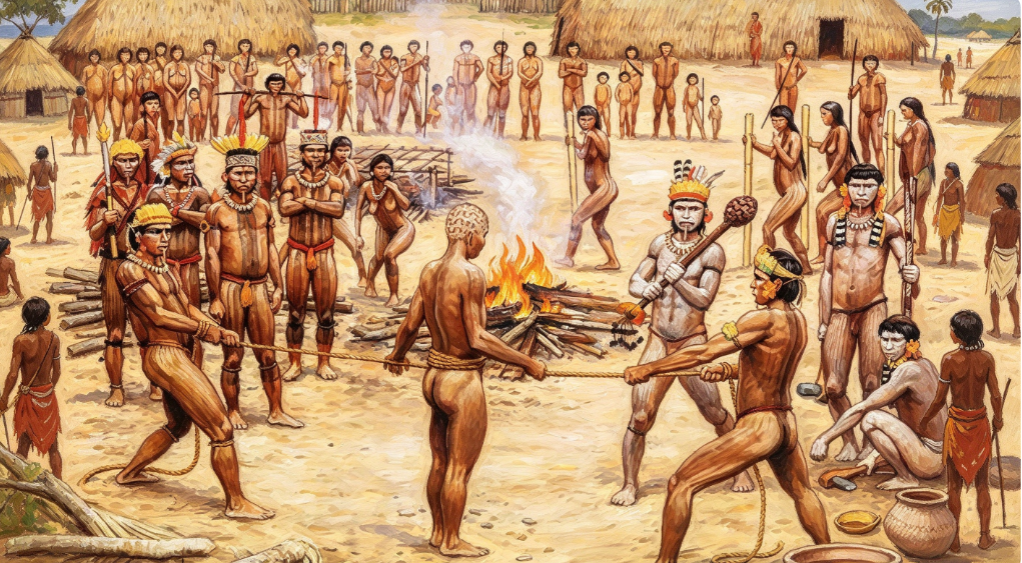
Long before the first Jesuit set foot on the grasslands, before the bells of São Miguel rang across the campos, before the cattle and the horses and the lazo and the boleadora, the southern plains of what would become Rio Grande do Sul, Uruguay, and northeastern Argentina were the domain of a people who belonged to no town and recognized no king. They were the Charrúa (the fierce nomadic warriors of the Banda Oriental), the Guenoa-Minuanos (their close kin who roamed the rolling hills between Uruguay and western Rio Grande do Sul), the Yaró, the Bohán, and the Pampas, the macro-ethnic groups that historians would later gather under the name Charrúa, though they themselves knew only their own bands and their own hunting grounds and the endless freedom of the open grass.
The Charrúa were warriors and master hunters, and they had occupied the Banda Oriental (the eastern bank of the Uruguay River, present-day Uruguay) and parts of Argentina for centuries before the Spanish came. They were tall and lean and hard as the land that made them, and they fought with a ferocity that the Europeans would never forget. In 1515, on the banks of the Río de la Plata, the Charrúa killed the Spanish explorer Juan Díaz de Solís and his entire landing party, and they ate the bodies in a ritual that shocked the Spanish court and gave the river its name, the River of Silver, though the silver the Spaniards sought was not there and the death they found was. From that day forward, the Charrúa were marked in the European mind as the most dangerous of the southern peoples, a nation of warriors who would not be conquered, who would not be tamed, who would rather die on their feet than live on their knees.
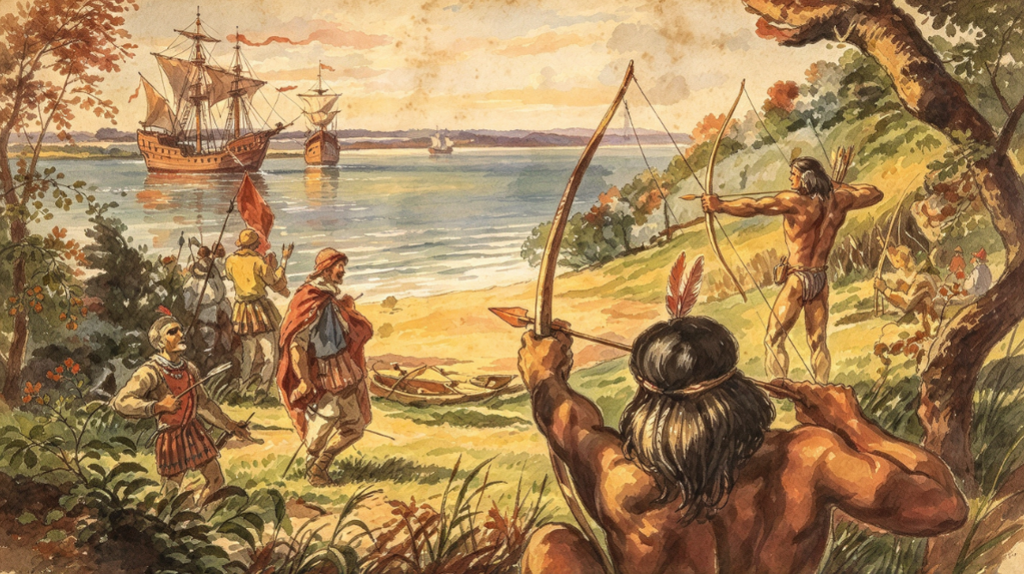
The Guenoa-Minuanos were cousins to the Charrúa, and they roamed the rolling hills between modern Uruguay and western Rio Grande do Sul, including the lands near where Uruguaiana would one day rise. They were horsemen before the horse, hunters of the wild cattle that the missions would later claim as their own, and they knew the pampa as only those who have lived on it for generations can know it: the hidden water holes, the paths through the thorn scrub, the places where the herds wintered and the places where they calved. The Yaró, the Bohán, and the Pampas filled the ecological niche of the southern plains, smaller groups that moved with the seasons, following the game and the wild fruits and the fish that ran up the rivers in the spring.
These peoples were not farmers. They did not plant mandioca (cassava) or maize or build permanent towns. They were hunters and gatherers and, in the fullness of time, they would become the finest horsemen in all of South America, but before the horse came they walked, and they ran, and they knew the land with the intimacy of those who have no walls to separate them from it. The Guaraní, the agricultural people of the forest and the missions, looked upon the Charrúa and the Minuanos with a mixture of fear and contempt, for the Guaraní had learned to live behind walls and the nomads had not, and the sedentary peoples of the world have always regarded the wanderers with suspicion. But the nomads looked upon the Guaraní with something closer to pity, for what is a man who cannot walk away, who is bound to a town, who must ask permission to move across the land that the Creator gave to all?
The Stone Cities of the Jungle
The Founding of the Reducciones (1609-1630)
The first Jesuits came to the Guairá (the region of the upper Paraná River, in present-day Paraná state, Brazil) in 1609, and they came not with swords but with breviaries, not with soldiers but with the quiet arrogance of men who believed that the Word of God, properly spoken, could remake the world. The Spanish Crown had given its blessing to the enterprise, a royal decree of 1608 authorizing the creation of reducciones (mission towns) among the Guaraní, and the Black Robes had answered the call with the fervor of the Counter-Reformation burning in their veins. The first two settlements were established in the Guairá: Nuestra Señora de Loreto and San Ignacio Miní, and within a decade the Jesuits had gathered thousands of Guaraní into these new towns, drawn by the promise of protection from the slave hunters who came raiding out of São Paulo.
The word reducción came from the Spanish reducir, to bring together or to reduce, and it carried within it the whole philosophy of the Jesuit enterprise: to gather the scattered people of the forest into towns where they could be taught, watched over, and saved. The Guaraní had lived for centuries in small, dispersed settlements, moving with the seasons, planting mandioca (cassava) in the forest clearings, fishing the rivers, hunting the tapir and the peccary. The Jesuits proposed something utterly foreign to them: a fixed life behind walls, a life of bells and schedules and catechism, a life where the ñande reko (the Guaraní way of being, their ancestral custom) would be bent and reshaped into something the priests could understand and control. And yet the Guaraní came, in their thousands, because the alternative was worse.
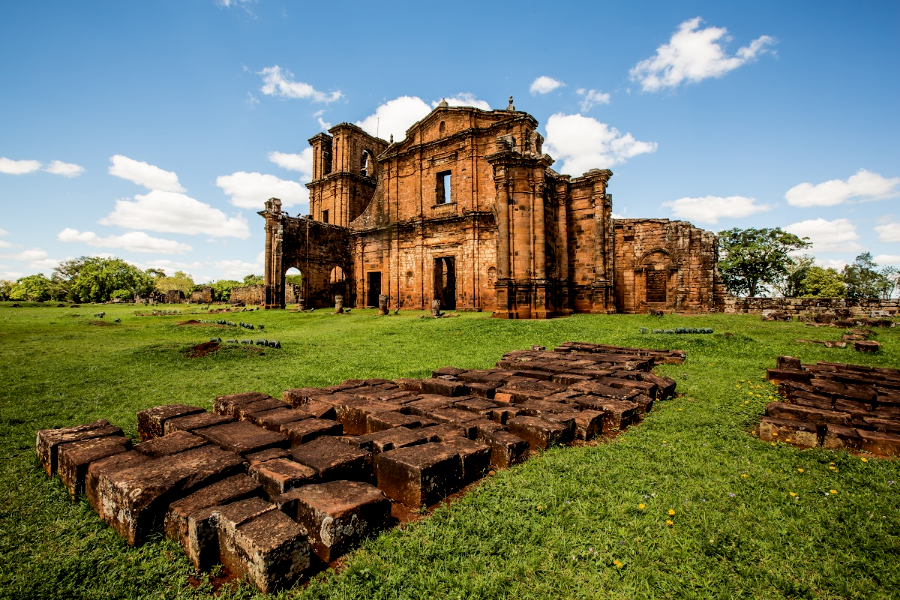
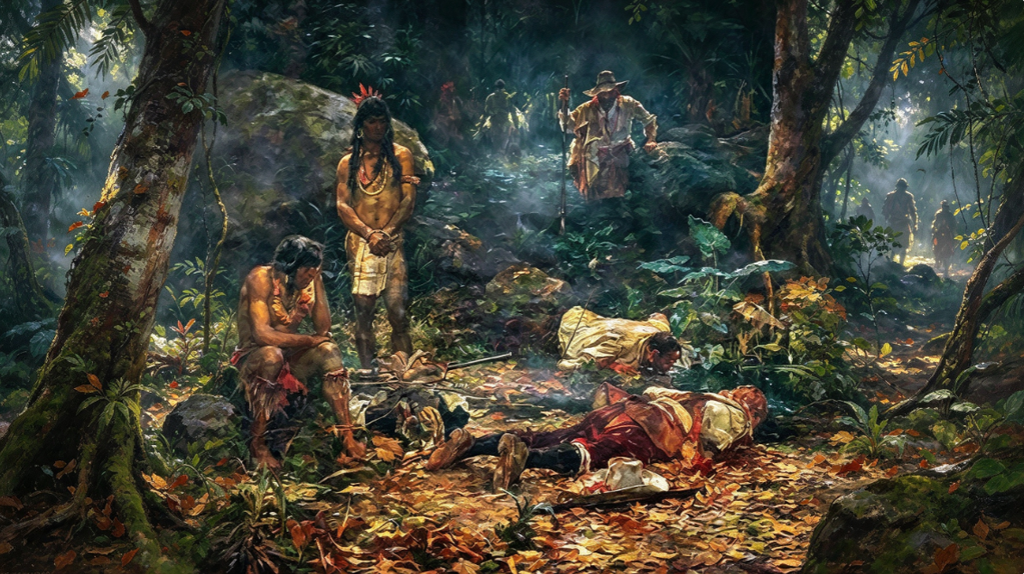
The alternative was the bandeirantes (slave-hunting expeditions from São Paulo), the men of Portuguese descent who came out of the east like a plague, with their Tupí allies and their dogs and their muskets, hunting human beings for the slave markets of the coast. The bandeirantes had discovered that the Guaraní of the missions, once they had been gathered and taught and made accustomed to regular work, were worth more than the wild Indians of the deep forest, for they knew how to plant and harvest and build, and they could be sold to the sugar plantations of Bahia and Pernambuco for good silver. Between 1610 and 1630, the bandeirantes took more than 150,000 Guaraní from the Guairá missions alone, and the Black Robes, who had come to save souls, found themselves leading their people in flight, abandoning the towns they had built with such labor, retreating down the rivers toward the safety of the Spanish territories to the south and west.
The Flight and the Foundation of the Thirty Peoples
In 1631, the Jesuit Antonio Ruiz de Montoya led a mass evacuation of the Guairá missions that became one of the great forced migrations of South American history. Twelve thousand Guaraní, with their cattle and their few possessions, traveled down the Paraná River in canoes and on foot, through the forests and across the swollen rivers, pursued by the bandeirantes and the diseases they carried. Many died on the journey. Those who survived founded new missions in the region of the Tape, in the grasslands south of the Ibicuí River, in what is now Rio Grande do Sul. And there, on the open pampa where the sky was immense and the grass stretched to the horizon, they built again: Loreto, San Miguel, San Ignacio, and the rest, the towns that would become the core of the Sete Povos das Missões (the Seven Peoples of the Missions).
The bandeirantes did not stop. In 1636, Antônio Rapôso Tavares led a force of 140 Paulistas and 1,500 Tupí warriors against the Tape missions, destroying San Cristóbal, Santa Ana, and Natividad, and killing or enslaving more than forty thousand Guaraní. The Jesuits, desperate and raging, armed their converts and raised a force of 1,500 Guaraní warriors to defend the missions, and in 1641, on the banks of the Mbororé River, the Guaraní militia met the bandeirantes in open battle and destroyed them. The Battle of Mbororé was the turning point. The bandeirantes ceased their attacks on the missions, and a period of peace began that lasted until the 1750s, a century of growth and prosperity that the Guaraní and their Black Robes would remember as a golden age.
The Architecture of the Missions: The Stone Cities
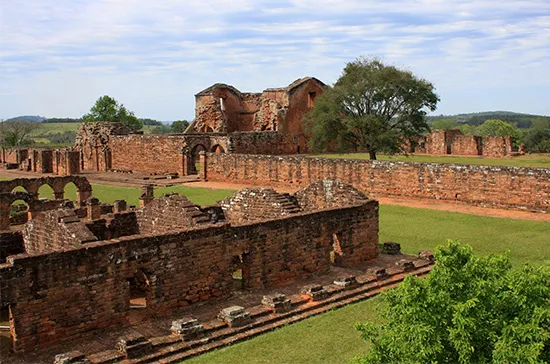
The missions of the Seven Peoples were not mere villages. They were towns, laid out on a grid with a central plaza, the church facing the plaza on one side, the cemetery beside it, the houses of the Guaraní arranged in long blocks along the streets, each family with its own apartment and its own plot of land beyond the town. The church of São Miguel Arcanjo (Saint Michael the Archangel), the greatest of the mission churches, was designed by the Italian architect Gian Battista Primoli and built between 1735 and 1745, a structure of sandstone and iron-red earth that reared against the pampa sky with its twin towers and its grand facade, a monument to the ambition of the Black Robes and the skill of the Guaraní artisans who executed their designs. The walls were painted white, the interiors ornamented with paintings and polychrome wooden sculptures, the altar covered in gold leaf, and the bells, cast in Europe and shipped across the ocean, rang across the grasslands at dawn and dusk, calling the people to prayer, to work, to the rhythm of a life that was no longer theirs alone.
The plaza could hold ten thousand souls. On feast days, the entire town gathered beneath the shadow of the cross, the men in their chiripá (the loincloth-wrap of the mounted herdsman) and the women in their mantas (cloth wraps), the children barefoot in the dust, the old ones seated on the low stone walls, and the priests on the steps of the church, administering the sacraments, teaching the catechism, reminding the people of the God who had brought them out of the forest and into these stone cities. The mission was the world, and the world was the mission, and beyond the walls of the town, the pampa stretched to infinity, a sea of grass that the Guaraní had learned to ride like horsemen born to the saddle.
Daily Life in the Reducciones: Work and Prayer
The day in the mission began with the bells before dawn. The people rose from their hammocks and their hides, gathered in the plaza or in the church for morning prayers, and then went to work: the men to the fields and the estancias (ranches), the women to the gardens and the workshops, the children to the school where the Jesuits taught reading and writing in the Guaraní language, a radical departure from the practice of other missionaries, who insisted on Spanish or Latin. The Jesuits had learned early that the fastest way to the soul of a Guaraní was through his own tongue, and so they learned Guaraní themselves, wrote grammars and dictionaries, translated the catechism and the prayers, and made the mission schools instruments of a literacy that spread far beyond the walls of the church.
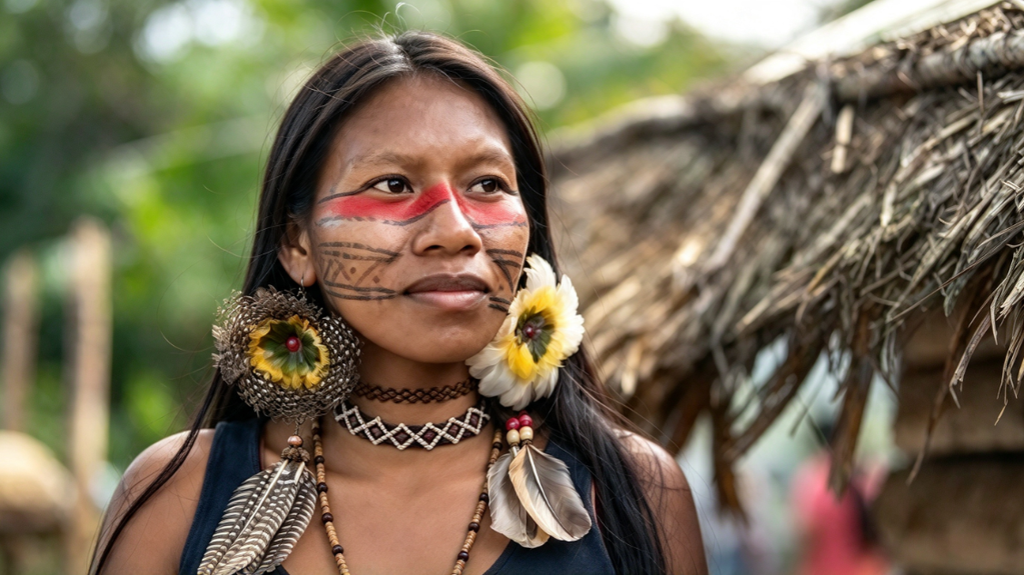
The Guaraní who could read and write were the ones who kept the records of the estancias, the inventories of cattle, the accounts of the yerba mate (the Paraguay tea, the green bitter ka’a that the people drank from the cuia, the gourd passed hand to hand around the fire). They were the ones who served as assistants to the priests, as catechists, as artisans in the workshops where the Guaraní learned the crafts of Europe: carpentry, blacksmithing, stonemasonry, weaving, painting, the making of musical instruments. And they were the ones who, in the militia, served as sergeants and captains, for the Jesuits had learned that a Christian Guaraní with a musket was worth ten Spanish soldiers in the defense of the frontier.
The Mission Economy – Cattle, Yerba Mate, and the Common Good
The economic foundation of the missions was the estancia, the great ranch that each town maintained in the surrounding campos. The Jesuits had introduced cattle and horses to the Guaraní in the early years of the seventeenth century, and by the middle of the eighteenth century, the thirty missions of the Jesuit Province of Paraguay pastured more than a hundred thousand head of cattle on lands that stretched for hundreds of miles. The estancias were the source of the hides that were sold to Buenos Aires and Santa Fe, the tallow that was used for candles and soap, the beef that fed the mission people and the dried meat, the charque, that was traded across the interior. And they were the source of the horses that made the Guaraní the finest horsemen of the Spanish Americas, the riders who could cut a wild bull from a herd of ten thousand at full gallop and have its hide off before the morning mist burned away.
The yerba mate was the other pillar of the mission economy. The Jesuits had found the Guaraní drinking the green tea long before the Black Robes arrived, and they had learned to cultivate it, to dry it, to pack it in hides for shipment to the markets of Asunción and Buenos Aires and even Lima. The missions of the Paraná and the Uruguay became the principal producers of yerba mate in the region, and the tea, which the Guaraní called ka’a and the Jesuits called the herb of Paraguay, became a currency as much as a beverage, traded for iron tools and cloth and the other goods that the missions could not produce themselves.
The Jesuits organized the economy communally, or so they claimed. The land belonged to the mission, not to the individual, and the fruits of the common labor were distributed according to need, with each family receiving its share of the harvest, the cattle, the cloth. But the reality was more complex. The Guaraní did, in fact, own private property: horses, clothing, jewelry, yerba mate, and the Jesuits repeatedly acknowledged that the mission people traded independently and paid bonuses to skilled artisans and workers who exceeded their quotas. The communal structure was flexible enough to allow individual initiative within the framework of the common good, and the result was a prosperity that made the missions of Paraguay the most successful experiment in indigenous economic development in the Americas.
The Guaraní Militia – The Soldiers of the Reductions
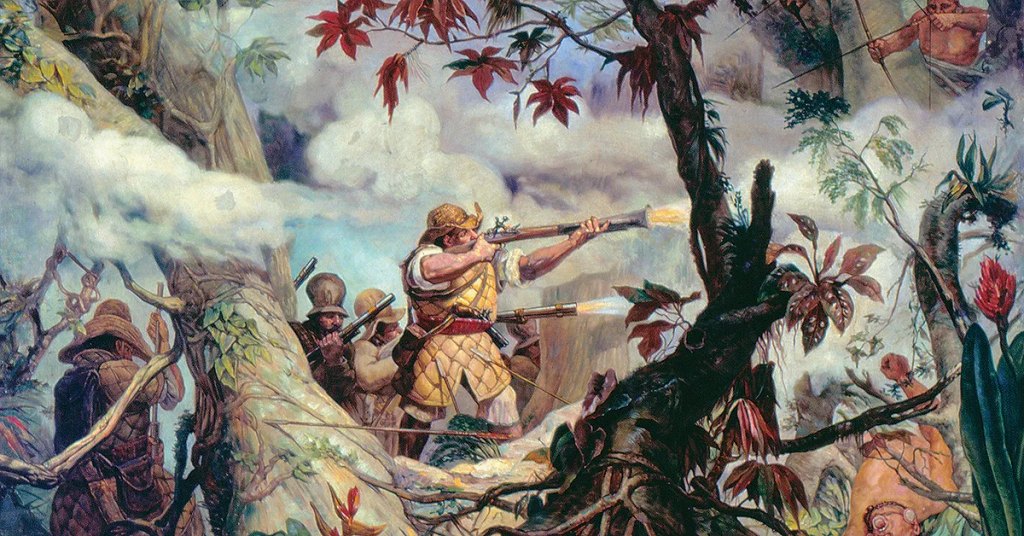
The formation of the Guaraní militia was born of necessity. The bandeirantes had shown that the missions could not survive without armed defenders, and the Jesuits, many of whom had served in the armies of Europe before entering the order, trained the Guaraní in the tactics of modern warfare. The Guaraní learned to use firearms, to march in formation, to form squares and columns and to fight in the manner of the Spanish tercios (the infantry formations of the sixteenth and seventeenth centuries). They were organized into companies, with a maestre de campo (field marshal), a sargento mayor (sergeant major), captains, sergeants, and corporals, the ranks of the Spanish army. And they combined the tactics of Europe with the tactics of the forest: the ambush, the raid, the knowledge of the terrain, the ability to move silently through the grass and the brush.
By the middle of the seventeenth century, the Guaraní militia was the most formidable military force on the frontier between the Spanish and Portuguese empires. In 1680, the Governor of the Río de la Plata ordered the Jesuits to mobilize nearly three thousand Guaraní soldiers to occupy the Colonia del Sacramento, the Portuguese fort and smuggling center on the north bank of the Río de la Plata. The Guaraní marched south, a month-long journey across the pampa, and they took the fort and held it, and from that day forward the Spanish Crown regarded the mission militia as an indispensable instrument of imperial defense.
But the militia was never merely an instrument of empire. For the Guaraní, the weapons and the training were also the means of their survival, the shield that protected their towns from the slave hunters and the Portuguese. And in the years of the Guaraní War, when the treaty of Madrid turned the Seven Peoples over to Portugal, it was the militia that formed the core of the resistance, the men who had learned to fight in the service of the King of Spain now fighting for the land that the King had given away.
The Cultural Synthesis – Music, Art, and the Guaraní Soul
The Jesuits brought more than the catechism to the missions. They brought the music of the Baroque, the polyphony of the European cathedrals, the violins and the harps and the organs that they installed in the mission churches. The musician Domenico Zipoli, who had been a rising star in Rome before he joined the order, arrived in the missions in 1717 and spent the last years of his life composing and teaching, and his music, and the music of the other Jesuit musicians, found in the Guaraní a people with an extraordinary gift for melody and rhythm. The mission churches were famous for their choirs, for the orchestras that played the masses of Haydn and the motets of the Renaissance masters, for the singers who could fill the vast spaces of the sandstone cathedrals with sound that seemed to come from another world.
But the synthesis was not one-way. The Jesuits learned Guaraní, wrote in Guaraní, translated the liturgy into Guaraní, and the Guaraní, in turn, took the music and the art of Europe and made them their own. The polychrome sculptures of the mission churches, the painted altarpieces, the carved wooden saints, were the work of Guaraní artisans who had been taught by the Jesuits but who brought to their work the sensibility of their own culture, the patterns and the forms that their ancestors had carved into the wood and painted on the walls of their houses. The ponchos that the Guaraní wove, the patterns that the women had once woven for the Jesuit fathers, became the distinctive dress of the gaucho, the rider of the pampa, the man who carried the legacy of the missions in the clothes on his back.
The Population and the Decline – The Numbers of the Missions
At their height, in the 1740s, the thirty missions of the Jesuit Province of Paraguay held between 100,000 and 150,000 Guaraní, making them the most populous native communities in the Americas outside of the great cities of Mexico and Peru. The Seven Peoples of the Missions, the towns on the east bank of the Uruguay, held more than 30,000 souls. The population had grown steadily through the seventeenth century, despite the epidemics that swept through the missions in the early years, the smallpox and the measles and the typhus that killed thousands but never destroyed the community. The Guaraní recovered, rebuilt, repopulated, and by the time of the Treaty of Madrid, the missions were prosperous, stable, and, in their own way, free.
São Miguel das Missões, 1745
The bells of São Miguel Arcanjo (Saint Michael the Archangel) rang across the pampa before the sun had torn itself free of the horizon, and the sound rolled over the grasslands like a rumor of God, deep and bronze and terrible in its beauty. In the half-light, the sandstone cathedral reared against the sky, its twin towers unfinished, its walls the color of dried blood, for the Guaraní (Guarani people) who had built it, stone by stone, over forty years, had mixed the mortar with the iron-red earth of the pampa itself, as if the church must bleed as the land bled.
Abaangatu, son of Itayu and nephew of the corregidor (indigenous district governor), stood in the great plaza where ten thousand souls could gather beneath the shadow of the cross, and watched the estancieiros (ranch foremen) drive the first herd of the morning down from the northern campos (grasslands). He was twenty-two years that dry season, and his grandfather had been born in the old reducción (Jesuit mission town) of Tape before the Paulistas, the bandeirantes (slave-hunting expeditions from São Paulo), came burning out of the east like a plague of men with dogs. His grandfather had been eight years old when his own grandfather carried him on his back across the Uruguay River, the family’s cattle lowing behind them, the Tape missions smoking on the far shore. That was the founding memory of Abaangatu’s line: fire, and the river, and a boy who survived.
“Look at them run,” said Padre Anselmo, the old Jesuit, coming to stand beside him on the plaza’s worn stones. The priest spoke Guaraní as his first tongue now, and Spanish only when Lisbon or Madrid required it, and Portuguese never, as a point of private war. His cassock was stained with the red dust of the pampa, and his hands were the hands of a man who had spent more years in the saddle than in the sacristy. “A hundred and forty thousand head the herd-master counts in the estancias of this people alone.” The fathers in Yapeyú (a mission on the west bank of the Uruguay) count more. “There was a time, Abaangatu, when your people walked. Now look at you. Riders of the red earth.”
It was true. The Guaraní of the Thirty Peoples (the thirty Jesuit reductions of the Guaraní) had been a people of the forest when the Black Robes came, planters of mandioca (cassava), fishers of the rivers, hunters of the tapir and the peccary. But the Jesuits had brought cattle and horses in the early years of the century, had brought the bit and the saddle and the lazo (lasso), and the Guaraní had taken to horseback the way water takes to a channel. Within a generation the mission Guaraní were accounted the finest horsemen of all Spanish America. The vaqueiros (cowhands) of the estancias, every one of them Guaraní, every one of them armed, every one of them trained by Jesuit sergeants in the militia, could cut a wild bull from a herd of ten thousand at full gallop, throw the lazo, bring the beast down, and have its hide off before the morning mist burned away.
Abaangatu was one of them. He had gone on his first cattle drive at eleven, down the long valley of the Ibicuí (a river of Rio Grande do Sul), past the strange twisted trees where the pampa rises into the mata (forest), to the salt flats where the wild herds wintered. He carried a boleadora (weighted throwing weapon) of his own making, three stones bound in rawhide cords, the hunting weapon of his ancestors, adapted now for the legs of running bulls. He wore the chiripá (loincloth-wrap of the mounted herdsman) and boots of hide with the hair left on, and a facão (long knife) at his back, and he drank the green bitter tea the old ones called ka’a (the mate herb) from a cuia (gourd) passed hand to hand around the fire, sucking it through the tacuapi (bombilla, the metal straw). The Jesuits had once preached against the tea and then, being practical men, had built the yerba plantations and taught the Guaraní to trade it across the whole of the interior.
“Today you ride to São Borja,” Padre Anselmo said. “Tomorrow, perhaps, you carry word for me to Yapeyú. And the day after, my son, the world changes.” The old man’s eyes were the gray of a rain-heavy sky. “There are men in Lisbon, and men in Madrid, who have drawn lines on a paper. And the lines cross this plaza.”
Abaangatu did not understand then. He was a rider of the red earth, a corporal of the mission militia, a young man with a new wife and a strong horse, and the herds were fat, and the bells rang, and the towers of São Miguel climbed toward a heaven that seemed, in that autumn of 1745, close enough to touch.
The Lines on the Paper – Madrid, 1750
In the yellow rooms of the court, the map lay across the table like a flayed skin of the New World, and the Portuguese minister drew his finger along a line that followed rivers, the Uruguai (Uruguay River), the Ibicuí, the Jacuí, as if water could be made to obey a treaty.
“Ultra urumque fluminem,” he murmured. Beyond both rivers. The Treaty of Madrid had been signed that January, and its ink was barely dry, and already the geographers were arguing over mountains that did not exist and rivers that ran nowhere. But the meaning for the missions was plain, and it was written in the exchange of territory between two empires: the Sete Povos das Missões (the Seven Peoples of the Missions, on the east bank of the Uruguay) would pass from Spain to Portugal.
In the missions, the terms of the treaty arrived with the spring rains and did not so much break the world as reveal that it had already been broken. The Guaraní heard the words through interpreters in the plaza of São Miguel: that their lands, their estancias, the graves of their grandfathers and the towers their fathers had raised, would be given to the Portuguese; that twenty-six thousand souls of the Seven Peoples must abandon their towns and cross to the Spanish shore; that the herds, the herds, would be inventoried, valued, and delivered.
Sepé Tiaraju (the Guaraní war leader, whose name means “sharp lance” in the telling of his people) stood among them, and those who were there said the plaza was utterly silent when he took the paper from the Spanish commissioner’s hand, and read it, for Sepé was literate, as the Black Robes had made so many of them literate, and let it fall into the mud of the plaza, deliberately, before the mounted Spaniards, so that the rain could finish what the ink had started.
“This land is not the King of Spain’s to give,” Sepé said, “nor the King of Portugal’s to take. “The land is ours, because our dead are in it.”
The commissioners laughed, some of them, the way men laugh at the doomed. The Jesuits did not laugh. Some of them wept openly. Others, quietly, in the night, in the cells and the granaries, began to move powder and muskets and instruction, and it was never afterward proven, and every Spaniard knew it, that the fathers of the missions fed the resistance as a woman nurses a child, silently, in the dark, with the door barred.
Abaangatu, riding that season between the Seven Peoples with the words of the treaty folded against his chest, heard Sepé speak twice. The second time was at São Luiz Gonzaga, before the great church, and Sepé stood in the portal of God’s house and spoke not of war but of the ka’a, the mate, drunk from one gourd, passed from hand to hand, each person drinking the same bitter water and passing it on, no one refusing, no one taking more than his turn. “This is the law of the land,” Sepé said. “The land is one gourd. We all drink from it, and we all pass it on, and no one owns it. Now comes a King who says the gourd is his.”
And ten thousand men and women of the missions, kin of the men who had died in the church of the old Tape at the hands of the bandeirantes a century before, understood him perfectly, and put their hands on the butts of their militia muskets.
The Red Morning of Caiboaté
February 10, 1756 – For six years the war that was not called a war ground along the rivers and through the campos. Sepé Tiaraju was killed in an ambush at the São Gabriel stream in the winter of 1756, shot from his horse with his host around him, and the Spanish officer who ordered it sent his uniform coat to Madrid as a trophy, but the Guaraní recovered the body and buried him in secret ground, and the place was never found, and Sepé’s death made of him what the land needed most, which was a story that could not be killed.
Abaangatu fought in the bands of Nicolás Ñeengirú (the principal Guaraní war leader after Sepé, whose name means “the jaguar that speaks” in the telling of his people), and he learned the trade of the guerrilla: the burning of the Portuguese estancias along the Jacuí, the driving of mission cattle deep into Spanish territory so the invaders found grass and silence and nothing else, the ambush at the crossings, the retreat. He learned, too, the other side of that war, which was hunger, and plague, the typhus the Spanish commissioners brought with the treaty, and the slow rot of the Seven Peoples, whose bells hung silent in their towers while the herds, unmanaged for the first time in a hundred years, drifted wild into the deep pampa.
At the Battle of Caiboaté (the final battle of the Guaraní War, near present-day São Gabriel, Rio Grande do Sul), on a single morning in the summer of 1756, the combined armies of Spain and Portugal, more than two thousand regulars with cannon, fell upon the Guaraní host encamped in the open campos. Ñeengirú’s people were no longer an army by then; they were a nation on the move, women and children, the old and the sick, cattle and dogs, the whole fabric of the Seven Peoples carrying itself into exile, refusing the treaty by walking away from it. The line of muskets opened at three hundred paces, and then at two hundred, and then at fifty, and the smoke lay over the campo like the end of the world.
They killed them for the space of a morning. Some of the Spanish soldiers afterward swore they had seen Guaraní warriors kneel and spread their arms at the last, offering their breasts to the volleys. Fifteen hundred of the mission people died in that campo. Ñeengirú survived, and signed what there was left to sign. The Seven Peoples were occupied. The towers of São Miguel looked down on Portuguese dragoons watering horses at the sacred fountain, and the era of the reducciones (mission towns) was finished, though no one yet said so aloud; empires rarely announce their funerals.
Abaangatu did not die at Caiboaté. He came out of the smoke on a lamed horse with his boleadora and his facão and nothing else, thirty years old, his wife dead of the fever the previous autumn, his son dead at the crossing of the Piratini, and rode northwest with a handful of survivors into the immense unfenced emptiness of the Vacaria (the vast wild-cattle ranges of the pampa), where the herds the missions had raised and abandoned had multiplied for six ownerless years into the millions, and where there was no King on any map.
The Men Who Belonged to No One (The Vacaria, 1756–1790)
What was born in the Vacaria in those years had no ceremony and no chronicle, and so the historians have argued about it ever since; but this much is certain: it was born of three bloodlines, the Guaraní, Munuano and Charrua horseman, the Spanish and Portuguese drifter, and the African escaped from the cane fields and the mines, and it was born on the open grass where no law ran and the only currency was a hide.
They called these men gaúchos (the horsemen of the pampas), the word itself of muddy origin, a child of several tongues, meaning perhaps “one who comes from the river,” perhaps something less kind, and their life was this: to ride out at dawn in the sea of grass, find the wild cattle, run them down in the old mission way, the lazo from the saddle, the boleadora whistling into the running legs, the facão freeing the hide and the fat while the flesh was for the fire, and the tongue, always the tongue, for the asado (open-fire barbecue) that evening. Then sleep in the hide, under the stars the Guaraní had named before any European arrived, with the saddle for a pillow and the horses hobbled near, and the fire of dry wood, and the mate gourd passed from hand to hand, each drinking his turn, exactly as Sepé had described the law of the land in the plaza at São Luiz Gonzaga.
Abaangatu lived twenty more years in that world, and it was the only world of his life in which he was free. His son by a second wife, a mestizo (mixed-heritage) boy called Jacarepaguá after his mother’s village, then simply Jaca, was born on the grass, and never saw a church until he was ten, and learned the pampa as other children learn a mother tongue: the signs of the sky, the wind that means water, the place where the herds winter, the salt flats, the thorn scrub. He learned that the chiripá of the old missions had become bombachas (loose riding trousers) among the wanderers, and the hide boots, and the wide-brimmed hat, and the poncho woven in the patterns the Guaraní women had woven for the Jesuit fathers and woven now for no one but themselves and their men; and that a rider’s poncho was his blanket and his shelter and his identity and, rolled around the forearm, his shield.
The wild herds of the Vacaria belonged to no one and fed everyone, and it could not last, because nothing that belongs to no one ever lasts where men of property exist. In 1767 the crowns expelled the Jesuits from all of Spanish America, and the last skeleton of the mission system blew away like ash, and the pampa that had been a commonwealth of stone cities became a grass ocean without a single anchorage. And then, from the coast, from the port cities, came the new men with their papers.
Porto dos Casais – The Port of the Couples, 1770s
In the port at the head of the Lagoa (the lagoon of Patos), where a scattered settlement of Azorean (from the Azores Islands of Portugal) families had been landed by the Crown in the hard years of the Guaraní War, a town the settlers called Porto dos Casais (Port of the Couples, named for the married couples the Crown had recruited to breed and hold the frontier), a town that would rename itself Porto Alegre (Joyful Harbor), a widow’s son named Inácio Teixeira stood at the door of his mother’s stone house and watched the wagons come up from the wharf, loaded with the possessions of new arrivals from the islands of the Atlantic.
Inácio’s people were açorianos (Azoreans), and there was a grievance in the family that had hardened, over a generation, into an inheritance: they had been promised land in the interior, good land, cattle land, the sesmarias (royal land grants) the Crown distributed to anchor its claim on the conquered mission territory, and instead they had been held a decade and more on the swampy coast, fighting floods and the Spanish war, building a town for other people to grow rich in. Now the wars were old, the treaties were older still, the Treaty of San Ildefonso (the 1777 treaty that finally settled the Spanish-Portuguese border in these lands, and gave the Seven Peoples their last legal silence), and Inácio, at twenty-six, held in his hand a paper sealed in the capital: a sesmaria of four square leagues on the Ibicuí, in the very campos where the mission estancias had once pastured their hundred thousand head, where the Vacaria herds now ran wild and unclaimed.
The grant was good paper; the land was real grass; the cattle on it belonged, in the only law the pampa recognized, to whoever could take them. Inácio rode inland with his brothers, three hired men from the coast, six ox-carts, and a shipment of fence stakes and wire and forged branding irons, and discovered within his first month on the Ibicuí that everything he owned was theoretical until he could make it stand up against the men who already lived there.
They came to him first as shadows on a ridge at dusk, five riders, and then at the crossing of a creek, and then openly at his fire, asking, in Guaraní and broken Portuguese, for the only things the pampa recognized as hospitality: fire, salt, and mate. They were gaúchos, Jaca and his brothers and their cousins, sons of Abaangatu of São Miguel, grandchildren of the missions, boys who had never lived inside a wall. Inácio fed them because a man alone on the grass feeds whoever rides in, and in the weeks after, Jaca’s people cut the first wild bulls of Inácio’s sesmaria with the lazo and the boleadora, worked them through the brush corrals (corrals built of thorn branches, the only fence the pampa offered), and put Inácio’s brand, a cross and a crescent, the mark of his island church, on the hides that would make his fortune.
By the second year Jaca’s people lived on Inácio’s estancia (ranch) as neither slaves nor equals but as something the law had no word for: the men who knew the cattle, and the grass, and the sky. Inácio’s brothers learned to ride as the riders rode, wearing the bombachas, drinking the mate, speaking the Guaraní of the corral in the mouths of their own children. The children of Jaca and the children of Inácio grew up in the same dust and the same smoke of the same churrasco (barbecue fires), eating the same meat roasted on the same spits of green wood that the mission vaqueiros had used a hundred years before them, and by the time Inácio was an old man, no one on the Ibicuí could say with any certainty which children of the estancia were of the islands and which were of the missions, and the question had begun to seem not only unanswerable but unimportant.
The Inheritance – Uruguaiana, 1843
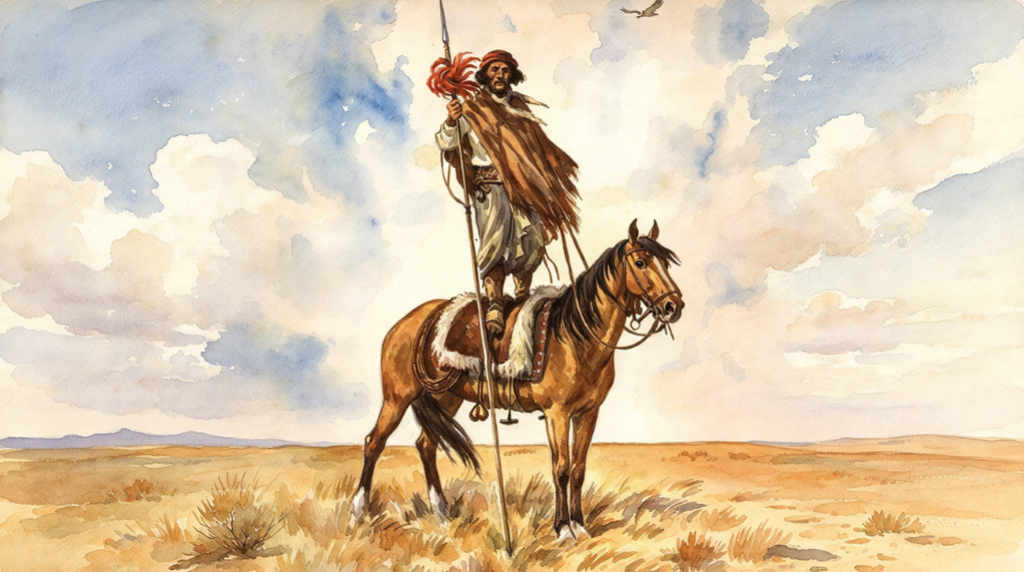
When the frontier town of Uruguaiana (the city on the Uruguay River, founded that year at the river crossing) was laid out with its plaza and its church facing the Argentine bank, the men who rode in for the founding ceremonies came from a hundred estancias of the western campos, and they came dressed as their grandfathers had not dressed and their great-grandfathers had: bombachas and boots, ponchos and hats, the facão at the back, the lazo on the saddle, the gourd of mate at the hip, the boleadora, by then almost a toy, almost a relic, knotted to the cantle by men who could still, on a wager, drop a running ostrich at forty paces with it.
Among them rode the grandsons of Jaca and the grandsons of Inácio Teixeira, and they shared fires and surnames now, and a way of sitting a horse that a Jesuit sergeant of the old São Miguel militia would have recognized across a century of grass, because it was his own posture, taught to Guaraní boys on the estancias of the missions, handed down hand to hand like the mate gourd itself, each generation drinking from it and passing it on.
An old man watching them, say a very old man, say the last living rider of Caiboaté, though none did live so long; say rather his ghost, standing where the towers of São Miguel still stand, ninety leagues to the north, leaning against the ruined sandstone in the evening of the world, an old man watching them would have seen the whole story in a single glance: the Guaraní seat and the Guaraní weapon, the Spanish horse and the Portuguese brand, the islanders’ church and the mission bell’s silence, and the tea, always the tea, the bitter green ka’a of his ancestors passed hand to hand around the fire, drunk in the manner Sepé Tiaraju had called the law of the land, in the last plaza of the last city of the missions, before the lines were drawn on the paper and the morning turned red at Caiboaté.
No one at the founding of Uruguaiana spoke of any of this. They spoke of borders, and of herds, and of the wars that would come, and the wars did come, the great wars of the pampa still ahead of them, in which the gaúcho would ride for empire and for republic and be used and mourned and idealized in turn. But beneath the speeches, the inheritance was already complete, and it had cost what such things always cost, and it was carried the way the pampa carries its own dead: silently, in the red earth, forever.