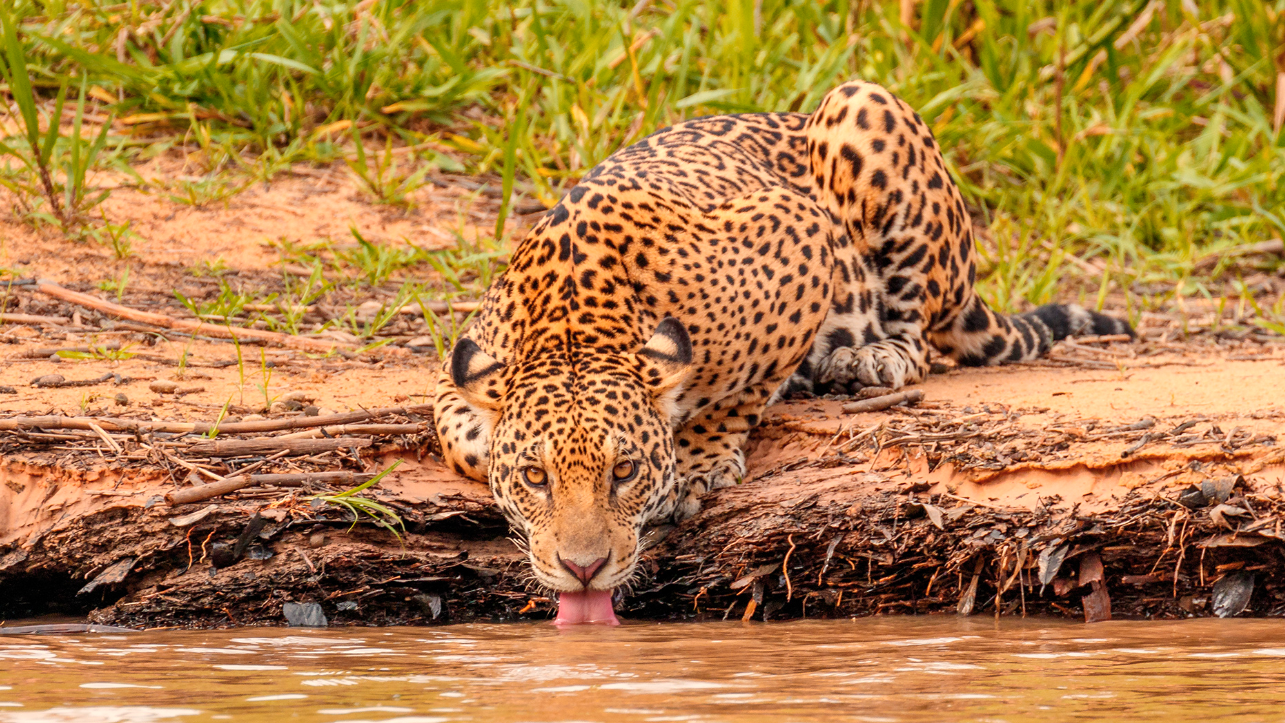
In the green heart of the Misionera rainforest, where the rivers wound like silver threads and the nights hummed with cicadas, the Guaraní people told of a puma cub whose cry was heard under a full moon. Hunters had killed his parents, and the little one, blind with hunger and grief, wandered alone until soft hands lifted him from the ferns. The hands belonged to Luna, daughter of the chief of the Chichiguay people, and she hid him in her hut, feeding him morsels of fish and letting him sleep against her shoulder.
Luna named him Yagua (a Guaraní word meaning “dog” or “beast”), for even as a cub there was something untamed in him, something that belonged to the deep forest. But he grew, as all wild things do, until no hut in the village could hold his majesty. When at last the Chichiguay discovered him, they saw what Luna had seen all along: a creature of great dignity with gentle eyes. So Yagua became one of them. Wherever Luna went, he went too, and where she slept, he kept watch.
He was more than a companion. Yagua was a superb hunter, and he brought meat to the village fires. The children tumbled over his flanks and rode his back in play. The women gathered fruit in the deepest parts of the forest without fear, for Yagua walked beside them, and not even the mighty anaconda dared disturb the Chichiguay while he drew breath.
Peace, however, does not last forever among old enemies. The Queraguay, a neighboring people sworn against the Chichiguay since the oldest stories, swept down on the village in the treachery of night. Luna woke to a sound that shook the trees: Yagua’s roar, enormous and terrible. By the time the Chichiguay warriors took up their arms, the great cat had already broken the raid, scattering most of the invaders into the dark. The few who remained were taken or fallen. From that night, Yagua was not merely a guardian of the village. He was its legend.
The survivors of the Queraguay did not forget their shame. They sought out the Quitiguay, a people who had long kept neutral in the quarrels of the two, and drew them into an alliance with a single shared purpose: the strength of the Chichiguay was Yagua, and so Yagua must die.
They came again under the cover of darkness, in two bands. One stormed the hut of the princess and seized Luna, meaning to carry her away. The other formed a wall of spears and arrows between the girl and the great cat. Yagua hurled himself at the kidnappers with a fury the forest had never witnessed. He fought with claws and terrible fangs for the friend of his heart, and though the attackers threw him down again and again, he rose again and again. Arrows hung in clusters from his strong body. Darts soaked in curare (a paralyzing plant poison) began to work their cold through his blood. Still, with one final effort, Yagua destroyed the last of the enemies. Luna was saved.
But the poison was in him now, and the strength was leaving his limbs. Mortally wounded, Yagua raised his head and let out one last, immense roar, and every living thing in the forest, human and animal alike, understood it: the Chichiguay were under his protection, now and forever.
He turned then toward the river, and Luna walked beside him, her hand buried in his fur. At the shore they said goodbye, the girl and the beast who had grown up together. Then Yagua slipped into the transparent waters and was gone.
The Guaraní say that in honor of so brave a puma, those clear waters took on the color of his magnificent coat, tawny and shining. Today the river bears the color of a lion, and it is known as the Río de la Plata (River of Silver). Whoever stands on its banks and watches the sunlight move across the water will remember Yagua, the immortal.