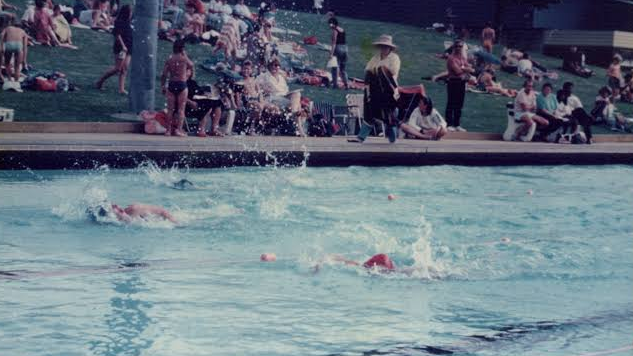
Every school holidays in Sydney, while other kids slept in and watched morning cartoons, I was up early, towel rolled under my arm, walking the long road from Fairfield Heights to the Fairfield swimming pools over an hour door to gate, more than an hour of suburban footpaths in the morning heat. Down the hill, past the shops, along the canal, through the parklands. The destination was the Australian Swim and Survive program, the Royal Life Saving ladder that takes a child from the first terrified bubble-blowing in the shallow end all the way up through the Wonder, Courage, and Adventure phases to Senior Swim and Survive, and finally to the Bronze Medallion: the entry rank of a lifesaver. The whole system was a staircase: each school holiday during High School (Middle School), I climbed one more step in that swimming journey.
Outside of the holiday intensives, the water never lost its hold on me. In those years I loved the pool and the beach with a devotion that bordered on escape artistry, and every weekend I would find some opportunity to vanish off to one or the other: long summer days at the Fairfield pools outside of lesson hours, or the train ride out to the coast where the surf taught lessons no certificate ever examined. My parents grew used to the evidence; I would return each Sunday evening carrying the unmistakable proof of where I had been, a deep Mediterranean tan upon return that no other boy in Fairfield Heights wore by accident. The chlorine and the salt water and the sun had become part of my complexion, a badge of skill and hours worn on the skin itself, and I wore it with the same quiet pride as the cloth patches sewn on my swimming bag. Looking back, all those unsupervised weekend hours in the water were their own training program: body-surfing taught me to read currents and rips, rock-pooling taught me what lived beneath the surface, and endless casual laps kept the endurance sharp so that when the holiday intensives resumed, I never arrived at the pool cold.
The program had just been launched in 1982 by Royal Life Saving Society Australia (RLSSA) and I was keen to participate. Junior Swim and Survive was the foundation, and it was earned stroke by stroke. This level built fundamental breathing control, deep-water confidence, and basic stroke mechanics, which in practice meant conquering a whole set of firsts: submerging fully and blowing bubbles without panic, mastering the back float, surviving the first deep-water drop, and producing a continuous swim of real distance for the first time. The certificates and cloth patches from this tier looked humble, but they represented genuine achievements of skill. Each one proved something you could now do that you could not do before, and the pool never accepted anything less.
Swim and Survive cemented the survival instincts. This tier demanded effective treading water, longer continuous distances, and standard sculling techniques, and it was where the water stopped being friendly and started being serious. We swum in our clothes, shoes and shirt and everything, learning how heavy a wet garment really is and how to wriggle out of trousers in deep water and inflate them into an emergency float. We trod water until our shoulders burned and practiced huddles in the deep end, learning that in cold water people survive together or not at all. There was the day of the timed survival swim when my stroke fell apart halfway and I finished on nothing but stubbornness, gasping at the wall, and the instructor wrote down the time anyway and said “passed.” That was this level’s real graduation: when survival stopped being a drill and became an instinct.
Senior Swim and Survive was the definitive stepping stone, the final gateway between swimming ability and true lifesaving, and it felt like it. This level focused heavily on advanced survival strategies, clothed endurance swimming, and initial surface dives, with graduation requiring a hundred-metre-plus continuous swim across varied strokes plus clothed survival sequences. It was the level where you stopped being a learner and started resembling what the program was building all along. From there, the pre-Bronze preparation demanded even more: advanced rescue initiative and stamina, a 250-metre continuous swim, and complex search and recovery work underwater, timed brick carries and all, until the final gateway stood open.
The Bronze Medallion was the formal entry into professional-grade lifesaving, and it consumed an entire holiday: it tested rescue judgment, simulated crisis management, and precision towing mechanics, backed by timed tows, comprehensive survival sequences, and workplace CPR, which I studied off the charts on the pool wall between turns. The rescue assessment was the summit of everything the ladder had built: a “drowning” classmate clung to me with the genuine, frightening grip of a drowning person, and I had to break the hold, turn them, and tow them the length of the pool on an exhausted sidestroke, because every level below had trained exactly this. When the examiner finally pressed the cold bronze into my hand, I remember the odd quiet of the moment. To this day, whenever I am near water, some instructor’s voice from a Fairfield summer decades ago still runs quietly in the background: watch the water, watch the people, know where the rope is. That, more than any certificate, was the achievement.