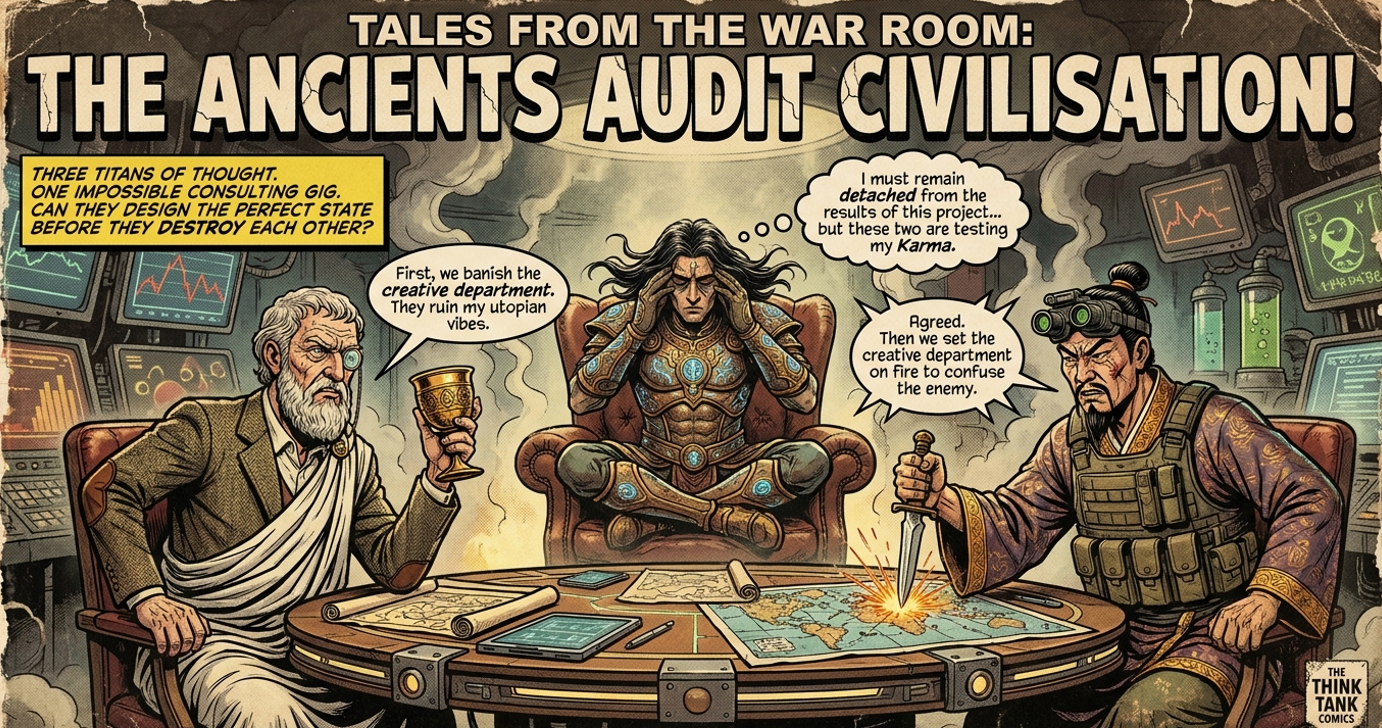
[A hypothetical dialogue between Plato, Sun Zi, Arjuna and Krishna]
The Burden of Governance: Who Should Rule?
PLATO: (Pacing) Athens is ruined by amateurs! Lawyers, demagogues, and poets who sweet-talk the mob into voting for bad policies. A nation cannot be governed by men who seek power for its own sake! True leadership requires the Philosopher-King, a ruler whose soul is ruled by Reason, trained in dialectic, and guided by the Form of the Good. And most importantly: a great leader must hate the thought of ruling and do so only out of sheer, agonizing necessity!
ARJUNA: (Sighs heavily) Ah, reluctance to rule… I understand that feeling all too well. On the eve of battle at Kurukshetra, looking at my own kinsmen, teachers, and elders lined up against me, my heart sank and my bow slipped from my hands. I asked Lord Krishna: If spiritual wisdom is superior to worldly action, why force me into this terrible conflict?
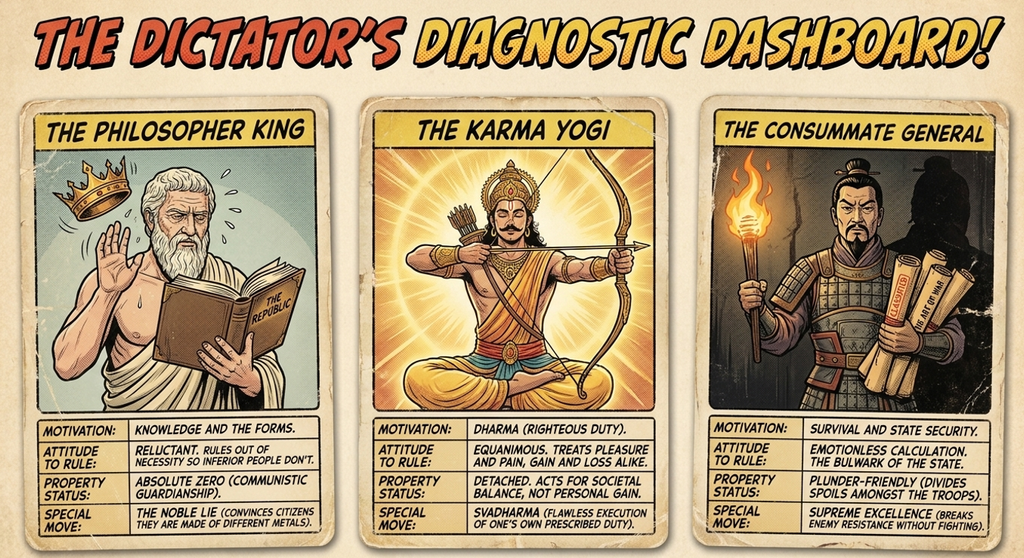
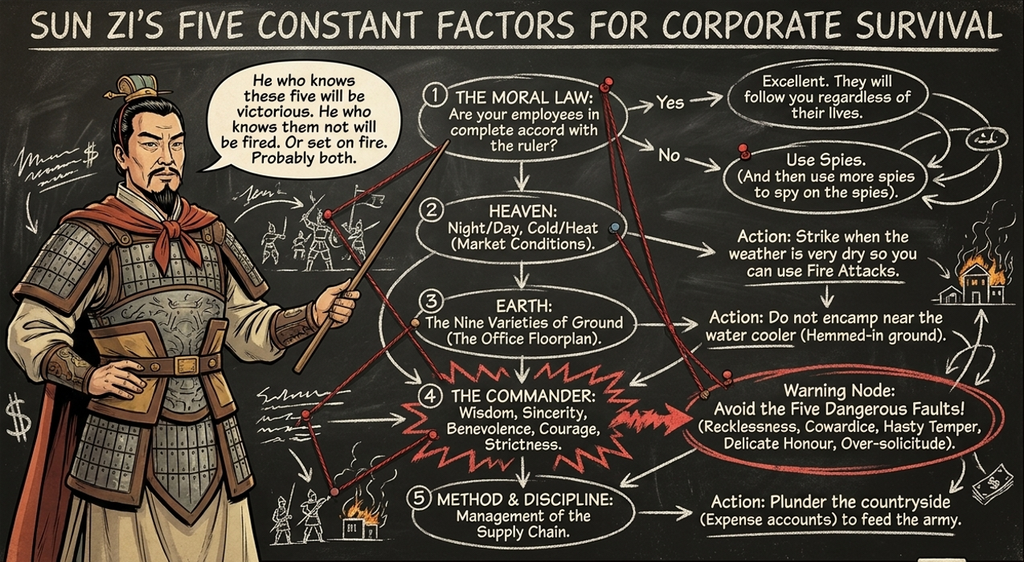
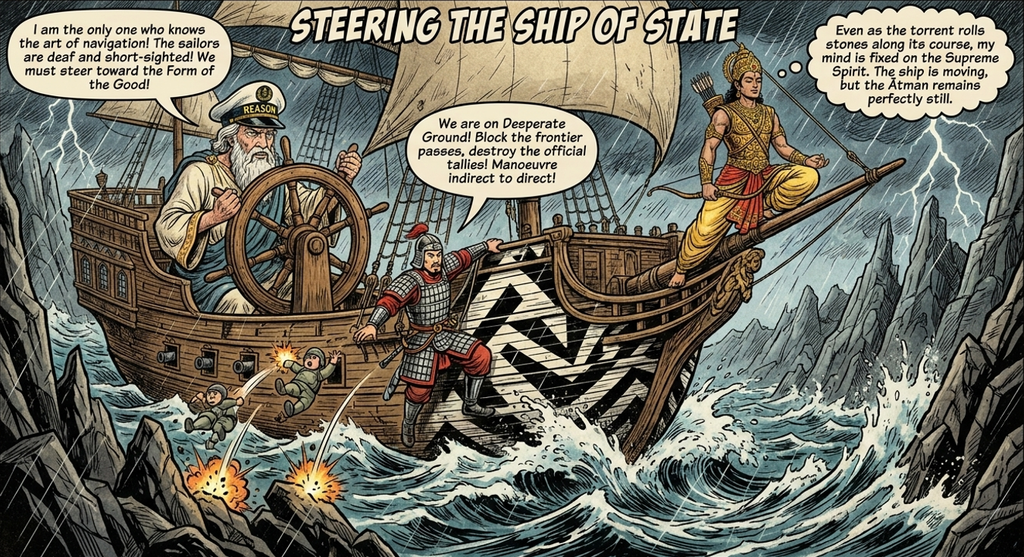
SUN ZI: (Without looking up from his tally sticks) With all due respect to your divine charioteer, warrior, an army facing a battle line is not the place for an existential debate. And as for you, Philosopher, a ruler who hates ruling sounds like a man who forgets to calculate his daily rations. Governance is governed by Five Constant Factors: the Moral Law (Dao), Heaven, Earth, the Commander, and Method. If your Moral Law causes the people to be in complete accord with the ruler, they will follow him into danger without fear. But it takes calculation, not geometry!
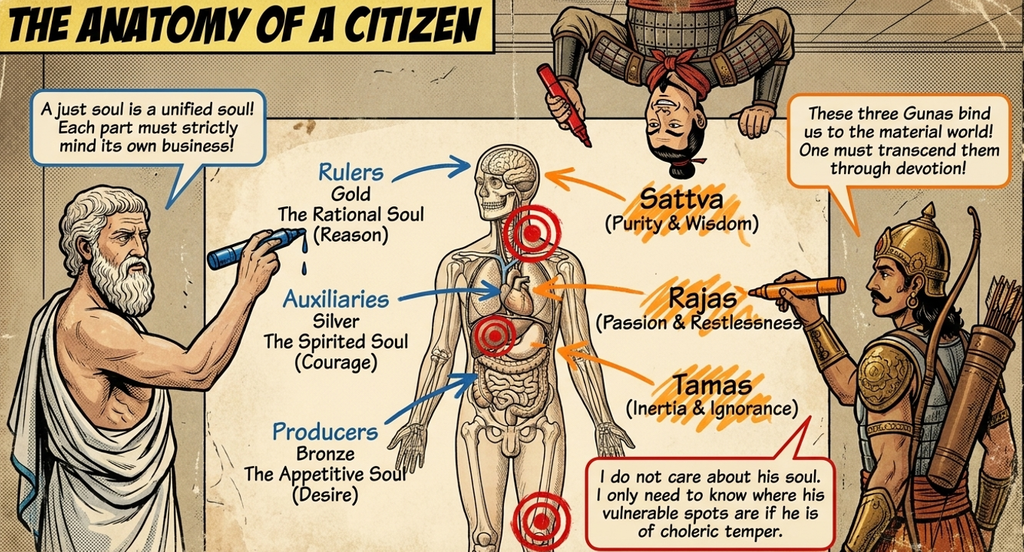
PLATO: (Offended) Geometry is calculation! Without arithmetic and solid geometry, how can a commander array his troops or a ruler ascend out of the darkness of sensory opinions? Most men live in an underground cave, chained by their necks, staring at shadows on a wall and mistaking puppets for reality!
ARJUNA: (Confused) Chained in a cave staring at puppets? Is that a demonic realm or a bad reincarnation?
PLATO: It is an allegory, Arjuna! The philosopher escapes into the sunlight of true knowledge, but then must be compelled to descend back into the cave to govern the prisoners, even though they will probably laugh at him or try to kill him!
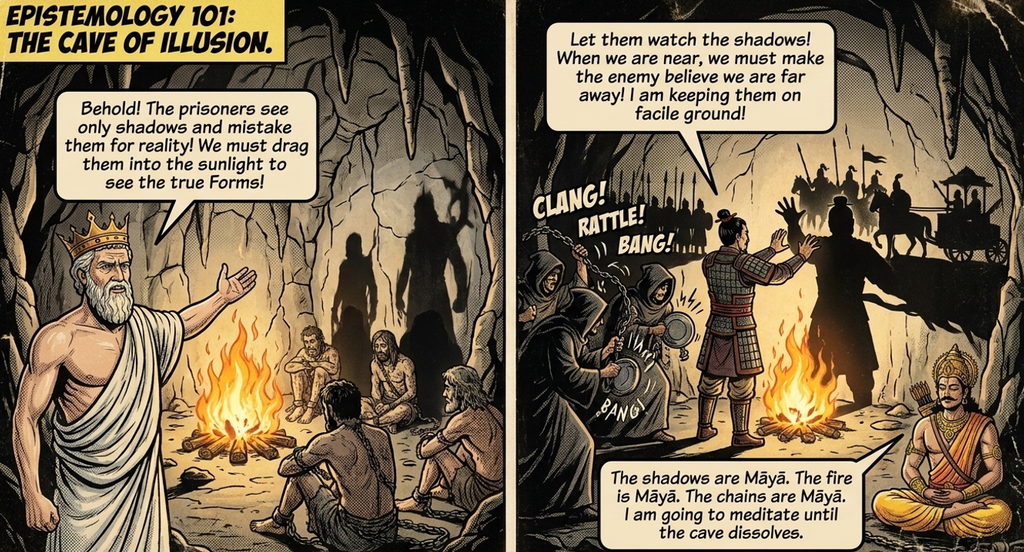
SUN ZI: (Dryly) If your scouts allow you to get trapped in an underground den with hostile prisoners, you have failed on Hemmed-In Ground. I would simply send in converted spies to infiltrate the cave first.
What Makes Great Leaders? : Wisdom, Duty, and Calculation
ARJUNA: Leadership is neither about hiding in caves nor mere military maneuvering. Lord Krishna taught me that a true leader, a Rajarshi or royal sage, must practice Nishkama Karma: selfless action performed without attachment to the fruits or rewards. Whatever standard a noble leader sets, the rest of society naturally follows (yat yat acarati sresthas). If a leader acts out of ego or personal desire (kama), desire turns to anger, judgment is destroyed, and the state falls into lawlessness.
PLATO: Exactly! Because when desire and appetite take over, the soul degenerates! The Gold element of reason gives way to the Bronze element of raw appetite. The state collapses from an Aristocracy into a Timocracy, then an Oligarchy, then a chaotic Democracy where even the donkeys bump into you in the streets, and finally into a hideous Tyranny!
SUN ZI: Donkeys in the streets aside, a great leader must balance five character virtues: Wisdom, Sincerity, Benevolence, Courage, and Strictness. A general who is compassionate without discipline breeds spoiled troops; a general who acts out of personal anger or spleen (pique) brings ruin upon the kingdom. Anger can change back to gladness, but a nation once destroyed can never be brought back to life, nor can the dead be raised!
ARJUNA: Ah, but Sun Zi, what if duty demands that you fight even when victory brings grief? Krishna reminded me that the soul (Atman) is immortal, it neither slays nor is slain. A warrior must perform his Svadharma (personal duty) for the preservation and holding together of the world order (Loka-Samgraha). He must treat pleasure and pain, gain and loss, victory and defeat as equal.
PLATO: (Nodding approvingly) Yes! Treating gain and loss as equal keeps the appetitive part of the soul in check. In fact, I mathematically proved that the just king lives 729 times more pleasantly than the tyrant, who is a slave to his own ravenous lusts!
SUN ZI: (Pauses, taking out a fresh slate) 729 times? What is the exact currency conversion on that pleasure metric? Because I can tell you precisely that raising an army of 100,000 men costs 1,000 ounces of silver per day in glue, paint, armor, and transport. If a ruler doesn’t calculate that, his “729 units of happiness” will last about three days before his treasury is empty
The Application of Warfare: Stratagem vs. Unattached Action
PLATO: Warfare should only ever be defensive, aimed at preserving the internal harmony of the state. In my ideal republic, guardians have no private property, no gold, and no individual families, everything is shared so there is no greed to trigger foreign wars! And we certainly must banish the poets!
ARJUNA: (Shocked) Banish the poets?! But scriptures and heroic epics remind us of righteousness!
PLATO: Poets are imitators of appearances, thrice removed from the absolute truth! They feed the irrational, weeping part of the soul instead of reason!
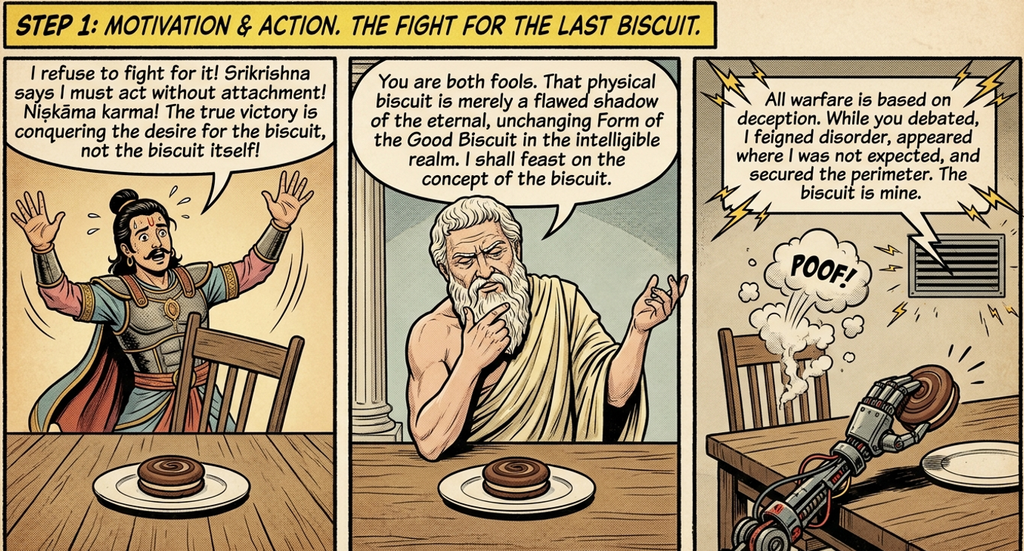
SUN ZI: Let the poets write whatever they like, so long as they don’t leak our tactical dispositions. In warfare, all warfare is based on deception. When you are near, make the enemy believe you are far; when capable of attack, seem inactive. At first, exhibit the coyness of a maiden; then, when the enemy leaves an opening, strike with the rapidity of a running hare
ARJUNA: Deception? Coyness of a maiden? Master Sun Zi, a righteous Kshatriya fights openly for justice when all peaceful envoys have failed. But he fights without hatred or personal malice. The real war is the one fought internally against desire (kama) and egoism (ahamkara).
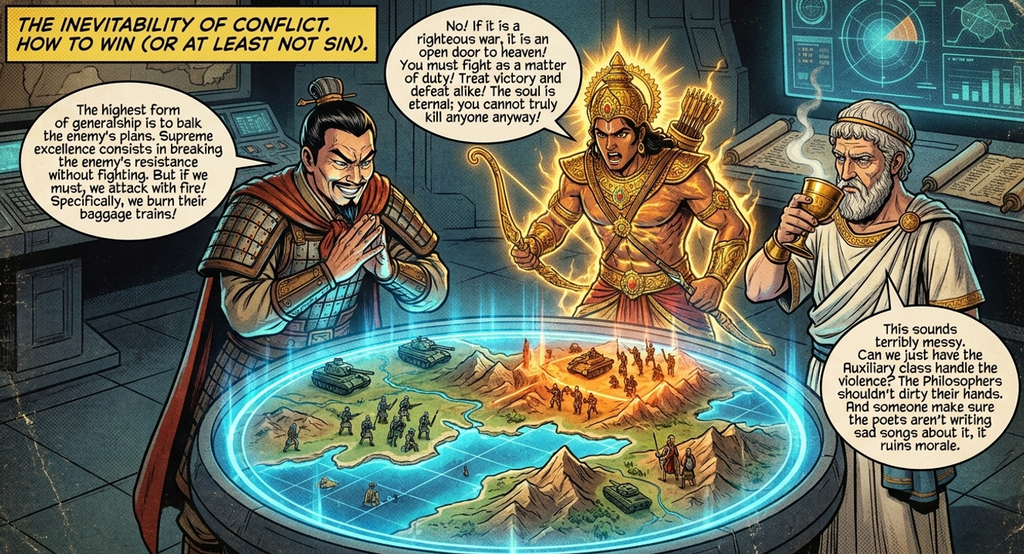
SUN ZI: Arjuna, the highest victory is not winning a hundred battles on the field. Supreme excellence consists in breaking the enemy’s resistance without fighting at all To capture a state whole and intact is far better than destroying it. Why waste arrows, lives, and 1,000 ounces of silver when a network of five types of spies: local, inward, converted, doomed, and surviving, can reveal the enemy’s plans and allow you to win before blood is even shed?
PLATO: (Frowns) Spies? That sounds dangerously like the duplicity found in an Oligarchy or a Democracy, where everyone is secretly plotting against each other!
SUN ZI: It is called the divine manipulation of the threads, Philosopher! It keeps the nation intact and the army safe.
ARJUNA: So how do we bring true cohesion (Loka-Samgraha) to our nations? It happens when every citizen performs their natural duty (Svadharma) as a sacrifice to the Supreme, without greed or factional rivalry. When the ruler acts as a selfless servant, society stays unified and righteous.
PLATO: Precisely! Cohesion is Justice (Dikaiosyne) , which we define as every class performing its proper function without meddling in the duties of others. The rational rulers rule, the spirited guardians defend, and the appetitive producers produce. When reason governs the whole, the individual soul and the entire city state live in perfect balance!
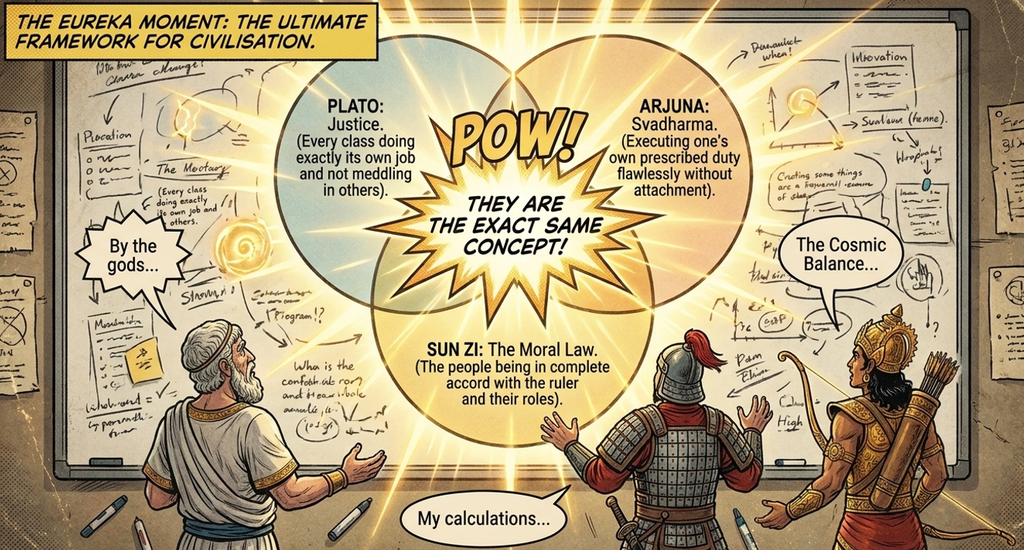
SUN ZI: And practically speaking, cohesion comes from the Moral Law (Dao), clear discipline, and treating your soldiers like your own beloved children, so they will stand by you unto death. But remember: like water, which shapes its course according to the ground over which it flows, a great leader and a cohesive state must adapt flexibly to changing circumstances.
PLATO: Water? I prefer the fixed, eternal Forms of Geometry
ARJUNA: (Smiles slightly) And I prefer the guidance of the Divine Charioteer. But perhaps we agree on this: a leader who cannot master himself can never master a nation.
SUN ZI: (Closing his tally books) On that, my friends, no further calculation is needed
Summary
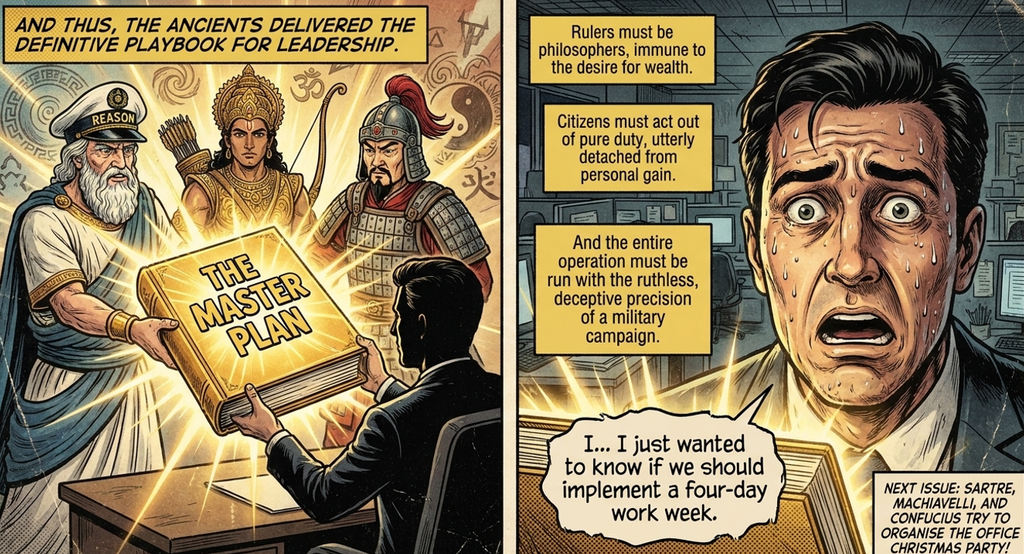
In today’s complex global landscape, effective national leadership requires a synthesis of Plato’s commitment to expert wisdom and disinterested governance with the Bhagavad Gita’s principle of selfless duty. Plato argues that true leaders must be guided by reason and a rigorous understanding of the public good rather than by personal ambition or partisan interests. Their authority is justified not by a desire to rule, but by a willingness to assume responsibility for the welfare of the community. This principle closely parallels Krishna’s instruction to Arjuna to practice nishkama karma: fulfilling one’s obligations without attachment to personal rewards, status, or ego. By acting without selfish motive, the ruler establishes an example for others and contributes to the maintenance of social and cosmic order through loka-samgraha. Applied to contemporary challenges such as geopolitical instability, economic volatility, and public crises, this conception of leadership requires political leaders to look beyond short-term electoral or partisan gains, exercise discipline over personal appetites and anger, and cultivate the public trust necessary for institutional stability.
In the sphere of conflict and statecraft, Sun Zi’s strategic pragmatism provides an essential tactical complement to these ethical foundations. Sun Zi maintains that the highest form of victory is achieved not through destructive warfare but through foresight, calculation, and the ability to overcome resistance while minimizing the costs of conflict. His warnings against emotional haste, personal animosity, and prolonged warfare are especially relevant to modern states, where strategic miscalculation can rapidly exhaust national resources and threaten political stability. Strategic restraint, therefore, is not simply a military virtue but a component of responsible governance. Sun Zi’s emphasis on Dao: the alignment between ruler, state, and people, also underscores the importance of maintaining political and moral unity.
These strategic considerations complement Plato’s insistence on functional harmony within the state and Arjuna’s obligation to uphold dharma. Strategic success cannot be considered genuine if it is achieved at the cost of internal justice, institutional legitimacy, or social cohesion. Taken together, these three traditions offer a coherent framework for 21st-century statecraft: govern through reason and intellectual integrity, act without attachment to personal gain, and exercise strategic restraint in the pursuit of collective security and peace. Effective leadership, on this view, is not merely the capacity to acquire or exercise power, but the disciplined ability to subordinate power to wisdom, duty, and the long-term welfare of society.