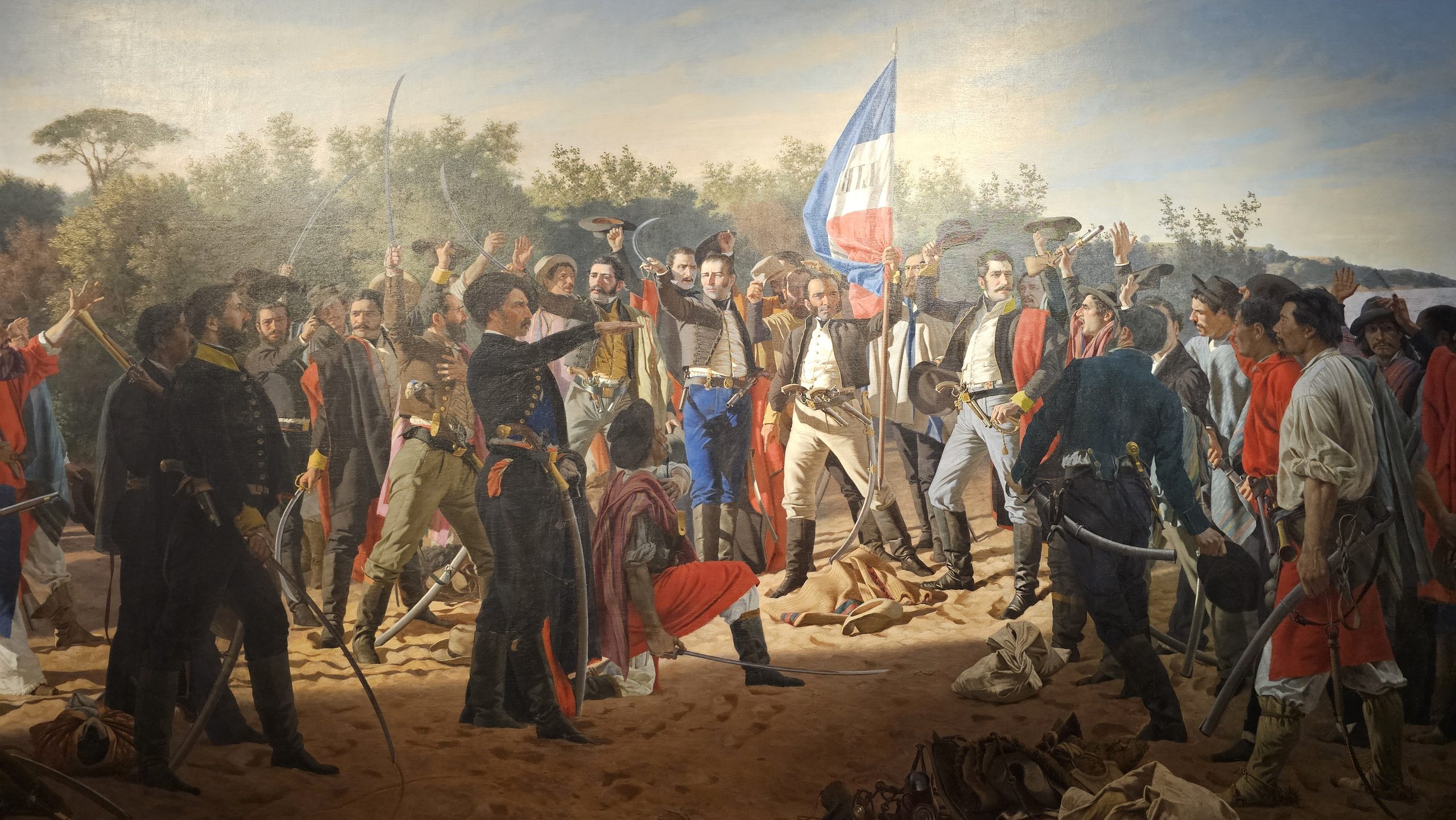
The Treinta y Tres Orientales (English: Thirty-Three Orientals or Thirty-Three Easterners) were a group of 19th-century revolutionaries who liberated their homeland from imperial occupation, directly leading to the foundation of modern Uruguay. They were called “Orientales” because their homeland was known as the Banda Oriental (the Eastern Bank of the Uruguay River). Despite their famous name, historical records show the group actually included more than 33 men, whilst mostly from the Orientales area, it included Paraguayan, Argentinian, Guarani, and Mozambique fighters. Between 1816 and 1820, the United Kingdom of Portugal, Brazil, and the Algarves invaded and occupied the Banda Oriental, renaming it the Cisplatina Province. The local independence leaders were forced into exile. On the night of April 19, 1825, led by military commanders Juan Antonio Lavalleja and Manuel Oribe, the group secretly crossed the Uruguay River, They landed stealthily on the beach of La Agraciada. There, they unfurled their now-famous tricolor flag (bearing the motto Libertad o Muerte, “Liberty or Death“) and took a solemn oath to either expel the Brazilian occupiers or die trying. Moving quickly through the countryside, the group rallied local livestock workers, horsemen, and former military personnel, expanding into a formidable revolutionary force. They won key early military victories at the battles of Rincón and Sarandí.
Just four months after their landing, on August 25, 1825, the group convened the Congress of Florida and officially declared independence from the Empire of Brazil, aligning themselves with the United Provinces of the Río de la Plata. Their rebellion forced a massive geopolitical shift, triggering the three-year Cisplatine War between the United Provinces and the Empire of Brazil. Because the war grounded to a bloody stalemate, Representatives from the British empire, stepped in to broker a peace deal. This resulted in the 1828 Treaty of Montevideo, where both Brazil and Argentina agreed to recognize the territory as a fully sovereign nation. By 1830, the new nation adopted its first constitution as the La Republic Oriental del Uruguay (Oriental State of Uruguay)
33? The number of members of the 1825 expedition has been the subject of much debate because several lists of participants were published between 1825 and 1832. According to research conducted by Jacinto Carranza during the 1940s, there were 16 different lists, mentioning up to 59 different names. It’s worth noting that the number 33 is considered a perfect number by Freemasonry. Since many of the crusaders belonged to the lodge, it was decided that the group would symbolically have that number.
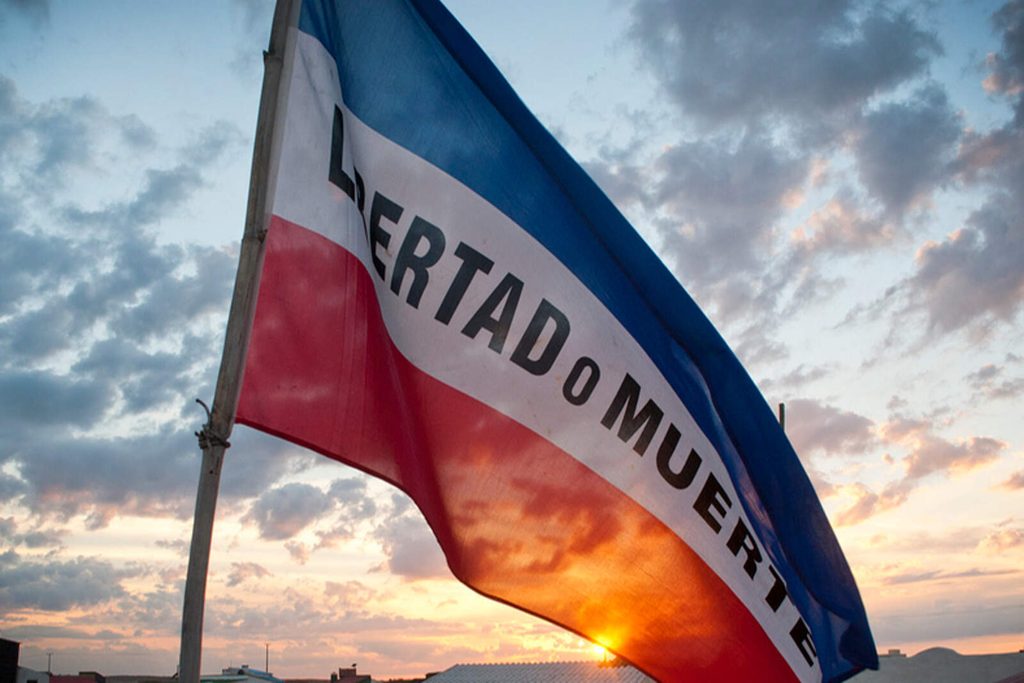
The flag of the 33, was made by Luis Ceferino de la Torre, and the Swiss painter Jean Philipe Goulou painted the inscription “LIBERTY OR DEATH” in the wardrobe of Luis Latorre, while a woman from the Pérez and Villanueva tailor shop in Buenos Aires, was the one who embroidered the letters.
Many of the crusaders had participated in the Orientales Revolution alongside Artigas, and most accompanied Lavalleja against Rivera. With few exceptions, they became Blancos with Manuel Oribe. One exception was Santiago Gadea, who aided Rivera in his fight against Lavalleja. In 1828, Juan Antonio Lavalleja compiled a list of names, which Manuel Oribe later corrected in 1830.
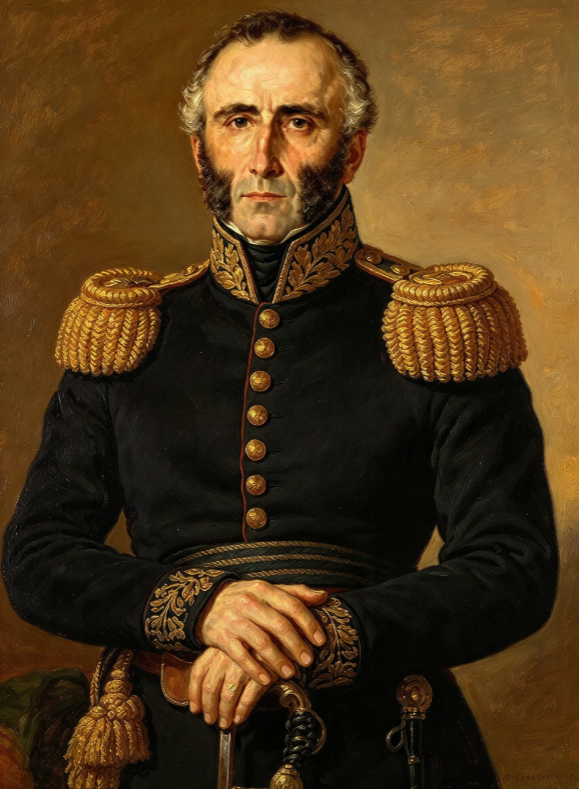
Juan Antonio Lavalleja (Juan Antonio Pérez de la Valleja) : Colonel Commander-in-Chief, leader of the Crusade. Juan Antonio Lavalleja was born on 24 June 1784 in the Villa de la Concepción de Minas, in the Banda Oriental, a region that was then part of the Viceroyalty of the Río de la Plata and is now Uruguay. Some historical sources identify his birthplace more specifically as Santa Lucía, in the Minas area. He was baptized on 8 July 1784 at the Chapel of the Purísima Concepción de las Minas, only a few days after his birth. His parents were Manuel Pérez de la Valleja (son of Pedro Pérez de la Valleja and María Gómez de la Torre), a Spanish-born landowner, and Ramona Justina de la Torre, who was also of Spanish descent. Juan Antonio was born into the Pérez de la Valleja family, and “Lavalleja” was an established variant of that family surname that gradually became the form by which he was known.
The family was relatively prosperous and owned an estancia in the rural area surrounding Minas. Lavalleja spent his childhood and adolescence on his family’s estancia in the mountainous countryside around Minas. His upbringing was therefore closely connected to rural life rather than to an urban or highly formal education. Gaining practical skills of the countryside, becoming an accomplished horseman and taking part in the demanding work of an estancia. His early environment exposed him to cattle work, riding, and the geography of the surrounding countryside, he became became involved in the revolutionary movement in 1811, when the uprising against Spanish colonial rule spread through the Banda Oriental. Lavalleja joined Artigas’s cause and participated in the fighting against Spanish forces.
After the failed revolutionary movement of 1823, Lavalleja went into exile in Buenos Aires. The 1823 movement had involved the Montevideo cabildo and the Caballeros Orientales lodge, which was a Masonic organization involved in opposition to Brazilian rule. The decisive preparation for the Treinta y Tres Orientales began in early 1825. News of the patriot victory at Ayacucho in December 1824 encouraged Oriental exiles in Buenos Aires to act. Lavalleja, his brother Manuel, Manuel Oribe, Luis Ceferino de la Torre, Pablo Zufriategui, Simón del Pino and Manuel Meléndez were identified as the seven initial organizers who committed themselves to the expedition, with Lavalleja chosen as its leader.
Manual Oribe (Lieutenant Colonel, second in command of the Crusade), he later became the second president of Uruguay, 1835-1838., Atanasio Sierra (Second Lieutenant). When he died in 1862, the flag used by the 33 covered his coffin.
Basilio Araújo (Lieutenant. He was born in San Carlos on March 25, 1797, son of Manuel Araújo. He served Artigas from the beginning of the Emancipation campaigns, taking his son with him, who at 19 years old participated as a first sergeant in India Muerta on November 19, 1816). He was carrying out a secret mission entrusted to him by Lavalleja , during the famous landing on April 19. Yet, Araújo is found on the current lists of the crusaders and Blanes painted him in his famous painting, where he corresponds to position 26, starting from the left. Having joined Lavalleja shortly after landing, he was given the rank of Captain on August 8th and, serving in the Eastern Hussars Squadron, participated in the victorious battle of October 12th, being promoted to Lieutenant Colonel in April 1826, and transferring to the Dragoon Corps. He fought in the Brazilian campaign with the Republican Army and on February 20, 1827, fought at Ituzaingó.Having participated in the uprising led by his former commander Lavalleja in 1832, he was discharged by the government on July 3rd. Re-enlisted in 1833, he lent his sword to the legitimate authority of President Manuel Oribe during the uprisings of 1836 and 1838.From 1843 he was stationed at the Cerrito Headquarters as an aide to General Manuel Oribe throughout the siege, and upon the peace of 1851, he was added to the list of attachés to the Army General Staff, as a graduate colonel, obtaining the position on November 9, 1853. He died in his hometown on February 20, 1855.
Juan Acosta (soldier, member, as a soldier, of the “Thirty-Three” group. He went blind and begged in Montevideo, where he died on August 29, 1868, at the age of 79).
Manuel Pantaleon Arrigas Maestro (born in Minas, baptized on August 14, 1801, son of Manuel Francisco Artigas and Estefanía Maestro. His father was the brother of José Artigas.He joined the “Thirty-Three” group as an Ensign, participating in the Battle of Sarandí. He died in combat as a First Lieutenant in 1828),
Felipe Carapé (Soldier. “Carapé,” a nickname meaning “dwarf,” was a native of the Paraná islands and worked as a woodcutter on the Uruguay River. He was accused of killing a soldier in a general store. His defender was Carlos Villademoros, author of a play in verse about the “33.” Carapé spent a year in prison. He died in 1835),
Francisco Romero (according to Aníbal Pintos, he was Guaraní, like Pedro Antonio Areguatí, Felipe Patiño, Francisco Romero and Luciano Romero, all members of the liberating crusade.Little is known about the Romero family; it’s not even known if they were brothers. They joined the expedition in the Paraná islands, where they lived. Francisco later changed his surname to Lavalleja. Luciano fought with the patriots at the Battle of Sarandí),
Andrés Cheveste (born in 1786, was the guide for the Thirty-Three expedition. Familiar with the Banda Oriental (present-day Uruguay), he undertook, among other risky tasks, the supply of horses to the members of the liberating expedition and to those who joined them. Other patriotic landowners, such as Tomás Gómez and his brothers-in-law, Manuel and Laureano Ruiz, also contributed),
Simon del Pino (Sergeant Major (1781-1844). A native of Córdoba, he was a member of the “Thirty-Three” group with the rank of Sergeant Major. In May 1825, he captured the town of Guadalupe, now Canelones, from imperial troops. In July 1825, he was elected by his town council to the First Chamber of Representatives of the Eastern Province. He was the only one to sign the Declaration of Independence.With the Canelones division, alongside Oribe’s forces, on February 9, 1826, he participated in the battle of Cerro Victorioso, continuing the siege of Montevideo until the end of the war against the Empire in 1828. He died in Canelones on December 12, 1844, at the age of 63),
Manuel Florentino Freire (Captain (1792-1858). Uruguayan, son of a Spaniard, he was an Artiguista warrior, reaching the rank of First Lieutenant. He was one of the “Thirty-Three” and served throughout the 1825-1828 campaign, being among the victors of Ituzaingó. Son of Manuel Freire, originally from Meira, Galicia, he was born in Las Piedras on March 13, 1792.He participated as a Colonel in the war against Rosas (1830-1842), fighting in the battles of Cagancha and Arroyo Grande. During the Siege of Minas, he carried out important military duties in service to the Government of the Defense. He later held important positions: Political Chief of Minas (1854); Chief of Staff (1855); Commander-in-Chief of Arms (1856); and Political Chief of Paysandú (1857). Involved in the revolution led by General Díaz in 1857, he was one of those killed in the tragic events of Quinteros (1858)),
Santiago Gadea (Captain. Soldier of the Orientales – War of Independence. Born in the town of Santo Domingo de Soriano on July 25, 1794, son of Juan Antonio Gadea and Florencia Salado. He was an officer under Artigas, emigrating to Entre Ríos during the Portuguese occupation. He returned as a member of the “Thirty-Three” regiment, and with the rank of captain, participated in the campaign of 1825-1828. Emigrating to Argentina after the fall of Oribe (1838), he came to the besieging camp of Cerrito in 1843, where he died on September 26, 1849),
Juan Joaquin Manuel Eustaquio Lavalleja (Manuel, Captain. Eastern soldier (1797-1852) of the struggles for independence. Younger brother of Juan Antonio, he participated in the victory of Cerrito during Artigas’s time and in 1825 was part of the “Thirty-Three” as a Captain.In a guerrilla action against Brazilian forces he was taken prisoner, and taken to Rio de Janeiro, he was held until 1828. Promoted to colonel, he held the positions of Chief of the Eastern Hussars regiment, and of the Paysandu Militias (1829), and General Commander of Borders (1830).He accompanied his brother Juan Antonio in his failed revolutionary attempts against President Rivera (1832-1834). He then served under Oribe during the revolutions instigated by Rivera and later during the “Great Siege” as Military Commander and Political Chief of Salto. He died a year after the end of this war (1852).),
Avelino Miranda (Corporal. As a soldier of the “Thirty-Three,” he participated in the victory at Sarandí, being promoted to corporal; he was later seriously wounded during the 1827 campaign against Brazilian forces, becoming disabled. Nevertheless, he became a soldier under Rivera. He received his pension. With the rank of Second Lieutenant, he died in action, fighting for the government, during the 1837 revolution. Another source says he was murdered by two brothers, one of whom was the brother-in-law of a woman whom Miranda had tried to rape.Juan Manuel Blanes, in his collection of data that could serve as a guide for his painting The Oath of the Thirty-Three, used to recreate the figure of Avelino Miranda a nephew of this, Nicolás Miranda, who was very similar in height, bearing and physiognomic features.
Ignacio Núñez (Soldier and member of the “33”. Belonging to a family of patriots, such as Joaquín Antonio, drafter of the 1830 Constitution and member of the General Constituent and Legislative Assembly; and Juan Tomás (1784-1869), Deputy for the town of Las Vacas to the Florida Chamber, last survivor of the signatories of the 1825 Declaration.),
Ramón Ortiz (Soldier. Son of Miguel Gigiau and María Martina Ortiz, the latter being the daughter of Serafín Ortiz, the father of Juan José Ortiz, also a member of the Crusade. Ramón was born Dionisio Ramón in Las Piedras on December 11, 1806. A soldier of the “Thirty-Three,” he participated in the victories of Sarandí and Ituzaingó. He accompanied Oribe during the Great Siege and later served the governments of Pereira and Berro, being promoted to Lieutenant Colonel of Cavalry. After the triumph of Flores’s revolution in 1865, he emigrated to Entre Ríos, where he died in poverty in January 1867.),
Juan Jose Ortiz (Soldier. Son of Serafín Ortiz, a native of Buenos Aires, and María Nicolasa Núñez. Fernández Saldaña states that he was born in Las Piedras, and gives 1788 as the probable date. A soldier of the “Thirty-Three,” in the ranks of the Liberating Dragoons, he was present at the victory of Sarandí. He died in Tacuarembó, on October 16, 1847.),
Dionisio Oribe (Freedman. He was one of the “Thirty-Three.” A freed slave and former servant of the Oribe family, he served as their assistant. According to Fernández Saldaña, he appears on the lists of the Patriot General Staff as a member of the Regiment of Liberating Dragoons from May 30, 1825. He died a few months before Brigadier General Oribe, on April 2, 1857, at the age of 60.
Joaquín Artigas (Freedman, born in Mozambique, who was raised by Pantaleón Artigas, a participant in the Crusade and nephew of the national hero.(These last two were released by Lavalleja for being soldiers, at the Barra del Pintado de la Florida Headquarters, in June 1825).
Juan Rosas (Soldier. Born in the Banda Oriental at the end of the 18th century, he was the son of José Pedro Rosas, guide of José Artigas in his time as a Blandengue, the “Black Blonde”, as he was called.He was a member of the “33” group and in 1827 he served as a Militia Sergeant. “During the Great Siege (1843-1851) he was with the Colorados on the walls of Montevideo, until on November 30, 1844, he went over with “vericú and saber” to the army of General Oribe. Already an old man, he scared away with gunfire a commission of aid to the survivors of independence that brought money.”He was the last survivor of the members of the Liberating Crusade, dying in Cerro Largo on March 30, 1902. He lived for more than 100 years).
Gregorio Sanabria (As a Captain, he fought bravely in Sarandí. In 1829 he had declared himself “indigent.”).
Pedro Antonio Areguati (serving as a Sergeant. His death certificate, kept in a parish in Paysandú, records his origins in Misiones. The document states: “On July 14, 1891, I buried Pedro Antonio Arehuatí, a native of Misiones, where he was married. He was one of the 33 who accompanied General Lavalleja. He received the sacraments. I attest to this.” It is signed by Father Solano García. Barrios Pintos recounts that Areguatí had previously fought in the Peruvian War of Independence: for 17 months he refused to accept his soldier’s pay, believing the patriot cause needed the money more. Later, he was a prisoner of the Portuguese between 1816 and 1822. But once freed, he returned to serve the cause of liberation.In 1842 Uruguay awarded a cash prize to all 33 Orientals. Areguatí did not come forward to collect it.), Augustin Velasquez (as a Corporal, they had a prominent role in the Crusade of the “Thirty-Three”.).
Juan Nicomedes Spikerman Pérez (Sergeant. He was born in Montevideo on September 14, 1802. He was the son of Juan Spikerman, a native of Amsterdam, and María del Carmen Pérez y Cabrera, from the Banda Oriental (present-day Uruguay).He served as a sergeant in the Battle of Sarandí and throughout the entire war of independence. In 1828 he was promoted to First Lieutenant, culminating his service record as Lieutenant Colonel in 1860 during the Berro administration.He was the only one of the “33” who left a written account of the “Liberating Crusade” from April 19 to May 6, 1825, which was made known in fragments in 1859 by José Pedro Pintos, and in 1878, published for the first time in the magazine “El Panorama”. He died in 1863.
Andres Spikeman (Cadet. He was the son of Juan Spikerman, a native of Amsterdam, and María del Carmen Pérez y Cabrera, a native of Montevideo. He was probably born in Las Piedras, a fact of his birthplace that emerges from his children’s birth certificates. Like his brother Juan, he was a cadet in the “Thirty-Three” Regiment. He fought in the Battle of Sarandí and participated in the campaign of 1826-1828, reaching the rank of Second Lieutenant. Due to an open criminal case, he was excluded from the award. He was exiled in 1832 and served as a soldier under Manuel Oribe. He died in Guadalupe on June 28, 1844.)
Jacinto Trápani (Captain. He was the son of Juan Camilo Trápani, from the Kingdom of Naples, and María Jacinta Castellanos, from Uruguay. Two Jacinto Trápanis appear at the time, it is not known which one was in the Liberation Crusade: Juan Jacinto Miguel Trápani, born on May 16, 1797 and baptized in the chapel of Peñarol or Jacinto Manuel Domingo Trápani, who was born on May 11, 1798 and baptized in the Matriz of Montevideo.He was a member of the Thirty-Three Regiment with the rank of Captain and fought in the Battle of Sarandí in the Hussar Regiment. In 1826 he was head of the escort of the Provisional Government (Villa de Guadalupe).Promoted to Sergeant Major, in 1832 he served in the Extramural Militia. He was a lieutenant colonel in the Government of Cerrito. He died on May 26, 1850, with that rank in the Villa de la Restauración.).
Pabo Jose Zufriategui Más de Ayala : Sergeant Major, born on January 25, 1783, son of Francisco Joaquín Zufriategui Lezca, a native of Placencia in Guipúzcoa, and Catalina Josefa Más de Ayala. According to Juan Alejandro Apolant (“Genesis of the Uruguayan Family”, 1975), “he joined the Spanish navy in which he fought against the English, being appointed in 1805 as a sub-lieutenant of Artillery Engineers.”In 1811, he fought in the Battle of Las Piedras and the first siege of Montevideo. In July of that year, alongside Dragoon Captain Colonel Juan José Quesada, he seized the powder magazine and ammunition depot of the Spanish Naval Station in Montevideo Bay, located on Isla de Ratas (Rat Island). As artillery commander during the second siege of Montevideo, he participated in the victorious Battle of Cerrito. He commanded the schooner “Fortuna” in Admiral Brown’s squadron and served as Port Captain of Montevideo from 1815 and as Captain of the Civic Regiment until 1817.As a Sergeant Major, he was part of the “33” group, serving as Chief of Staff in the victory at Sarandí. As a Colonel in command of the Eastern Freedmen Infantry Regiment, he participated in the victory at Ituzaingó. As a Representative for Colonia, he was a member of the General Constituent Assembly between 1828 and 1830.)
Carmelo Colman Pérez: Soldier. Registered in 1801 as José del Carmen, he was known as Carmelo. He was the son of Jacinto Colman and Agustina Pérez Bravo. He was a member of the heroic group of the “Thirty-Three.” He participated in the Battle of Sarandí in the Liberating Dragoons Regiment. Upon his death (1876), he was given military honors as a Second Lieutenant.
Manuel Meléndez Machado : Lieutenant. He was born on May 22, 1797, son of Manuel Meléndez, a native of Seville, and Catalina Josefa Machado. A soldier with the rank of Lieutenant, he was a member of the “Thirty-Three” group from the first meetings in Buenos Aires. With the rank of Captain, he participated in the victory at Sarandí in 1825. Due to the wounds he received, he died a few days later, at the age of 28. Other sources say that he died of typhus and his crusader pension was collected by his mother, who handled the paperwork.
José Leguizamón: known as “Palomo” had joined the 33 Orientals in Paraná, but when he died in the battle of Sarandí in 1825, he did not receive any recognition.
Norberto Ortiz : A member, as a soldier, of the “Thirty-Three” group. He bore the surname of Serafín Ortiz, father and grandfather of the other two Ortiz members of the Thirty-Three. According to Fernández Saldaña, he was a member of the Ortiz family in Las Piedras. He died during the Liberation Crusade, in May 1827, in a guerrilla battle on the coast of Miguelete.
Other notable mentions include: Celedonio Rojas (Soldier), Miguel Martinez, Santiago Nievas (Soldier), Lucian Romero (Soldier, Guarani), Ignacio Medina, Tiburcio Gómez, Manual Alvarez, Juan Arteaga, and Jose Yagurete.
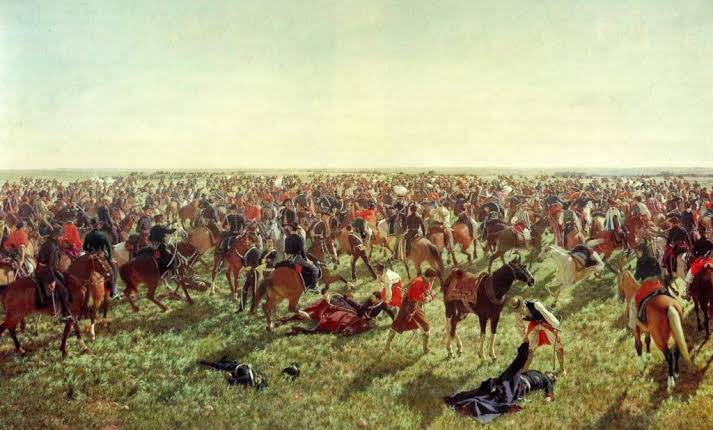
“Palomo” Leguizamón
José Julián Leguizamón (1773-1827), was from Chascomús, Chascomús Partido in eastern Buenos Aires Province of Argentina. He was married to María Francisca Genes, and they had a son Jorge Ignacio Leguizamon (1804-1871). He later joined the armed forces. Known among his comrades as “Palomo,” belonged to that large and much less visible class of men who made the wars of independence possible. He was not one of the political men who planned the future government, nor one of the great commanders whose names would dominate the histories written afterward. He was a fighting man. By 1825 he was already associated with the Oriental cause in the Paraná region, and contemporary material places him among the men who voluntarily joined the expedition being prepared against the Brazilian occupation of the Banda Oriental. Later family testimony remembered him as a Santafesino, but the details of his early life can be left open for now. What is certain is that, by the beginning of 1825, he had entered the circle of men preparing to return to the Banda Oriental by force.
The world into which he stepped was still unsettled by the collapse of the old Spanish and Portuguese empires. Portugal invaded the Banda Oriental in 1816 during the war against Artigas, defeated organized resistance, occupied Montevideo and much of the countryside, and incorporated the territory into the Cisplatine Province. After Brazil became independent in 1822, the province passed to the Brazilian Empire. By 1825 the region that had fought for autonomy under Artigas was under Brazilian military authority. In Buenos Aires, exiled Orientals and their sympathizers prepared a practical conspiracy, not a romantic gathering. Juan Antonio Lavalleja was a central organizer, while Manuel Oribe, Pablo Zufriategui, Manuel Lavalleja, Pedro Trápani and others assembled men, money, weapons, horses and information. Buenos Aires maintained official neutrality but tolerated and in practice assisted the preparations. The expedition needed local contacts, horses and secrecy before it could fight. José Leguizamón, known as Palomo, volunteered to go.
On the night of 1 April 1825, the first group of nine left San Isidro, north of Buenos Aires. Manuel Oribe led it, with Manuel Freire, Manuel Lavalleja, Atanasio Sierra, Juan Spikerman, Carmelo Colman, Sergeant Areguatí, José Leguizamón and the guide Andrés Cheveste. They crossed the Paraná delta, camped at Brazo Largo and waited for Juan Antonio Lavalleja’s second group, delayed by a storm. They also depended on patriots along the eastern coast to gather horses and establish contacts, despite Brazilian surveillance. On the night of 18 April the expedition crossed the Uruguay River in two small boats, passing between Brazilian patrols in darkness and silence. At dawn on 19 April 1825 they landed at La Agraciada. Lavalleja raised the tricolor flag bearing “Libertad o Muerte.” After landing, the force moved quickly through Soriano and other settlements, gathering supporters, horses and weapons. Soriano was taken on 24 April, Guadalupe in May, and Montevideo was placed under siege.
The victory at Sarandí nevertheless encouraged the government of the Provinces United to become more directly involved. The conflict now expanded beyond an Oriental revolt. Brazil was confronting the forces of the Provinces United, while the Oriental army remained an essential part of the republican military effort. The men who had crossed the river in two small boats were now caught inside an international war.The Brazilian Empire possessed substantial resources. It controlled Montevideo and other fortified positions, had a navy capable of contesting the rivers, and could recruit and transport troops over great distances. The republican side had experienced officers, large numbers of cavalry and the advantage of local knowledge, but it also faced enormous logistical difficulties. The war became a struggle in which neither side could easily deliver a final blow.
The campaign became a struggle for supplies and mobility. Fructuoso Rivera who had defected from the Brazilian empire, soon became vital because of his influence among the rural population and his skill in mobilizing cavalry. On 24 September 1825, at Rincón de las Gallinas, he defeated Brazilian forces and captured about eight thousand horses, depriving the Brazilians of mounts and increasing revolutionary mobility. On 12 October 1825, near the Sarandí stream, Lavalleja’s roughly two thousand men defeated Bento Manuel Ribeiro’s Brazilian force. Sarandí proved that the revolutionary army could win an open battle and gave the movement greater political weight. On 25 August 1825, representatives at Florida had declared the province independent of Brazilian and Portuguese domination and requested incorporation into the Provinces United of the Río de la Plata. This was not yet the independent Uruguay that emerged in 1828 after further war and negotiation. The conflict widened into an international war. Leguizamón remained with the revolutionary forces and advanced within them. By 1827 he was a sergeant, and later testimony places him beside Manuel Oribe in the cavalry, in the unit associated with the Dragones Libertadores.
The war moved north into southern Brazil. In February 1827 the republican army under Carlos María de Alvear, with Lavalleja and Oribe among its principal Oriental commanders, confronted the Brazilian army under the Marquis of Barbacena near the Santa Maria River, at Ituzaingó or Passo do Rosário. On 20 February the battle began. It was a large, confused contest of infantry attacks, artillery fire and repeated cavalry movements. The republican army won, but the victory did not end the war. The Brazilian army was beaten but not destroyed, while the republican army was exhausted, short of supplies and unable to pursue effectively. A later list by Oribe records José Leguizamón’s death at Ituzaingó. The man who had crossed the Uruguay River with the first group in April 1825 was killed in the final battle of his life. The war continued without him.
He was killed at Ituzaingó on 20 February 1827.
Leguizamón Lineage:
José Julián Leguizamon (1773-1827) married to María Francisca Genes (1777-1843)
Jorge Ignacio Leguizamón (1804-1971) married to Petrona Segunda Cerna Acuña (Florida, Uruguay)
Mariano Leguizamón Serna (1838-1925) married to Maria Petronila Amaro (Florida, Uruguay)
Carballo Leguizamón (1861-1926) married to Pila Saragoza (1865-1953) (Illescas Florida, Uruguay)
Amabilia Celedonia Leguizamón (1907-1980) married to Paulino Rodriguez (Illescas Florida Uruguay)
Felipa Selva Rodriguez (1927-2009) (Montevideo Uruguay)
President Rivera and The Betrayal
During the 1825 uprising against Brazil, the Thirty-Three Orientals welcomed the Charrúa because they desperately needed their fierce cavalry. The Charrúa fought alongside leaders like Juan Antonio Lavalleja and Manuel Oribe because they saw them as a shield against the Brazilian Empire, which had been encroaching on their territories. However, this was a military alliance of convenience, not a political pact for the future. Once independence was won and the Constitution of 1830 was signed, the new government transitioned from an insurgent army into a state dominated by wealthy patricians and cattle ranchers. To these elites, the semi-nomadic Charrúa were no longer brave freedom fighters; they were suddenly labeled as “savages” who disrupted private property lines and cattle farming.
The Thirty-Three Orientals were not a unified political block in 1831. Immediately after independence, they split into hostile factions. Because the Charrúa historically held immense respect for Lavalleja and the old Artigas officers, Rivera viewed the independent, heavily armed indigenous tribes as a massive national security threat. Rivera feared that if Lavalleja launched a rebellion, the Charrúa cavalry would join Lavalleja and crush Rivera’s government. By wiping out the Charrúa at Salsipuedes, Rivera was tactically disarming a population he believed his political rivals could weaponize against him. The Charrúa trusted the Thirty-Three Orientals based on the old promises of Artigas and the shared blood of the independence wars. But once the state was born, the Orientals fractured into warring political parties.
Manuel Oribe, another primary leader of the Thirty-Three Orientals, did not stop Rivera. In fact, Oribe would go on to become Uruguay’s second president and continued the hardline stance against any remaining indigenous autonomy. The political survival of the entire post-independence leadership relied on satisfying the wealthy land-owning class.
Rivera began his military career as a loyal officer under Artigas. During the war of independence against Spain, Rivera fought side-by-side with Artigas and the Charrúa cavalry. At this stage, Rivera and the Charrúa were fighting for the same flag. When Portuguese forces invaded from Brazil and defeated Artigas in 1820, Artigas chose exile in Paraguay. Rivera, however, chose to stay. He surrendered to the invading Portuguese army and swore allegiance to the occupation. He was made a commander in the Portuguese (and later Brazilian) military forces, directly serving the empire Artigas had fought against. In 1825, Rivera switched sides again.
When Juan Antonio Lavalleja and his 33 men landed at Agraciada Beach on April 19, 1825, Rivera was actually on the opposing side (thus not included in the list above). Because he had previously surrendered to the Portuguese/Brazilian occupiers, Rivera was serving as a high-ranking officer in the imperial army. The Brazilian military command even dispatched Rivera to track down and arrest Lavalleja’s insurgent group.
He joined the Treinta y Tres Orientales (Thirty-Three Orientals) to liberate Uruguay from Brazilian control. When Uruguay finally gained independence, Rivera’s political maneuvering earned him the position of the nation’s first president in 1830. is involvement happened through a famous historical turning point known as the Abrazo del Monzón (The Embrace of Monzón) on April 29, 1825.
As president, Rivera needed to secure the loyalty of the wealthy, white cattle-ranching elite. These landowners viewed the semi-nomadic Charrúa as a threat to private property and ranching expansion. While Artigas saw the Charrúa as the rightful owners of the land and the backbone of the revolution, Rivera came to see them as an obstacle to the “civilized” economic growth of the new republic. By ordering the Salsipuedes massacre, Rivera completely inverted Artigas’s principles, taking land from the indigenous population and giving it to the wealthy elite.
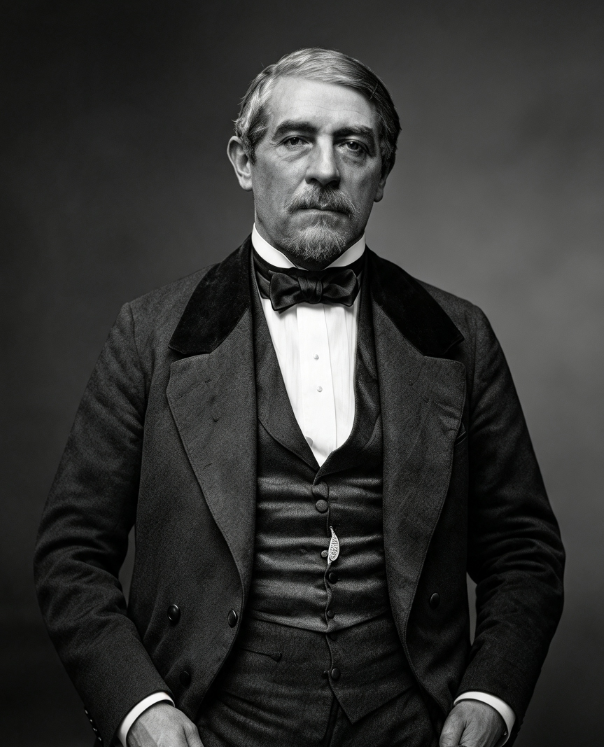
José Fructuoso Rivera was born in October 1784. His father was a wealthy landowner. Unlike the educated, elite politicians in Montevideo, Rivera grew up on a ranch. He spent his youth living the life of a gaucho, he became a master horseman, grew accustomed to the harsh frontier, and learned how to survive in the wild. This rural upbringing gave him two things that would shape his destiny.
Rivera grew up in a region known as the Banda Oriental (the Eastern Bank of the Uruguay River). This was not a stable country; it was a violent frontier buffer zone between two massive colonial empires – The Spanish Empire (ruled from Buenos Aires and Montevideo) and The Portuguese Empire (ruled from Brazil). Because the borders were vaguely defined, the countryside was plagued by smuggling, cattle raiding, and minor military skirmishes. Growing up on a wealthy ranch in this environment meant that Rivera was exposed to frontier defense and military logistics from a very young age. You had to be a soldier just to protect your property. When the revolution against Spain began in 1811, Rivera joined his mentor, José Gervasio Artigas. However, a major political rift quickly developed that defined Rivera’s early political worldview. This meant that Rivera spent his 20s fighting a brutal, multi-front war. On any given month, he was either fighting Spanish loyalists, invading Portuguese armies from Brazil, or centralist armies sent from Buenos Aires. This relentless warfare bred an environment where survival required rapid political shifts.
By 1820, Artigas’s forces were completely exhausted by the multi-front conflict. When the Portuguese launched a massive invasion and successfully captured Montevideo, the revolutionary project collapsed. Artigas chose permanent exile, but Rivera had to look at the reality on the ground. Recognizing that the Portuguese held absolute military superiority, Rivera negotiated a surrender. The Portuguese treated him with immense respect because they knew they could not control the countryside without him. They annexed the region, renaming it the Cisplatina Province, and made Rivera a high-ranking military commander. During this decade (the 1820s), Rivera consolidated his personal wealth, expanded his land holdings, and learned how to navigate high-level imperial politics, setting himself up to be the undisputed leader of the rural interior when the next revolution sparked in 1825.
Although Lavalleja and his Thirty-Three Orientals started the revolution, they were a small guerrilla force. When Rivera defected from the Brazilian Empire at the Abrazo del Monzón (1825), he didn’t just bring himself, he brought the entire rural interior with him. Rivera commanded the loyalty of the rural gauchos and landowners. Without Rivera’s immediate defection and military infrastructure, Lavalleja’s rebellion likely would have been crushed by Brazil. By switching sides, Rivera effectively co-led the war for independence, erasing much of the public anger over his past collaboration.
Near the end of the war, Rivera pulled off a massive rogue military stunt. Without permission from Lavalleja or the provisional government, he invaded the Misiones Orientales (a territory held by Brazil) in 1828 and conquered it. This unexpected victory forced the Brazilian Empire to the negotiating table, directly resulting in the 1828 Treaty of Montevideo which guaranteed Uruguay’s total independence. Rivera went from being viewed as a former Brazilian collaborator to the military genius who forced Brazil to surrender.
When the Constitution of 1830 was signed, the presidency was not decided by a popular public vote. Instead, the General Assembly (parliament) elected the president. The Assembly was made up of wealthy, conservative landowners and urban merchants who desperately wanted peace, stability, and trade. They looked at the two main leaders and whilst Lavalleja fully expected to be the first president, but his political rigidness cost him. Rivera spent the months leading up to the election building alliances with influential politicians in Montevideo and rural landowners. On October 24, 1830, the General Assembly voted, and Rivera won the presidency over Lavalleja.
Lavalleja felt completely betrayed by the political establishment, leading him to launch multiple armed insurrections to overthrow Rivera during his first term. It was this exact threat, the fear that a furious Lavalleja would rise up and use rural forces to seize power, that motivated Rivera to systematically disarm and eliminate potential wildcards like the Charrúa population in 1831.
Puppet of the Landowners: Whilst Rivera hated the bureaucracy of the capital. He spent much of his presidency away from Montevideo, living on the frontier and letting his ministers run the day-to-day government. Because his power depended entirely on the support of wealthy cattle ranchers and landowners (the group his father had belonged to), he adopted their worldview.
The fact that the Charrúa were a semi-nomadic, highly mobile, and scattered population is precisely why the Uruguayan government could not defeat them in traditional warfare. To overcome this, President Fructuoso Rivera relied on deep psychological manipulation, exploitation of past alliances, and tactical deception to gather them in one place. Fructuoso Rivera was not a stranger to the Charrúa; he had fought alongside them years earlier in the wars of independence against Spain and Brazil. The Charrúa trusted him and viewed him as a comrade. Rivera used this personal relationship to send out a massive summons to the leading Charrúa chiefs (including Venado, Polidoro, Rondeau, and Juan Pedro), asking them to bring their entire families to a grand council. Because the Charrúa were scattered across a vast territory, Rivera needed a compelling reason for them to consolidate. He told the chiefs that the newly formed Uruguayan state needed their legendary tracking and combat skills to help protect the national borders against incursions from Brazil. Enticed by the prospect of an alliance, resources, and state recognition, multiple distinct bands of Charrúa traveled from different regions to meet at the designated spot.
When the Charrúa arrived by the hundreds at the Great Salsipuedes Creek, they were naturally cautious. To lower their guard, an Uruguayan army general performed a calculated gesture of trust: he ordered his soldiers to release their military horses to graze. Seeing this, the Charrúa chiefs reciprocated, releasing their own horses. This tactically immobilized the Charrúa, as their supreme advantage in conflict was their rapid, mounted cavalry movement. With the Charrúa stationary and separated from their horses, Rivera hosted a large feast. The soldiers provided large amounts of alcohol. Once the Charrúa were heavily intoxicated and distracted, Rivera executed a pre-arranged signal. According to historical accounts, Rivera asked Chief Venado to lend him his knife to chop tobacco. When Venado handed it over, Rivera drew his pistol and shot him dead. On that cue, 1,200 heavily armed soldiers under the command of Rivera’s nephew, Bernabé Rivera, surrounded the camp and opened fire on the unsuspecting families.
While Salsipuedes was the primary trap that broke the backbone of Charrúa leadership, the military knew that some scattered bands remained elsewhere. Over the following months, Bernabé Rivera led targeted, smaller hunt-and-ambush operations (such as the attacks at Queguay and Arapey) using similar deceptive tactics to track down and eliminate the remaining pockets of the population
Unfortunately Artigas was already living in permanent exile in Paraguay, the following event completely violated his vision for the nation. The Charrúa Were Artigas’s Loyal Allies: During the wars of independence, the Charrúa were not outsiders; they were a core part of Artigas’s army. Famous Charrúa chiefs like Sepé and Polidoro fought alongside him against Spanish and Portuguese empires. When Artigas led thousands of citizens into exile during the famous Éxodo del Pueblo Oriental in 1811, the Charrúa walked with them as equals. In his final military stand, Artigas even trusted the Charrúa to act as his personal bodyguard. Artigas’s political philosophy, famously written in his 1815 Land Regulations, explicitly prioritized the poor, free Black people, and Indigenous groups. He believed that the native peoples had the primary right to the land. Rivera’s campaign did the exact opposite, wiping out the Charrúa to clear the land for rich, white cattle ranchers When Artigas was defeated and exiled in 1820, the Charrúa lost their greatest political protector. The new ruling class of Uruguay viewed the indigenous population as an “obstacle” to progress. Rivera, who had once served under Artigas, took the country in a drastically different direction by choosing extermination over integration.