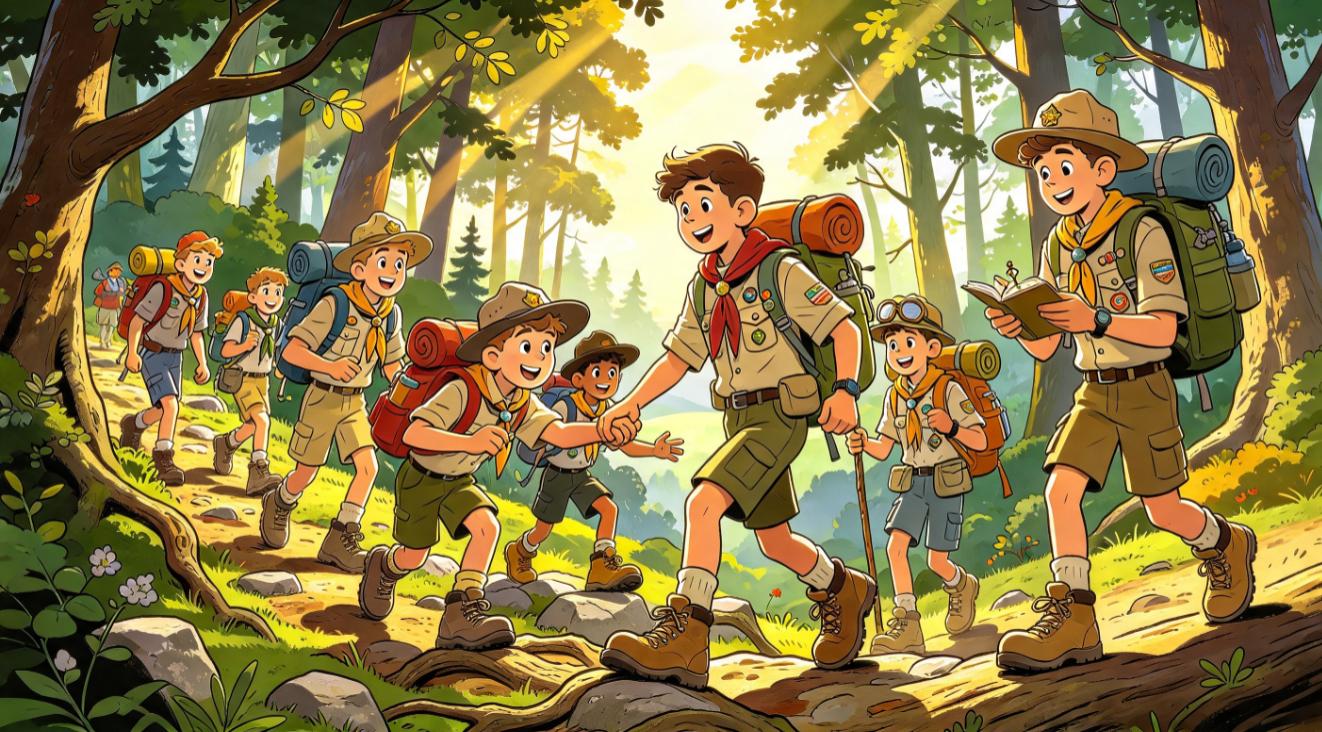
As a young boy I was sent to join the Cub Scouts from a young age at eight years old, as part of the LDS Church and progressed through to Scouts, finishing that journey before the Venturers program. Our Scout Master was an ex-military Swiss leader who was very focused on mountain defense, engineering, and self-reliance. He brought a precise, high-stakes military mindset to our troop, and our tents were structural “three-log” canvas builds. There were so many lessons, memories and stories. It was an essential part of my education, for which I am forever grateful.
In the early 1980s, in a modest LDS Church in Fairflied a group of eight-year-old Cub Scouts straightened their scarves under the gaze of a man who had once led soldiers in the Swiss Alps. He was our Scoutmaster, and he carried the mountains with him, the meticulousness, the quiet discipline, the unshakable belief that a boy who could build a fire in the rain would never truly be lost in the world. Cubs earned their Bobcat, Wolf, and Arrow Points, but ours came with a Swiss accent: our knots had to hold under strain, not merely look neat, and our flag ceremonies were rehearsed with a precision that made other packs look like they were playing tiddlywinks. We learned early that this program would be less about badges sewn on a shirt and more about capabilities sewn into a boy.
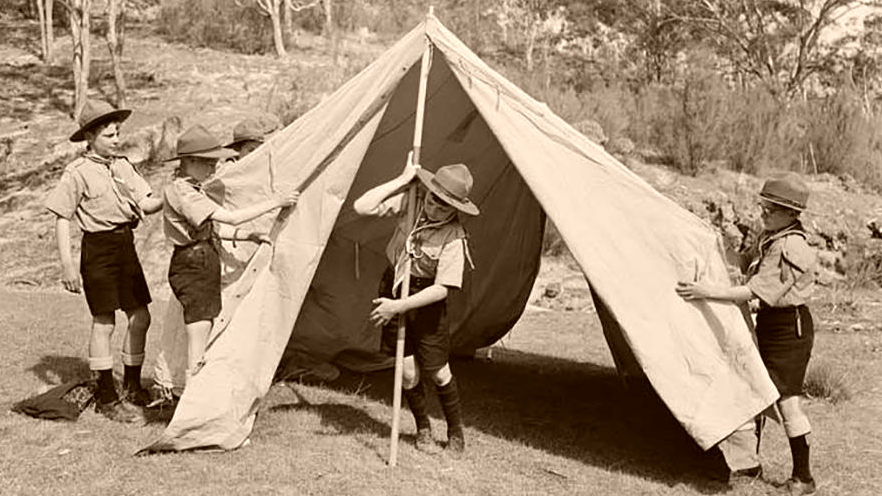
The camps began almost before we could tie our bootlaces. Once a month, sometimes twice, the trailers were loaded and we pointed toward the Hawkesbury sandstone country, the Royal National Park, or the frosty ridges of the Blue Mountains. And always….always, there were the three great canvas tents: heavy, white, army-surplus Baker tents that smelled of wax and woodsmoke, each one demanding a small engineering crew to raise. The Scoutmaster taught us to log every build: the site selection, the drainage trench, the tension of the guy lines, the proper rolling for the journey home. “A tent built sloppy is a tent that falls on you at 3 a.m. in the rain,” (and it did at least once!, that was the lesson) he’d say, and we discovered he was right exactly once, and never again. By the time we crossed from Cubs into Scouts at eleven, raising those tents in failing light was as natural as saying grace.
His curriculum was survival, pure and suffocating at times and utterly glorious in retrospect. We passed our mapping and compass work tramping cross-country through kunai grass; we earned bushwalking, first aid, and camp cooking badges learning to make bannock and stew over an open fire in persistent drizzle. He taught us to read weather in the sky the way his mountain instructors had taught him, to purify water, to trap and snare (theoretically, mostly), to find our way back to camp using only terrain association. The swimming and lifesaving badges came at a cold boatshed on the Hawkesbury, the pioneer badge came with rope bridges and spar lashing, and the bushcraft badge consumed entire weekends of whittling, bark shelter-building, and fire-by-friction attempts that mostly produced blisters and, once, triumph. Every Scout badge, the First Class trek, the camping standard, the emergency preparedness work, was stamped with his insistence that we could do it without being rescued.
The map-tracing hike began as a simple navigation exercise: trace the route from station to campsite, but the Swiss Scoutmaster, ever the believer in the scenic education, forbade the direct public-transport path and sent us cross-country instead. Somewhere near Holsworthy our pencil lines crossed a fence we should never have crossed, and suddenly we were blinking in the middle of an army base as cadets bellowed and gave chase across the parade ground. We ran, packs flapping, compasses swinging, burst out through a gate, down a lane, and straight past the verandah of an old lady who emerged with a shotgun to demand what on earth a dozen frightened boys in scarves were doing stampeding through her property. She got no answer worth keeping; we vaulted her fence en masse and landed, sprawling, in a reeking garbage dump, where we lay gasping among the rubbish bins while the Scoutmaster’s phrase about “reading terrain before crossing it” burned itself into our memories. We walked the last stretch along old, rusting railway tracks, single file and silent, arriving at the destination filthy, exhausted, and absurdly proud that we’d technically completed the exercise.
Then there was the river. He told it to us straight-faced and we believed every word: the water held deadly spikes on the bottom, and worse, if any of us bled, even a scratch, the scent would call the attention of other creatures that lived there. So we crossed it the only way he deemed safe: packs and supplies hoisted high in our arms, fully clothed, arms stretched above our heads like pilgrims, swimming with our legs only, forbidden on pain of unimaginable consequence from ever letting a foot touch the ground. The crossing took an eternity, muscles screaming, boots dragging us down, whispers of “don’t bleed, don’t bleed” passing down the line. Whether the spikes were real we never tested and never dared to ask; to this day, some of us still swim with an irrational respect for that river, and I suspect the Scoutmaster knew that was precisely the point. Fear, properly administered, makes for very careful swimmers.
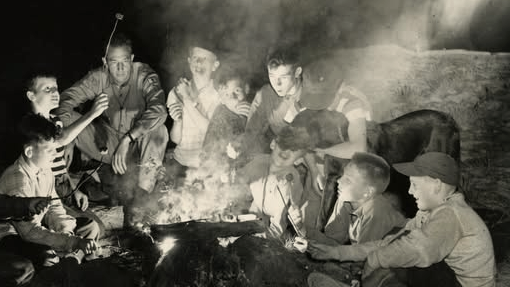
And there were the nights, cold, coal-black nights in the bush where silence had texture, and the only sounds were the canvas breathing in the wind and the drip of condensation at the tent mouth. Those were the nights the older scouts earned their reputations. A scrape of metal on stone in dead darkness. A low, rasping whisper that moved between the tents. And then, somewhere out beyond the fire’s dead ashes, the unmistakable sound of a man dragging claws along a canvas wall, the older boys had elected one of their number to play Freddy Krueger, and he took the role with a dedication that would have impressed Wes Craven himself. Cubs woke up in a single communal shudder, torches clicked on like a nervous applause, and the Scoutmaster, we were certain, heard everything from his tent and allowed it, because a boy who survives a night of controlled terror sleeps a little deeper forever after, and tells the story for forty years.
But the pinnacle of our education in survival was the war game: two teams, one ridge, one objective, and an unspoken escalation that would have alarmed any responsible adult not raised in the Swiss Army. We set traps with the sincerity of combat engineers, sharpened stakes (blunted, mostly, after a stern briefing) hidden beneath hollow grounds covered with leaves, trip ropes strung at shin height between saplings, bent branches under tension waiting to swing anything that came careless through our kill zone. For an entire afternoon the valley echoed with war whoops, the whump of triggered traps, and the howls of the ambushed, until the Scoutmaster finally strode through the battlefield dismantling our handiwork like a disappointed ordnance officer, delivering his verdict: the traps were excellent, which was exactly the problem. Then he made us camp there, in the very valley we’d fortified, and somehow sleeping inside our own defences made us feel like the safest boys in New South Wales.
Everything began, always, with the packing lists, and the Swiss Scoutmaster’s iron rule that a scout carries only what is necessary, a minimum number of items and not one more. We would crouch over our packs in the meetinghouse hall, paring down, negotiating grams, and inevitably the little things lost the argument: the spare socks made the cut, but the small tin of salt, more than once, stayed home on the shelf. He would inspect our rations with a quartermaster’s eye, and the logic was his old mountain logic, weight is the enemy, redundancy is weakness, and a boy who cannot decide what truly matters will carry too much of everything and too little of what counts. We grumbled about the austerity at the time, half-starved on our trail rations, but we learned to pack the way he had packed in the Alps: with a surgeon’s ruthlessness. That the salt would come to matter, and soon, was a lesson he left for the trail to teach us.
It taught us on the day of the leeches. We had been wallowing through swamps and wet forest for hours—boots sucking mud, ferns plastering us with cold water, when the strange sensations began: a soft tug at an ankle, an odd warm heaviness at the back of a knee, something that itched precisely where you could not see. When we finally stopped and checked, the discovery rippled down the line like a war report: leeches, fat and black and already drunk, latched onto half the troop. And there we stood in the middle of nowhere with our knife-sharp packing discipline and no salt—the one item that would have made them let go in an instant, because it had been voted off the packing list back in Sydney. What followed was field surgery by committee: knives sterilized over matches, leeches flicked and flamed and peeled with gritted teeth, ankles bleeding freely under the great lesson of the day, which the Scoutmaster delivered with barely concealed satisfaction: this is why salt weighs almost nothing and matters almost everything. From that trip forward, no scout in our troop ever left salt behind again.
Then came the day we had to kill an animal for food, and I won’t say which one, because the animal itself matters less than the odd, solemn journey it took us on. The Scoutmaster treated it with complete seriousness, no jokes, no rushing, as he walked us through what had to be done, and we stood in a ring around the whole procedure with our First Aid manuals and our hunger, learning that the distance between a lamb chop in a Styrofoam tray and an animal in the grass is the entire distance between boyhood and something older. Some of the boys looked away; one of them cried quietly and then stayed anyway, and the Scoutmaster told us that staying was the point: a scout who eats must be willing to look at what eating costs. We said a prayer over the animal, prepared it properly as he had been taught to prepare it, and that night we ate what we had taken with a reverence I have never felt at any table since. It was an odd journey, nobody spoke much walking back to camp, but every one of us walked a little differently, and none of us ever wasted food again without thinking of that still afternoon in the bush.
Between camps, our troop poured itself into the community, because he believed a scout who only served himself was no scout at all. We swept gutters after storms, ran log-splitting bees for elderly widows in the ward, planted hundreds of trees for council regeneration projects, collected mountains of newspapers and bottles for recycling drives before curbside collection existed, and served at ward dinners and fetes in our uniforms, hot and formal in the summer heat. Anzac Days found us in press-stiff uniforms alongside veterans, learning from men who had seen real survival why our Scoutmaster taught what he taught. The service hours piled up quietly, and looking back, that was the point: competence meant nothing unless it was spent on other people.
By fifteen, we had grown from boys who couldn’t strike a match into young men who could navigate by stars, carry a mate with a sprained ankle three kilometres out of a gully, cook for thirty, teach an eleven-year-old to build a fire, and stand before a bishopric or a council ranger with calm confidence. The Swiss soldier never gave speeches about character; he just gave us storms, saws, axes, responsibility, and each other. The badges eventually yellowed in drawers, but eight years of monthly canvas-and-smoke living left something harder to misplace: the knowledge that hardship is a teacher, preparation is love made practical, and a boy who has slept under a tent he built with his own hands, in rain he was caught in because he read the sky wrong, will remember the lesson for the rest of his life.
We do.
We remember all of it.