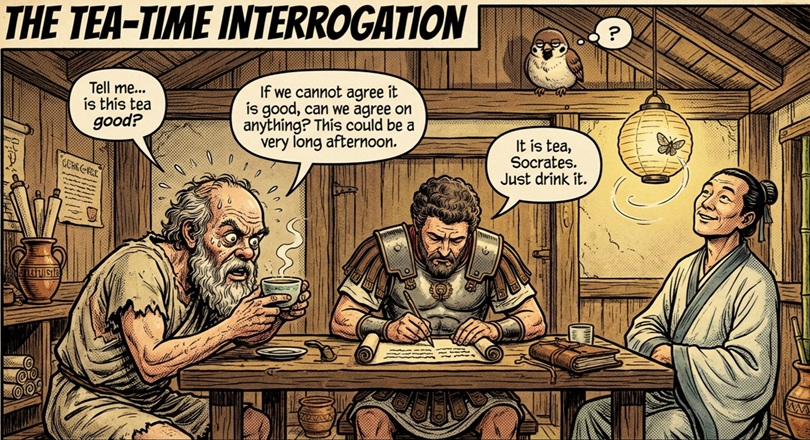
The philosophical legacies of Marcus Aurelius, Socrates, and Zhuangzi form a triptych of the human search for meaning. Separated by centuries and civilizations, they nevertheless converge on a shared concern: how should a human being live? Each articulates a distinct discipline of the inner life. One teaches mastery, another examination, the third release. Together they offer not a single doctrine, but a dynamic framework for authenticity.
Marcus Aurelius wrote his reflections amid the burdens of empire. In the solitude of campaign tents and imperial chambers, he composed what we now know as Meditations, a private journal never intended for public eyes. Its enduring power lies in its austerity. Marcus reduces philosophy to a single operational principle: distinguish what is within your control from what is not. Judgments, intentions, and choices belong to us. Reputation, illness, political fortune, and death do not. Emotional disturbance arises, he argues, not from events themselves but from the meanings we attach to them.
“The impediment to action advances action. What stands in the way becomes the way.” – Marcus Aurelius
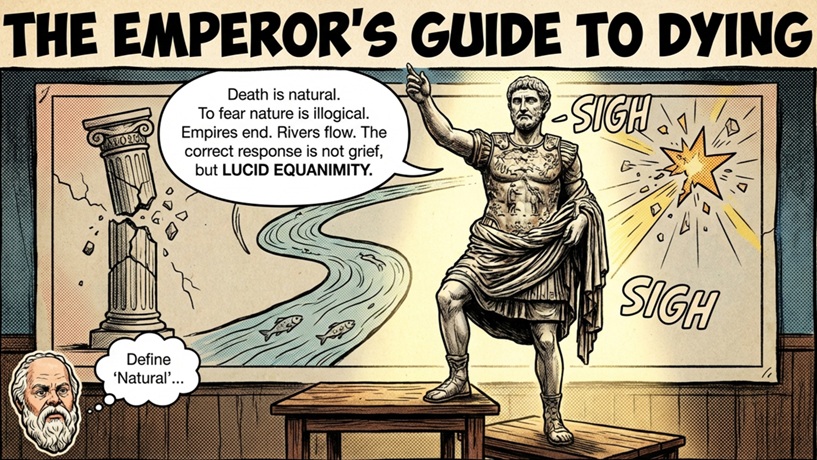
For Marcus, virtue is the only genuine good because it alone cannot be taken away. To live rationally is to live in accordance with Nature, understood as an ordered whole in which each person plays a part. Obstacles are not interruptions of the path but the path itself. The resistance we encounter becomes material for the exercise of courage, justice, temperance, and wisdom. This Stoic discipline does not deny suffering. It reframes it. Mortality, ever present in his reflections, serves as a moral accelerant. Life is brief. Therefore act well now. The urgency is ethical, not anxious.
“You have power over your mind, not outside events. Realize this, and you will find strength.” – Marcus Aurelius
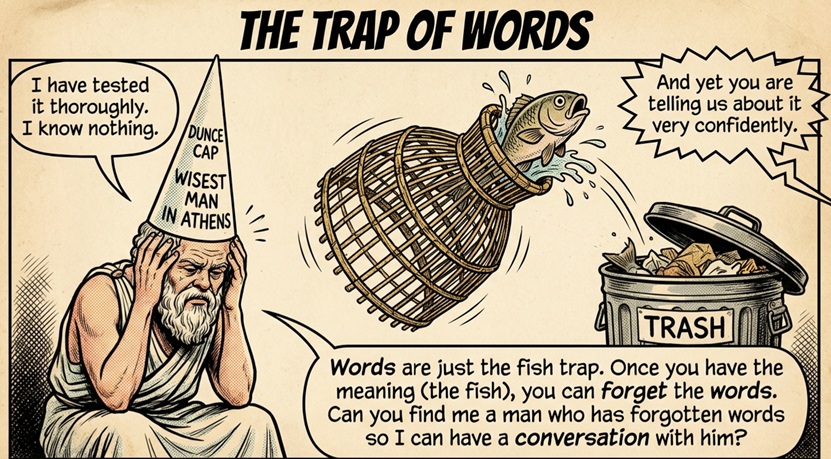
If Marcus provides a manual for composure under pressure, Socrates provides a method for moral awakening. Unlike the emperor, he left no writings of his own. His philosophy survives through dialogues, most memorably those of Plato, where Socrates appears less as lecturer than as relentless questioner. His most famous claim, that the unexamined life is not worth living, was not rhetorical flourish but existential commitment. For Socrates, the central human task is care of the soul.
“The unexamined life is not worth living.” – Socrates
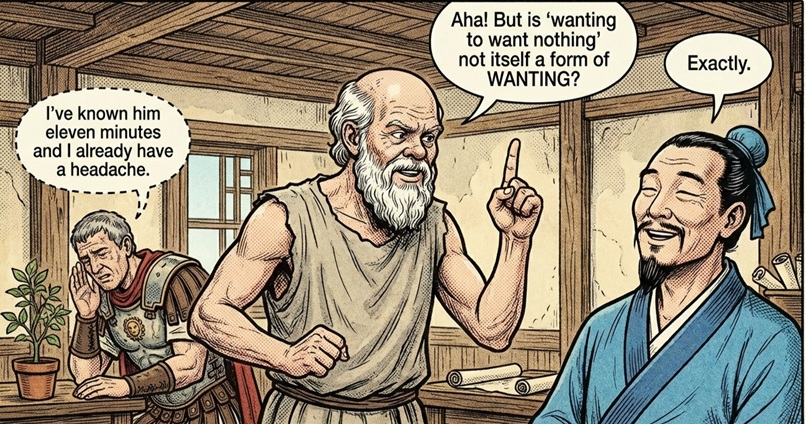
He believed that wrongdoing stems from ignorance. If one truly understands what is good, one will act accordingly. Ethical failure is thus a cognitive failure. His dialectical method, often called the elenchus, exposed contradictions in his interlocutors’ beliefs, dismantling complacent certainty. Yet this was not intellectual aggression. It was moral midwifery. By revealing confusion, Socrates created the possibility of clarity. His trial and execution stand as the ultimate testimony to his priorities. Faced with exile or silence, he chose death rather than betray his commitment to truth. Integrity outweighed survival. The examined life required courage as much as reason.
“The only true wisdom is in knowing you know nothing.” – Socrates
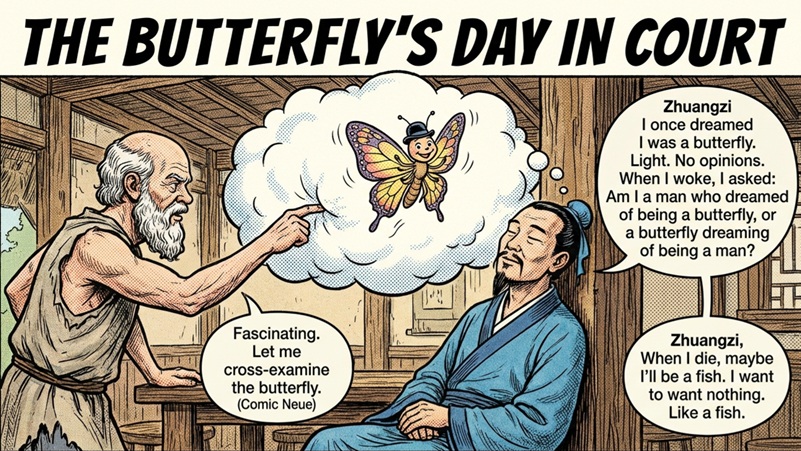
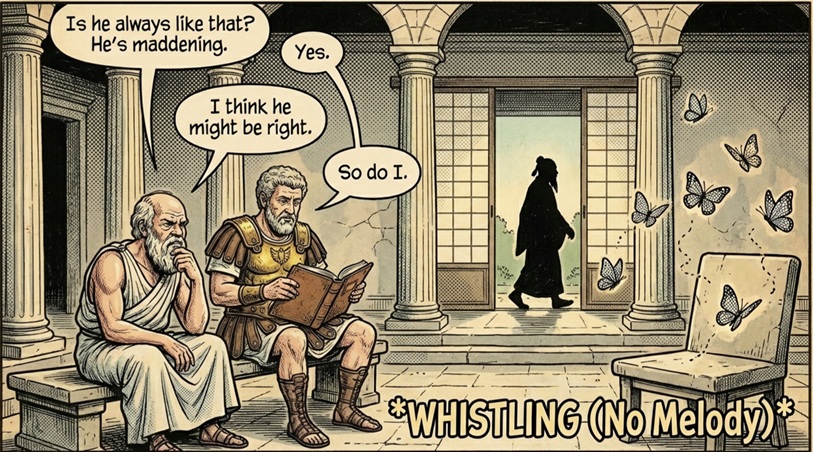
Where Socrates sharpens and Marcus steadies, Zhuangzi dissolves. Writing in the turbulence of ancient China’s Warring States period, he crafted parables that subvert fixed distinctions and mock rigid certainty. In the text that bears his name, often referred to as the Zhuangzi, he invites readers into a world where perspectives shift as fluidly as wind through trees. The famous dream of the butterfly blurs the boundary between self and other, waking and dreaming, certainty and illusion. The point is not skepticism for its own sake, but liberation from cramped thinking.
“Happiness is the absence of the striving for happiness.” – Zhuangzi
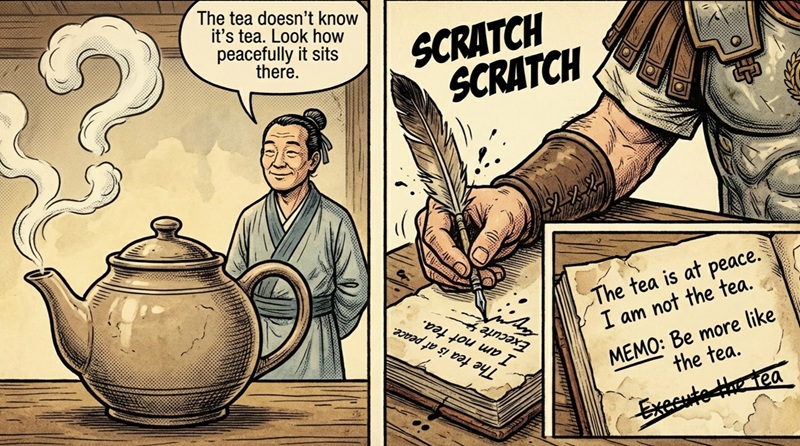
Central to Zhuangzi’s vision is alignment with the dao, the generative process that underlies all things. Rather than impose will upon the world, he counsels wu wei, action without forcing. This is not passivity but attunement. The skilled butcher who carves an ox without dulling his blade does so because he follows the natural grain. Mastery here is effortless because it is uncontrived. Zhuangzi’s sage wanders beyond rigid binaries of success and failure, life and death. In relinquishing the need to control outcomes or defend identity, one discovers a deeper ease.
“Flow with whatever may happen, and let your mind be free. Stay centered by accepting whatever you are doing.” – Zhuangzi
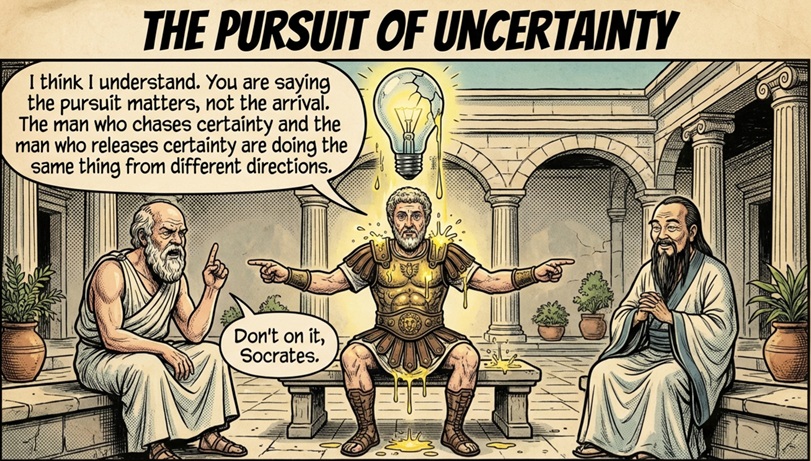
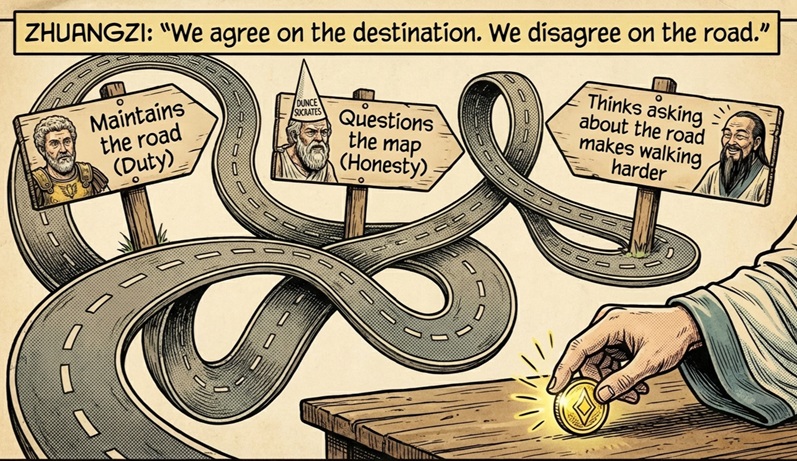
Taken together, these three philosophies trace complementary arcs of development. Socrates insists that we interrogate our assumptions. Without examination, we drift in borrowed beliefs. Marcus teaches that once we discern what is right, we must train the will to enact it despite adversity. Without discipline, insight collapses under pressure. Zhuangzi reminds us that even discipline can calcify into rigidity. Without spaciousness, virtue becomes self-righteousness and inquiry becomes anxiety.
“The perfected person employs thier mind as a mirror. It grasps nothing, it refuses nothing. It receives but does not keep.” – Zhuangzi
Their integration suggests a layered practice of living. First, question. What do I believe? Why? What is truly good? Second, act. Given what is within my power, how can I respond with justice and steadiness today? Third, release. Can I loosen my grip on outcomes and identities enough to move with changing conditions?
In a restless age defined by distraction and volatility, their combined wisdom feels strikingly contemporary. We confront external forces beyond our control, moral confusion amplified by noise, and relentless striving that exhausts rather than fulfills. The emperor counsels composure, the gadfly demands clarity, and the Daoist sage invites lightness. None alone is sufficient. Together they form a resilient architecture of the self.
A life well lived, in their shared vision, is neither rigid nor aimless. It is examined without paralysis, disciplined without harshness, and free without indifference. It requires the courage to seek truth, the strength to embody it, and the humility to recognize that we move within a reality far larger than ourselves.