
[ A historical fiction ]
The winter wind howled off the North Sea, cutting through the stone ramparts of Bruges with a cruelty that no man who had not endured it could properly describe to another. But inside the great square, the cold was forgotten. Twenty thousand souls had gathered, merchants from Venice, bankers from Florence, knights from every corner of Christendom, to witness the spectacle that would be remembered for a generation. Jacob van Aertrijcke felt the weight of his chainmail like a second skin, and beneath him his destrier snorted steam into the frozen air, hooves dancing on cobblestones worn smooth by a century of commerce. Bruges was the jewel of Flanders, the beating heart of European trade, and today it would witness his glory.
Or his death.
What Jacob did not know, what no man in that frozen square could possibly imagine, was that this single charge would echo across five centuries, that the blood about to be spilled on these cobblestones would one day flow in the veins of farmers on volcanic islands, gold prospectors in a jungle wilderness, and gauchos on the endless plains of a land no European had yet dreamed existed.
In the year of our Lord 1390, the city of Bruges was a miracle of human ambition, and a nest of human treachery. The House of van Aertrijcke stood on the Wollestraat, a stone’s throw from the belfry whose carillon marked the hours of commerce. Three generations of van Aertrijckes had served as poorters, citizens with the right to trade freely, and two had sat as burgomasters. Theirs was a name built not of royal blood but of shrewd minds and patient hands.
Jacob van Aertrijcke was thirty years old in 1390, a man carved from the same Flemish oak as his ancestors. He had been taught by his father to value land over gold, bloodlines over coin, though in Bruges the two were always inseparable. His marriage to Maria van de Walle had united two of the oldest families in Flanders. She was not beautiful in the conventional sense. She was tall for a woman, with hands that could wield a quill as deftly as a needle, and eyes that missed nothing. In the counting houses of Bruges, men said that Maria van de Walle could spot a bad debt at fifty paces and a liar at a hundred. Jacob loved her not despite this, but because of it.
Their union had not been without its shadows. Maria had miscarried twice before their first child, Jan, was born. She had never spoken of those losses to Jacob, not directly, but he had heard her in the night sometimes, praying in a voice too quiet for prayer and too broken for silence. He had stood outside the door of the solar on those nights, not entering, not leaving. It was, he thought, the most helpless he had ever felt, and he was a man who had fought in border skirmishes at nineteen and buried his father at twenty-three.
The message from the Duke of Burgundy arrived on a bitter night in February 1393. The messenger wore the livery of Philip the Bold, uncle to the mad king of France and the most powerful man in the Low Countries. The seal was crimson, the colour of blood and royalty.
Maria read the letter over Jacob’s shoulder, her breath warm on his neck. ‘This is not an invitation,’ she said quietly. ‘It is a test.’ She was right. The Duke was consolidating his power, drawing the noble houses of Flanders into his orbit. Those who fought well would be rewarded. Those who refused would be forgotten, which in those years was a form of death all its own.
‘If I die,’ Jacob began. ‘You won’t die,’ she said, and her voice was steel wrapped in silk. ‘You will win, and then you will come home to me.’ She pressed a small silver reliquary into his palm, a fragment of Saint Donatian’s robe purchased from a relic dealer in Venice at a cost that would have fed a peasant family for a year.
Jacob held it and did not tell her what he had heard from a merchant who arrived from Ghent that very morning. The man was a cousin of one of the tournament’s organisers, and he had drunk too much Rhenish wine and spoken too freely. Two of the knights entered against Jacob were not who they claimed to be. One was a creature of the Duke’s own household, placed in the lists to watch who survived with honour and who survived by subterfuge. The other was rumoured to have won his last four tournaments through a substance, purchased from an apothecary in Cologne, that dulled an opponent’s reflexes without leaving any visible trace. Jacob had told no one, not even Maria.
The tournament was held on the frozen ground of the Marche du Vendredi, the Friday Market, where executions were usually conducted. The symbolism was not lost on anyone. On the first day Jacob unseated a knight from Hainault so violently that the man’s arm snapped like a dry branch. The crowd roared. Maria watched from the stands, her face impassive, her hands hidden in her sleeves so no one could see them tremble.
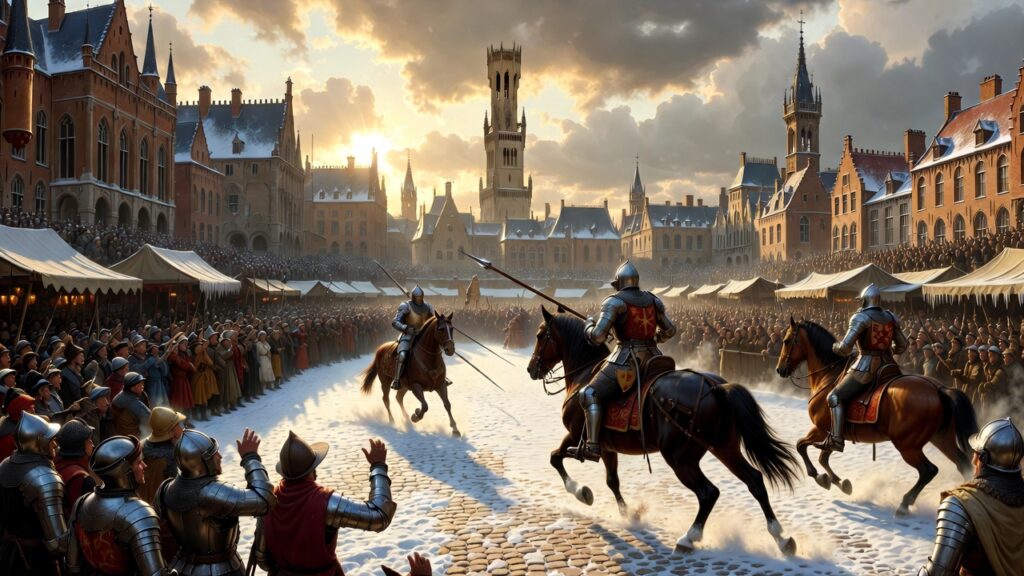
On the second day he faced the German baron they called the Hammer of the Rhine, a man twice his size who had not been unhorsed in six years of tournament. For thirty minutes they circled, hacked, and thrust, their swords ringing off shields until the sound became a demonic carillon rising over the city’s rooftops. When at last Jacob found the gap between the German’s gorget and helm, a fraction of an inch deeper would have killed him outright. As it was, the man yielded, blood bright on the grey snow, and the crowd’s roar became sustained thunder.
But that night, alone in the quarters the Duke had provided, Jacob could not sleep. He lay staring at the stone ceiling and thought about the apothecary’s poison, and about the reliquary against his chest, and about Maria three streets away in their own house, probably not sleeping either. He thought about Jan, their son, nine years old, who had cried when his father left and then composed himself with a dignity that had broken Jacob’s heart more completely than the tears would have.
The third day dawned clear and cold, the sky a hard winter blue. Jacob’s opponent was a French knight from the household of the Duke of Orleans named Simon de Montfort, a man who had never lost. When they met at the gallop the impact shook Jacob’s bones to their roots, and his vision went briefly white. But his aim was true, his lance shattering in a spray of splinters that caught de Montfort’s visor and blinded him for a crucial second. Jacob drew his sword and, in a move his father had drilled into him on the practice fields of Tillegem, hooked the Frenchman’s shield and twisted hard.
De Montfort fell.
The crowd surged forward, hungry with the old, dark appetite that tournaments fed. But Jacob raised his hand. ‘This man fought with honour,’ he declared, his voice carrying across the suddenly silent square. ‘He will dine at my table tonight, and we will speak of battles past and battles yet to come.’ In the Duke’s pavilion, Philip the Bold turned to his advisors. ‘That one,’ he said, pointing. ‘Mark him. He will go far.’
Jacob returned home that night with a purse of gold and a pair of Percheron stallions. He also returned with the knowledge he had kept from Maria, the knowledge of the poisoner in the lists, the spy among the knights. He had identified him on the first day. The man’s name was Pieter van Houtte, and Jacob had beaten him in the second round, but not before he had looked into the man’s eyes and seen something cold and knowing there. Van Houtte was a servant of the Duke, yes. But he was also a collector of information, and information in Bruges in 1393 was worth more than lances and stallions combined.
That night, as Maria tended his bruises with comfrey oil and the careful efficiency she brought to everything, Jacob told her none of this. Instead he watched her hands moving over his skin, and he thought: we are at the edge of something. He could feel it the way a sailor feels a change in the weather before the clouds gather. Something was coming, and it was larger than a tournament, and it would require everything they had.
‘The Duke will call on you again,’ Maria said softly, not looking up from her work. ‘When he does, we must be ready.’ He did not ask her how she knew. He had long since stopped wondering at the things Maria van de Walle understood without being told.
II. The Price of a Duke’s Favour
Dijon and Bruges, 1395 to 1419
The years that followed the tournament were years of surface prosperity and underground fear. Jacob and Maria had three children: Jan, the eldest; Liesbet, who had her mother’s eyes and her father’s stubbornness; and little Pieter, born in the winter of 1396, the same year the French crusade was crushed at Nicopolis. Jacob mourned the cousins who had died on Ottoman lances. He also memorised the lesson their deaths had written: glory was a fool’s bargain, and the men who survived were not always the men who deserved to.
Pieter van Houtte reappeared in Jacob’s life in 1398. He came to the house on the Wollestraat on a cold Tuesday afternoon, dressed as a cloth merchant, which he was not. Jacob received him in the counting room with Maria present, because he had learned never to have important conversations without Maria present. Van Houtte smiled the smile of a man who knew he had been expected, and laid a document on the counting table between them.
‘The Duke wishes to know,’ he said, ‘how far the loyalty of the House of van Aertrijcke extends.’ The document was a list of names, prominent Flemish families, beside each of which was a column of numbers. Debts, Jacob realised. Every family on the list was in debt, to the Duke’s agents, to Italian bankers who worked at the Duke’s pleasure, to institutions that existed only on paper. ‘You are not on this list,’ van Houtte said pleasantly. ‘The Duke wishes to ensure you remain off it.’
After van Houtte left, Maria sat for a long time without speaking. The fire in the hearth had burned low, and the shadows in the room were deep. ‘He is using you,’ she said at last. ‘If the Duke falls, they will say you were his man. If the Duke rises, he will own a piece of everything we build.’ She looked at Jacob directly, her eyes steady as stone. ‘We must diversify. Our fortune cannot depend on Burgundy alone. We need friends in other courts, and those friends must never know each other.’
Jacob looked at the fire. He thought about the children sleeping upstairs, Liesbet in her bed with the carved oak headboard, little Pieter who still woke crying from dreams he could not explain. He thought about what it meant to place the name you had been given into the hands of men who used names as currency. ‘There is a Florentine,’ he said slowly. ‘Cosimo de Medici’s cousin is in Bruges this month. He has asked for a meeting.’ Maria nodded as though she had known this already, which she probably had.
The relationship with the Florentines proved to be the saving of them. When the storm broke, on November 23, 1407, with the hacked body of the Duke of Orleans left in the gutter of the Rue Vieille du Temple in Paris, Jacob received the news three days later and felt a coldness settle in his chest that had nothing to do with the February air. He handed the letter to Maria without a word. She read it, set it down, and said, ‘Now it begins. Civil war. We are caught in the middle, and we must choose wrong sides correctly.’
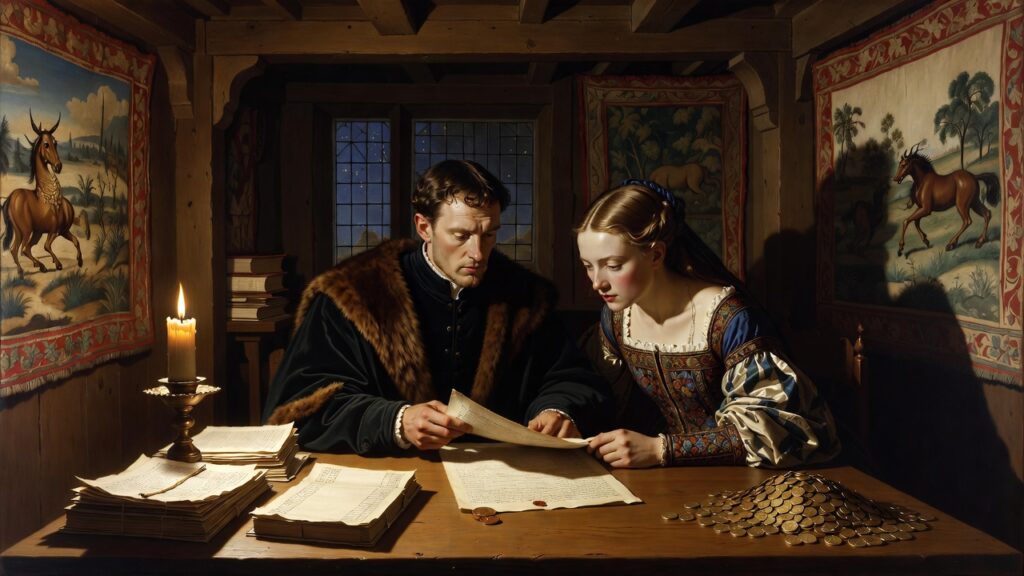
Jan van Aertrycke was nineteen that year, a young man with his father’s build and his mother’s precision. He had been trained in law as well as arms, educated by the canons of Saint Donatian in the arts of rhetoric and persuasion. Men said Jan could talk a fish out of water, but Maria said privately to Jacob that the boy’s real gift was that he knew when not to speak, which was rarer and more valuable. In 1408 Jan married Barbara Fertyns, daughter of one of the wealthiest wool merchants in Ghent, and to everyone’s surprise, including their own, they fell genuinely and helplessly in love.
Liesbet van Aertrycke did not marry.
This was not for want of suitors. She was the daughter of a tournament champion, educated beyond most women of her station, with a face that the miniaturist hired for her portrait said was ‘formed by God in one of His more careful moods.’ But Liesbet at twenty said to her mother that she could not imagine binding her life to a man she did not choose for herself, and at twenty-two she entered the beguinage of the Vineyard, where women could live in community without taking permanent vows. She was not unhappy there. She wrote letters to Jacob that he kept in a cedar box until his death, and in those letters she described a life of prayer and scholarship and the particular quiet pleasure of being answerable to no one.
Jacob died in September 1405, five months before Jan’s wedding. He died of a fever that no physician could name and no prayer could slow, in his bed in the house on the Wollestraat, with Maria holding his hand and Jan and Barbara and little Pieter ranged around the room like a painting of something sacred and unbearable. He tried to speak at the end and could not manage more than a whisper. ‘The name,’ he said to Maria. ‘Protect the name. It is all we have that cannot be stolen.’ He was buried in the Church of Our Lady under a slab of black marble carved with the van Aertrycke arms: six golden pitchers on a sable field. ‘Here lies a knight who fought with honour and lived without fear,’ the inscription read, which was not entirely true, but was true enough.
Maria van de Walle outlived her husband by twenty years. She ran the family’s affairs with an authority that brooked no argument, expanded their trading network into Portugal, and watched with composed pride as Jan rose to become one of the most respected voices in the councils of Flanders. She also watched Pieter, her youngest, grow into a young man who had his father’s eyes and no other resemblance to him whatsoever. Pieter drank. Not publicly, not disastrously, but enough that Maria knew it, and knew he knew she knew it, and knew that this knowledge changed nothing. She kept him away from the counting room and gave him management of the family’s farmland, where he was, to her cautious relief, genuinely competent. She loved him as fiercely as she loved the others and worried about him more than all of them combined.
In 1419, the year of Maria’s death, Portuguese navigators discovered the island of Madeira. She heard the news from a sailor in the dockhouse at Sluys, where she had gone to inspect a shipment of Mediterranean goods. She stood in the cold salt wind and looked out at the grey sea and thought about edges, about the way a map ends not in a wall but in a question. When she died that autumn, quiet in her bed with Jan and Barbara and their children around her, she had told no one about the island except Josse, Jan’s eldest son, a boy of eighteen with restless feet and a hunger she recognized from somewhere deep in herself.
She had told him simply: ‘There are islands. Go and see them.’ And she had closed her eyes.
III. The Flemish Who Followed the Wind
Bruges to Lisbon, 1420 to 1450
Josse van Aertrycke grew up in a house haunted by his grandfather’s armour and his grandmother’s silences, both of which he found equally instructive. He was born in 1401, four years before Jacob’s death, and had no memory of the man except a particular smell: chainmail oil and cedarwood, which he associated ever after with both safety and grief. He had his father Jan’s facility with language and something else that had skipped a generation, his great-grandfather’s need to move, to press against whatever horizon presented itself, to see what lay on the other side.
He was twenty-nine when everything changed.
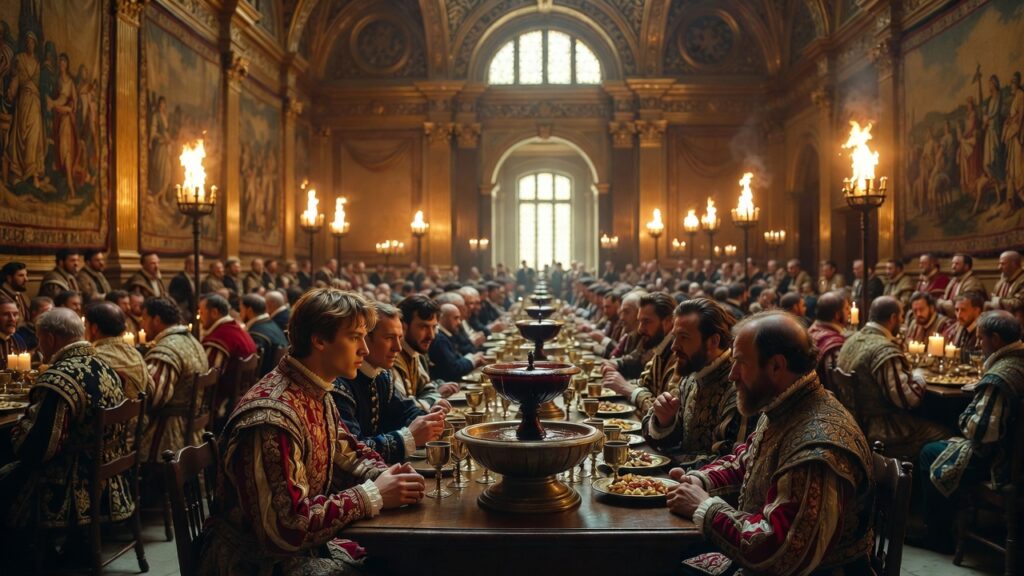
In 1430, Philip the Good, Duke of Burgundy, married Isabella of Portugal in Bruges, with a magnificence that beggar all description. The streets ran with wine. Fountains spouted rosewater. Flemish merchants dressed in silks they had been saving for a year. And in the great hall of the Prinsenhof, Josse van Aertrycke found himself seated near enough to the Portuguese delegation to hear them speak in the soft, liquid dialect of Lisbon, which he had taught himself from a grammar he had purchased from a book dealer on the Vlamingstraat for what his father considered an outrageous sum.
They were speaking of islands.
Nine specks of volcanic rock a thousand miles from Lisbon, a thousand miles from anywhere, called the Azores. A Flemish captain named Joost De Hurtere had persuaded the Infante, the man they were calling Henry the Navigator, to grant him the captaincy of the westernmost island. He was gathering settlers. He needed Flemish families, families who knew how to build and plant and endure, families unafraid of the sea or of beginning again in soil that had never felt a plow.
Josse returned home that night with a fever that had nothing to do with illness. Barbara Fertyns, his mother, saw it in his eyes before he opened his mouth. She was sixty years old, her hair white, her hands gnarled with arthritis, but her mind was as sharp as it had ever been and her capacity for being surprised by her own children remained, despite considerable evidence, intact. ‘You are thinking of going,’ she said. It was not a question. ‘Yes.’ She was quiet for a moment. ‘Then I will come with you.’
He stared at her. She met his stare with the particular expression she used when the conversation was over before it had begun. ‘Do not argue with me, Josse van Aertrycke. I am a Fertyns of Ghent. My father traded wool with England when the English were burning French fields. Do you think I am afraid of a few trees and a long sea voyage?’ There was a silence. ‘What about father?’ Josse asked. Jan van Aertrycke had died two years before, peacefully, at his counting table, which was how he would have wished it. Barbara’s expression did not change. ‘I outlived your father,’ she said. ‘I will not outlive the chance to see something new.’
The journey to Lisbon took three months, through lands ravaged by war and plague, past villages where the peasants were gaunt as winter branches. In Paris they saw English flags over the walls, the mad king’s son having signed away his own inheritance, and the sight of it made Josse feel something he could not name for some days, until he identified it: relief. Relief that his grandmother had not lived to see it. Relief that the world he was leaving was already half-destroyed, which made it easier to leave.
Joost De Hurtere met them at the Lisbon docks. He was a big man, weathered through and through, with the kind of face that looked as though it had been carved by someone who valued function over form. He looked at Josse for a long moment, then at Barbara. ‘I expected one of you,’ he said. ‘Why has the mother come?’ Barbara Fertyns answered before Josse could open his mouth. ‘Because the mother goes wherever she pleases,’ she said, ‘and because I have outlived two husbands, buried three children, survived the plague and the English and the Duke of Burgundy’s financial policies, and I intend to see one more thing before I die.’ De Hurtere looked at her for a moment, then laughed, a great booming sound that echoed off the stone walls of the dockhouse. ‘God help the island,’ he said.
The marriage was arranged before departure, as such things were arranged. De Hurtere had identified a Flemish family, the van der Haegens, also bound for the Azores, whose daughter Margaretha needed a husband of good family. Josse met her on the dock three days before sailing. She was twenty-four, her father’s daughter in every visible quality, dark-eyed and direct and not particularly interested in making conversation to fill silence.
‘You are Jacob van Aertrijcke’s grandson,’ she said, after they had been standing together for some minutes without speaking. ‘By reputation and by name, yes.’ ‘My father spoke of him. He said the tournament of Bruges was the last great act of the old Flanders. That everything after was just… maintenance.’ Josse looked at her. ‘Do you believe that?’ She looked back without hesitation. ‘No. I think it was the first act of something else entirely. I think we are still in the second act, and I intend to know what the third looks like.’ Josse, who had thought he might take some time to feel anything for this arranged wife, found that he had considerably less time than expected.
IV. The Atlantic Swallows Cowards Whole
Lisbon to Faial, 1451
The fleet departed from Lisbon on a grey morning in March 1451. Three ships, a caravel and two smaller barks, carrying perhaps two hundred souls and everything needed to build a new world: axes, plows, seeds, livestock, and the collective hopes of people who had left everything they knew. Josse stood at the rail as the city faded into the morning mist, Margaretha beside him, her hand not quite touching his on the wooden rail.
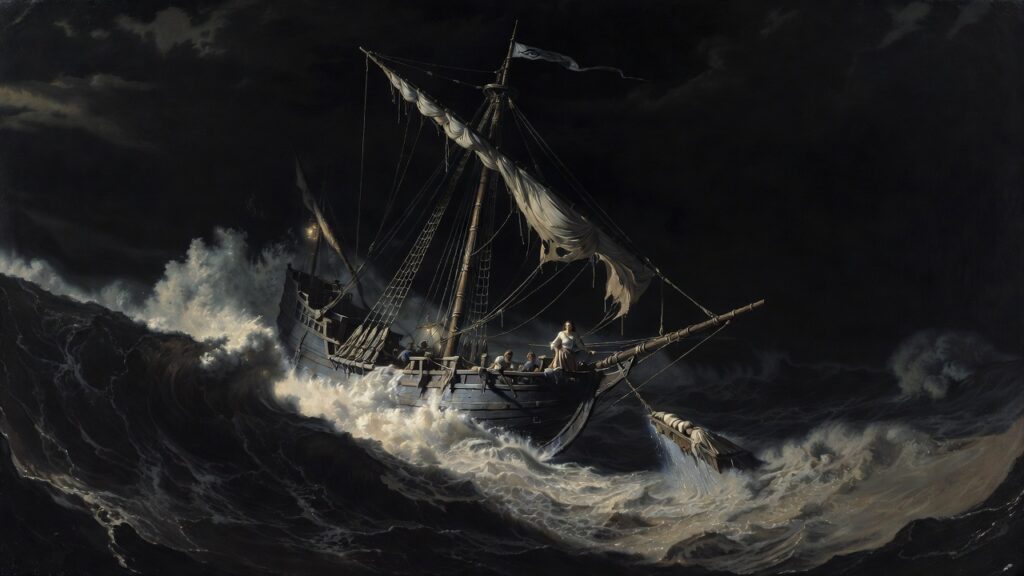
For the first three days the sea was calm and the passengers spoke quietly of how the voyage might not be so terrible after all. Then the wind shifted, the sky went the colour of pewter, and the Atlantic showed them what it truly was.
It was during the storm of the second week that Barbara Fertyns died.
She had been unwell since Lisbon, a cough that she dismissed and that everyone else watched with the particular helplessness of those who love someone who will not be worried over. On the ninth night, in the hold of the caravel while the ship climbed and fell and climbed again in a sea that seemed determined to end them, she called Josse to her side and held his hand with both of hers, which were cold despite the wool blankets piled over her.
‘I have been thinking,’ she said, speaking carefully between breaths, ‘about what your grandfather said. About the name.’ Josse could not speak. He pressed her hands between his own and tried to give her warmth he was not sure he had. ‘He was wrong about one thing,’ Barbara said. ‘He said the name is all we have that cannot be stolen. But that is not true. Names can be taken. Languages change them. Priests misspell them. Empires rename the places that hold them.’ She paused for a long time. Around them the ship groaned and the ocean thundered. ‘What cannot be stolen is the story. Stories live in the body. In the blood. In the way a grandchild sits or laughs or knows, without knowing how they know, that they come from somewhere.’ She looked at him with eyes that were still, even now, entirely clear. ‘Make a good story, Josse. Make it worth the telling.’
She was dead before dawn.
They buried her at sea, which she would not have minded. Josse stood at the rail and watched the ocean take her, and Margaretha stood beside him and for the first time in their acquaintance put her hand over his. She said nothing. There was nothing to say that the ocean was not already saying better.
Margaretha van Aertrycke discovered, as the voyage continued, that she had no fear of storms. While others huddled in the hold praying to every saint they could name, she stood on deck beside Josse, her hair whipped by spray, her eyes fixed on the mountains of water that rose and fell around them with a terrible beauty. ‘Is this what your grandmother meant?’ she shouted over the wind one night, during the worst of it, when the mainmast was cracking and three men were lashed to the rigging to keep it from going over entirely. ‘Meant by what?’ ‘By a good story. Is this the kind of thing she meant?’ He looked at her for a moment, then despite everything, despite the fear and the grief and the ship’s agonised groaning, he almost smiled. ‘I think,’ he said, ‘she would have preferred us to survive it. That tends to help with the telling.’
On the forty-seventh day, a cry went up from the masthead. Land. Faial rose from the sea like a green jewel, its volcanic peak wreathed in clouds, its slopes covered in forests so dense they looked like velvet. De Hurtere stood beside them as the ship drew close, his face alight with something that might have been love. ‘There,’ he said, pointing to a sheltered bay on the southern coast. ‘Horta. Named for the garden we will make of this wilderness.’ The boats were lowered. Josse took Margaretha’s hand, and together they climbed down into the first landing party. The sand of the beach was black, volcanic, warm under their feet. Above them, the forest stretched away into mystery. Birds called in languages no European had ever heard. The air smelled of flowers and earth and something else, something wild and unwitnessed.
Josse knelt and pressed his hands into the soil of his new home. He thought of his grandmother, who had wanted to see one more thing before she died, and had seen this ocean, and he thought this was probably close enough. He thought of Maria van de Walle, who he had never met but whose face he had seen in a portrait in the house on the Wollestraat, and whose voice he had heard in every careful, watchful silence his own mother ever kept. He thought of Jacob, who had broken lances in a frozen square and been told he would go far, and had not gone far enough to reach this particular shore but had sent his blood here in his place.
‘We are here,’ he said. ‘We have arrived.’ Margaretha, still holding his hand, said, ‘Then let us see what that means.’
V. What the Soil Keeps
Faial, 1451 to 1500
The first winter nearly killed them. They had arrived too late to plant, too late to build proper shelter. The rains came in October and did not stop until March. Streams swelled, washing away the first crude huts. Winds tore roofs from the few buildings completed. Josse and Margaretha lived in a shelter of stone and driftwood, roofed with thatch that leaked in a hundred places, their food salted fish and hardtack, supplemented by whatever they could hunt in the forest.
Margaretha discovered she was pregnant in December.
She found Josse one evening standing at the edge of a cliff, looking down at the sea below with an expression she had come to recognise as the face he made when he was trying to solve a problem that had no solution. She stood beside him, not speaking, until he said, without turning, ‘My mother died to bring us here. My grandmother died at sea. And now we are here, and the child you are carrying will be born in a place that does not yet have a name worth speaking.’ He paused. ‘I am trying to decide if we have been courageous or simply stupid.’ Margaretha considered this with the seriousness the question deserved. ‘My father says there is very little difference,’ she said at last. ‘The distinction depends entirely on whether you survive.’
She was right about most things, he would come to understand, and she had the particular mercy of being right without making a great occasion of it.
Their son was born in March 1452, on the first warm day of spring, with the whole island seeming to exhale around him, birds calling in the forest, the sea lying still and bright below the cliffs. They named him Jacob, after the grandfather he would never know. De Hurtere himself came to witness the baptism, standing in the small stone chapel they had built through the winter months with the same stubbornness one applies to things that must exist because the alternative cannot be contemplated.
Within three years, the van Aertrycke holding was producing enough food to feed not only themselves but a dozen other families. Josse built a house of stone and timber, with walls thick enough to withstand any storm, windows glazed with precious glass brought from Lisbon, and a great fireplace that burned the wood of trees that had stood for a thousand years. He planted vines from Madeira, wheat from the fields of Flanders, vegetables from the markets of Bruges. He planted them as a man plants things he intends to outlast himself.
What no one knew, and what did not become clear until years later, was that he was also planting something else. The records he kept, the letters he wrote to correspondents in Lisbon and Bruges and eventually to the royal court itself, the careful noting of births and marriages and deaths and land transactions, constituted a kind of architecture. He was building the documentary skeleton of a family, ensuring that when they were gone, evidence of their presence would remain. Maria van de Walle had understood accounts. Jacob van Aertrijcke had understood honour. Josse understood something his grandparents had not quite had the language for: that in a new world, memory is not inherited. It must be made.
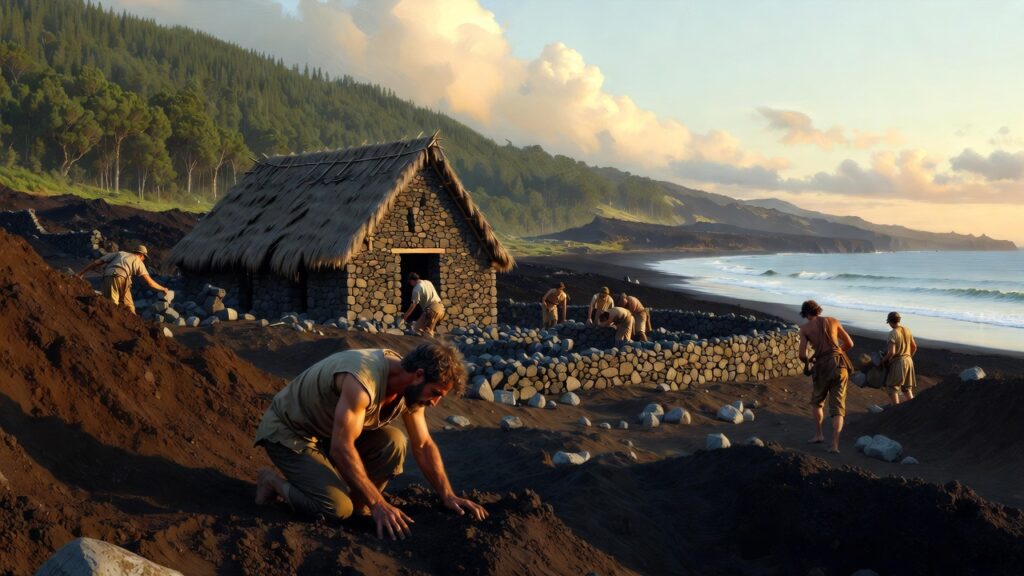
In 1455, Margaretha’s father Willem van der Haegen arrived with a second wave of settlers. The old man had not softened with age. He was as hard as lava rock and as sharp as obsidian, and he had brought with him, among the new settlers, a young woman named Catarina Bruges who was nobody in particular and who within six months had become, through the sheer gravity of her personality, indispensable to half the settlement.
Josse watched Catarina from a careful distance. She was perhaps twenty-five, dark-haired, with the kind of competence that makes itself invisible until it is gone. She organised the storage of winter provisions, mediated a dispute between two settler families over a land boundary that had been incorrectly surveyed, and delivered three babies when the only midwife on the island was herself confined with a broken arm. Margaretha liked her immediately, which was its own endorsement.
It was Catarina who told Josse, one evening in the autumn of 1456, what she had heard from a sailor who had come in from a westward voyage. He had seen land, the man said, or thought he had, far to the west, beyond anything on any chart. He was uncertain, frightened, and had said nothing to anyone except her, because he was afraid of being thought mad, or worse, being sent back to verify it. Josse sat with this information for three days before telling Margaretha. She sat with it for an afternoon before saying, ‘Willem must know.’ Her father, when told, went very quiet for a very long time. ‘Not yet,’ he said at last. ‘The world is not ready for what is in that direction. But it will be.’ He looked at Josse steadily. ‘Make sure our name is ready when it is.’
In 1468, word came from Flanders that Jan van Aertrycke had died at eighty, still active until the end. Barbara Fertyns had followed a month after, as if she could not bear to conduct even the afterlife without him. Josse stood on the cliffs of Espalamanca and looked out at the sea that separated him from everything he had come from. His son Jacob, sixteen years old and already carrying himself with an assurance that sometimes stopped Josse mid-sentence in simple admiration, stood beside him. ‘They are gone,’ Josse said. ‘My father. My mother. The world I knew.’ Jacob was quiet for a long moment. ‘You are here,’ he said at last. ‘I am here. My children will be here. That is the world now.’ Josse looked at his son and did not speak, because there was nothing to add to that.
VI. The King’s Seal on Borrowed Ground
Faial, 1500 to 1546
Josse van Aertrycke lived to be ninety-five years old. He outlasted two of his children, a fact that rearranged something fundamental in him and that he never entirely recovered from, though he learned to carry it without letting it show. He had always thought that grief was something one survived and left behind, like a town you pass through on a long road. He understood now that it was more like a stone placed in the chest that you learned, over time, to breathe around.
He watched Horta grow from a cluster of huts to a proper town with stone houses, a church, and a harbour that welcomed ships from every corner of Europe. He watched his children marry into the other great families of the Azores, the van der Haegens, the De Hurteres, the Utras, creating a web of kinship that bound the islands together like the mortar between stones. He watched grandchildren born and great-grandchildren, until the name van Aertrycke echoed through the archipelago in a dozen variations, some Flemish still, some bent into the soft shapes of Portuguese, some already becoming something entirely new.
The document arrived in 1545, on a warm afternoon when Josse was sitting in the chair by the window he had occupied most days for the last decade, the chair from which he could see the sea. It was from the King of Portugal, written on vellum, sealed with gold, formal as a cathedral. It granted him a majorat, a hereditary estate that would pass to his descendants in perpetuity. It named him Josse van Aertrycke as a nobleman of the Portuguese realm.
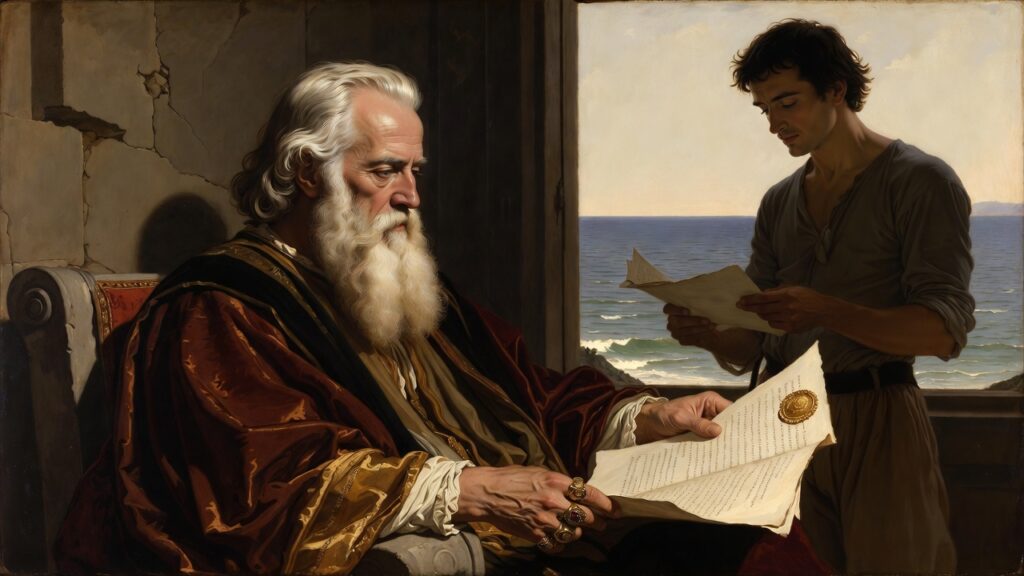
His eldest grandson Willem read it aloud, his voice clear in the quiet room. Josse sat listening with his eyes half-closed, the document resting on his knees, and when Willem finished there was a long silence in which nothing moved except the light on the wall and the distant rhythm of the sea.
‘Grandfather?’ Willem asked. ‘Are you well?’
Josse smiled. It was a smile that held ninety-five years in it: the frozen square in Bruges, the sea burial of Barbara Fertyns, the black sand beach and Margaretha’s hand, Jacob at sixteen already carrying the weight of the future without appearing to notice. ‘My grandfather,’ he said, ‘rode in a tournament in Bruges one hundred and fifty years ago. He broke lances with the greatest knights of his age. He won glory and a name that men still speak.’ He looked down at the royal document in his lap. ‘But I have done something greater. I have taken that name and planted it in soil that no van Aertrycke had ever seen. I have made it grow here, in this garden in the sea. And now the King himself acknowledges what we have built.’ He handed the document back to Willem. ‘Keep it. And remember: the name is not just letters. It is the story. It is the blood. It is everything we have been. And one day your children will carry it further still.’
He died the following summer, in his sleep, on a warm night when the wind off the Atlantic was gentle and the stars were clear. They buried him in the chapel he had built on his land, overlooking the sea he had crossed sixty years before, beside Margaretha, who had preceded him by twelve years and whom he had missed every day of those twelve years with a steadiness that those around him sometimes mistook for peace.
The name endured. The stone above him read, at his own instruction, simply: ‘He kept his grandmother’s word.’
VII. The Tongue That Reshapes the Name
Faial and Pico, 1546 to 1700
In the generations that followed Josse’s death, the van Aertrycke name underwent a transformation that was gentle and inevitable and, to those who understood such things, entirely predictable. The Portuguese tongue, with its soft vowels and its preference for liquid sounds, had never been at ease with Flemish gutturals. ‘Van Aertrycke’ became ‘van Aertrike,’ then ‘da Terra,’ and among those who remembered the old stories it sometimes became ‘Jorge da Terra,’ a half-memory of the first Josse, the name Josse being too strange to survive unchanged, bending into the nearest Portuguese equivalent. The Silveira name rose from Margaretha’s side, van der Haegen translated and transformed into something the island tongue could hold.
And so the children of Josse and Margaretha carried two names, the father’s name and the mother’s name, the Flemish name and the Portuguese name, the old world’s gift and the new world’s demand. In records this became complicated. Priests wrote what they heard, and what they heard was shaped by what they knew, which was Portuguese, not Flemish. A child baptised on Faial in 1570 might find his name recorded three different ways in three different documents, each one a small act of translation, each one adding a layer of meaning to what had already been layered.
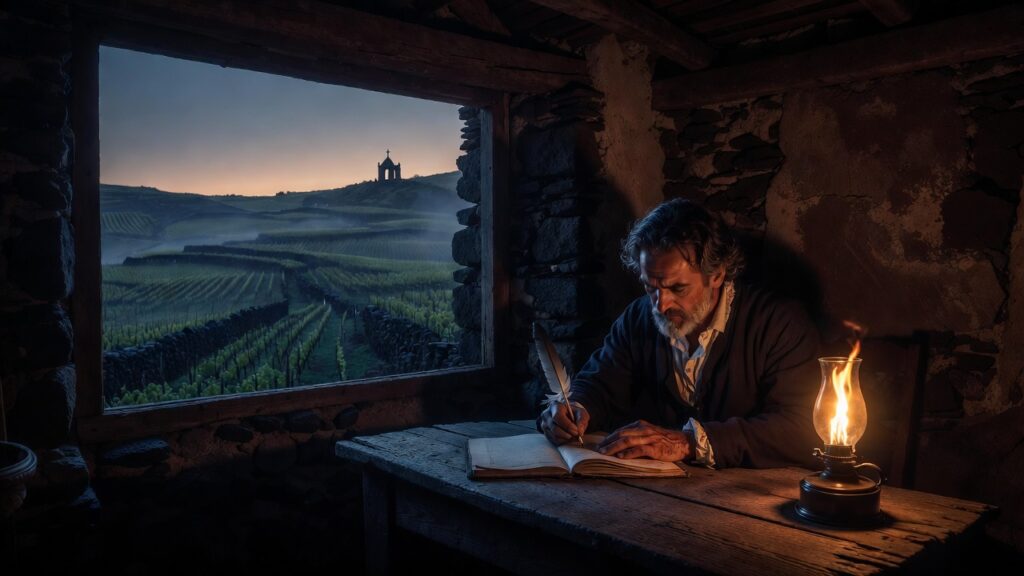
On Pico, the island of the mountain, a branch of the family established themselves as vintners, learning to grow wine grapes on the black lava soil that had no precedent anywhere in Europe. The wine they produced was dark and mineral-tasting, unlike anything made in Flanders or Burgundy or Portugal proper, and it developed a reputation among the sailors who passed through as something worth the detour. One of these vintners, a man named Henrique da Silveira who was the great-great-grandson of Josse’s son Jacob, kept a notebook in which he wrote down what he remembered of the family’s history. The notebook has survived, partly. The pages that remain show a man wrestling with an unusual problem: how to tell a story that is partly in Flemish, partly in Portuguese, partly in the gaps between languages where no word exists that means what you mean.
‘We came from Bruges,’ he wrote, in his careful schoolroom Portuguese. ‘This I know because my grandfather told me, and his grandfather told him, and further back than that I cannot trace with certainty. Bruges is a city in Flanders, which is a place of cloth and canals. A man named Jacob fought in a tournament there, which was a kind of organised battle for the entertainment of dukes, and he won, and this made our family important. I do not know what a tournament looks like because there are no tournaments here. I have never seen a canal. I have seen the sea, which is I think what canals pretend to be. I will tell my children what I know, and they will tell theirs, and some part of this will survive. The part that survives will be true. The part that does not survive will also have been true, once. This seems important to say, though I cannot explain why.’
The seventeenth century brought violence from outside. The Spanish kings had claimed the Portuguese throne, and the Azores became a place of military and political significance they had not asked for. English privateers raided the islands through the 1580s, burning, stealing, and leaving behind a particular kind of terror that changed the way people built their houses, placing fewer windows on the seaward side. The van Aertrycke chapel on Faial, the one Josse had built, was destroyed in 1589. Its records were lost. Its stones were scattered. The only documentation of what the chapel had contained was in Henrique’s notebook, in a passage added later by a different hand, and it read simply: ‘The chapel is gone. We remember what it held.’
Through it all, they survived. Not dramatically, not through any single act of heroism, but through the ordinary tenacity of people who have decided that the place they are standing is the place they intend to stay. They terraced the hillsides. They maintained the vineyards through drought and storm. They sent their sons to sea and waited with the particular patience of islanders, which is different from the patience of mainlanders in ways that are difficult to articulate but easy to recognise. They told the old stories, and the old stories changed as they were told, picking up details that had been forgotten and losing others that had seemed permanent, reshaping themselves to the shape of the mouths that spoke them, the way any living thing reshapes itself to its environment.
They became Azorean.
It was not a surrender. It was an arrival.
VIII. The Crowded Islands Call Eastward
The Azores, 1700 to 1750
By the dawn of the eighteenth century, the Azores were overcrowded. Nine islands, each with its own character, its own families, its own economy, and not enough land to absorb the children of families who had been multiplying for two hundred and fifty years. The plots that had seemed boundless to the first settlers were now divided and subdivided until some were barely large enough to sustain a vegetable garden. Young men looked at their inheritance and then looked at the sea, which had always been the Azorean habit when confronted with limits.
From Brazil came rumours. Gold had been discovered in a region called Minas Gerais, the General Mines, in quantities that strained description. Mountains of it, rivers of it, gold that men picked up from streambeds and carried away in bags. The Portuguese Crown was offering land grants, tax exemptions, and noble titles to anyone who would settle there and keep the wealth flowing back to Lisbon.
Andre da Silveira was born on Faial around 1700, a descendant of the van der Haegen line through Margaretha. He was not, by the testimony of those who knew him, a man of exceptional gifts. He was not eloquent like Jan van Aertrycke, not strategic like Maria van de Walle, not visionary like Josse, not steady-courageous like Margaretha. He was practical. He could look at a piece of land and tell you what it needed. He could look at a balance of accounts and tell you where the money was going. He could look at a situation that had been described to him as complicated and describe it back to you simply. These were not the gifts that made legends. They were the gifts that made legends possible.
He had heard the old stories all his life. He knew about the tournament in Bruges, which had become in the family’s telling a kind of founding myth: the knight who fought with honour and spared his opponent and was noticed by a duke, which was how their whole long story began. He knew about the crossing, about Barbara Fertyns who died at sea and asked for a good story, about Josse who knelt in the black sand. These stories had the texture of scripture in the telling, burnished by repetition into something smoother and more luminous than the events themselves had likely been.
In 1736, Andre da Silveira arrived in Brazil. He was not like most of the adventurers flooding into Minas Gerais, chasing the fantastic mirage of easy wealth. He had brought capital and had purchased enslaved people at the market in Rio de Janeiro with the matter-of-fact brutality of his time, a fact that the documents record without comment and that we must not allow ourselves to pass over quickly either. He had done this because it was the means by which the land could be worked, and the land was what he had come for. The valley of the Rio Aiuruoca, a wild region on the frontier between the mining districts and the unexplored interior, was where he chose to stop. There he established the Fazenda das Bicas, a name that meant, roughly, the farm of the springs.
The work was hard and the frontier was never safe. There were fevers that killed men in a week and went unnamed and unjudged. There were conflicts with other settlers over land boundaries drawn by officials who had never seen the land in question. There were years when the gold in the river reduced to almost nothing, and the plantation work had to carry everything, and the margins were thin enough that a bad harvest meant a choice between feeding the family and feeding the workers, and the choice was always the same, and it was never comfortable.
But there were also mornings when the mist lay in the valley below the house and the mountains rose out of it like a dream of something ancient and permanent, and Andre da Silveira stood on the veranda of the house he had built and felt something he had no good word for, because he was not a man for whom feeling and language met easily. Perhaps it was what Josse had felt on the black sand beach. Perhaps it was what Jacob had felt standing over a fallen opponent in a frozen square, that particular stillness that comes when you understand that the thing you have been doing has been worth the doing.
In 1749, Andre da Silveira petitioned the Bishop of Mariana for permission to build a chapel on his land. The chapel was built. Around it grew a village. Around the village grew a community. In 1755, he wrote out a declaration of debt that survives in the archives in Mariana, a document remarkable for its specificity, listing names and amounts and dates with the same care that Josse had brought to his own records three centuries before, on a different continent, in a different language. The handwriting is clear and unhurried. It is the handwriting of a man who does not doubt that what he is recording matters.
He died in 1782, an old man, his children settled, his grandchildren already scattered into the broader world that Brazil was becoming. He was buried, presumably, in the chapel he had built, though the record of his burial has not been found. He would not have minded this, being the kind of man who considered the lasting importance of documents to be in direct proportion to their usefulness to those who came after.
The town that grew from his settlement would eventually be called Andrelandia, in his honour.
The name had changed again. From van Aertrijcke to van Aertrycke to da Terra to da Silveira to Silveira to this: a town’s name on a Brazilian map, a word that held within it, compressed and unrecognisable to anyone who did not know to look, the echo of a frozen square in Bruges, a tournament champion’s lance, a grandmother’s last request made to the sea, and the black sand of an island under a man’s open hands.
The story continues. It always does. The blood moves forward.