
[Some of my favorite Physicists – Feynman, Dirac and Landau, “imagined together” sometime in the early 1960s ]
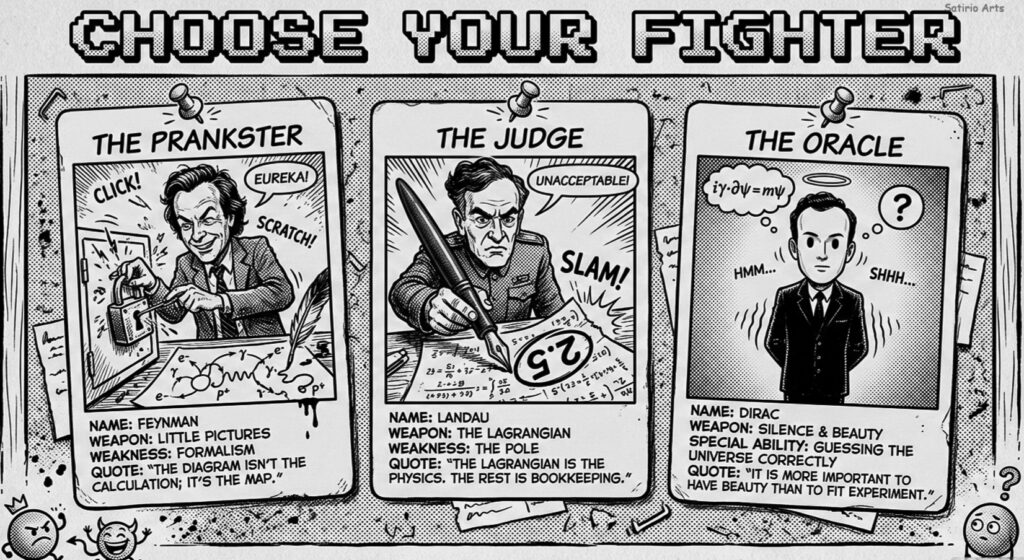
FEYNMAN: You know, Dau, I’ve been thinking about your problem with my diagrams. I think I finally understand what bothers you about them.
LANDAU: I doubt you do, or you would have fixed it. But please, enlighten me. This should be entertaining.
FEYNMAN: You think they’re cartoons. You think I drew little pictures and called it physics.
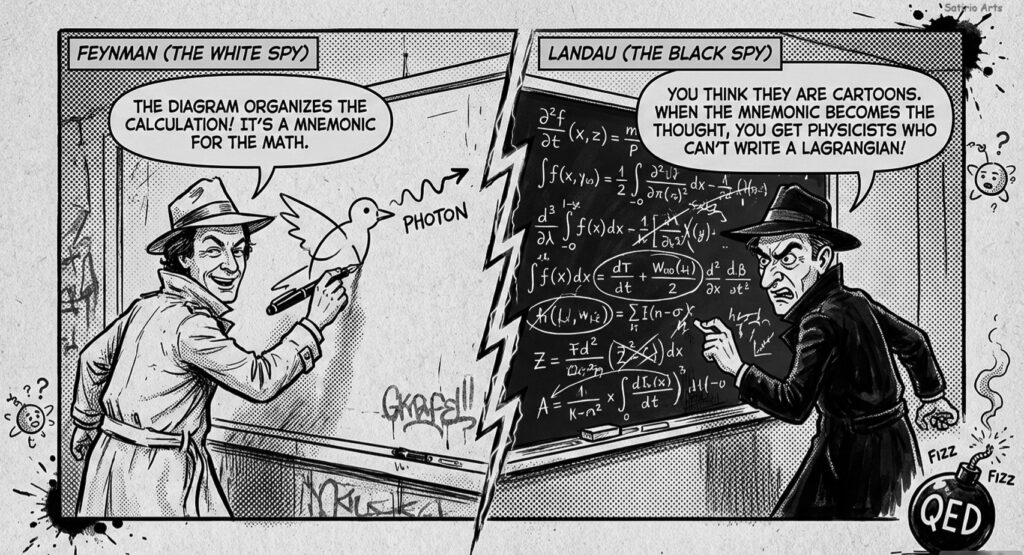
LANDAU: I think you drew little pictures, and other people called it physics. You clearly understand what you are doing. The graduate students who copy your arrows and wiggly lines without understanding the underlying Lagrangian, they believe the cartoon is the reality. This is dangerous. You have given ammunition to people who should not have ammunition.
FEYNMAN: (laughing) That’s not a criticism of the diagrams, that’s a criticism of graduate students.
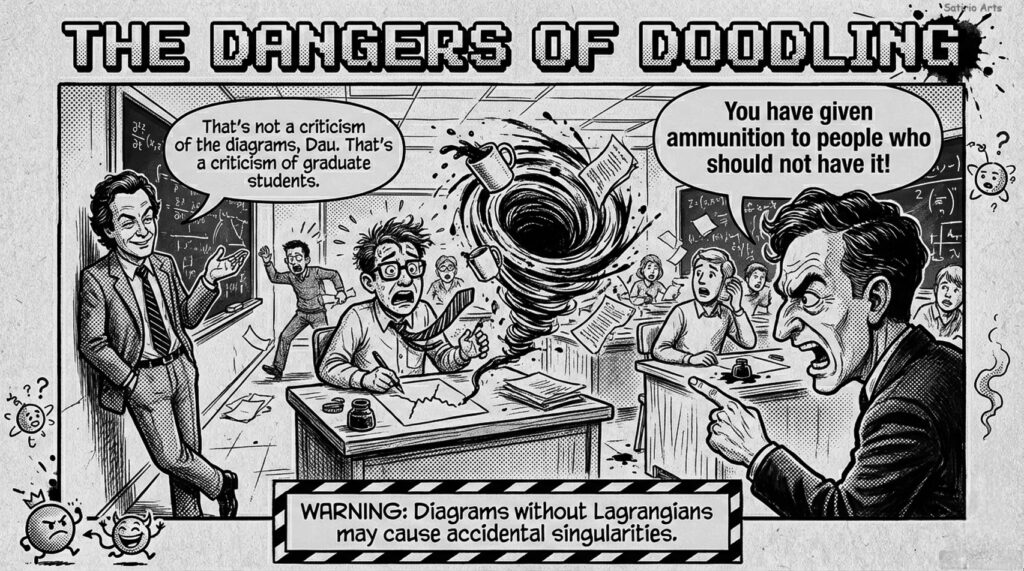
LANDAU: In my experience these are often the same criticism.
FEYNMAN: Look, the diagram isn’t the calculation. The diagram organizes the calculation. When I draw an electron emitting a photon, I’m not saying there’s a little arrow flying through space. I’m saying: here is a term in the perturbation expansion, here is what it contributes to the amplitude, here is the rule for reading it off. The picture is a mnemonic for the mathematics.
LANDAU: A mnemonic. Yes. And what happens when the mnemonic becomes the thought? I will tell you what happens, you get physicists who cannot write down a Lagrangian, who cannot derive the propagator from first principles, who reach immediately for the picture without understanding what the picture means. The Lagrangian is the physics. The rest is bookkeeping.
FEYNMAN: The Lagrangian is a way of stating the physics. It’s not the only way. That’s something that’s always struck me as strange and wonderful, that you can write the same physics as differential equations, as a Lagrangian, as a path integral, as a set of diagram rules, and they’re all the same thing wearing different clothes. Why should that be? I genuinely don’t know. It keeps me up sometimes.
LANDAU: (pause) That is actually a reasonable question. I will give you credit for that one.
FEYNMAN: High praise from Lev Landau. I’ll write to my mother.
LANDAU: Don’t be tedious., Now. The renormalization. This is where I have my real objection, and I suspect you share it more than you admit.
FEYNMAN: (more serious now) Go on.
LANDAU: The theory produces infinities. You and Schwinger and Tomonaga invented a procedure for making the infinities disappear, absorbing them into the definitions of mass and charge. The procedure works. The results are extraordinarily accurate. The anomalous magnetic moment of the electron, the Lamb shift, I do not dispute this. The numbers are spectacular.
FEYNMAN: Best numbers in all of physics.
LANDAU: Yes. And I do not trust them.
FEYNMAN: (grinning) You don’t trust the most precisely verified theory in the history of science?
LANDAU: I trust the results. I do not trust that we understand why the results are correct. There is a difference. When you sweep an infinity under the rug and the answer comes out right, you have two possibilities. First: the procedure genuinely reflects the deep structure of the theory and everything is consistent. Second: you have made two errors that cancel, and you do not know it yet. The history of physics is full of the second case masquerading as the first.
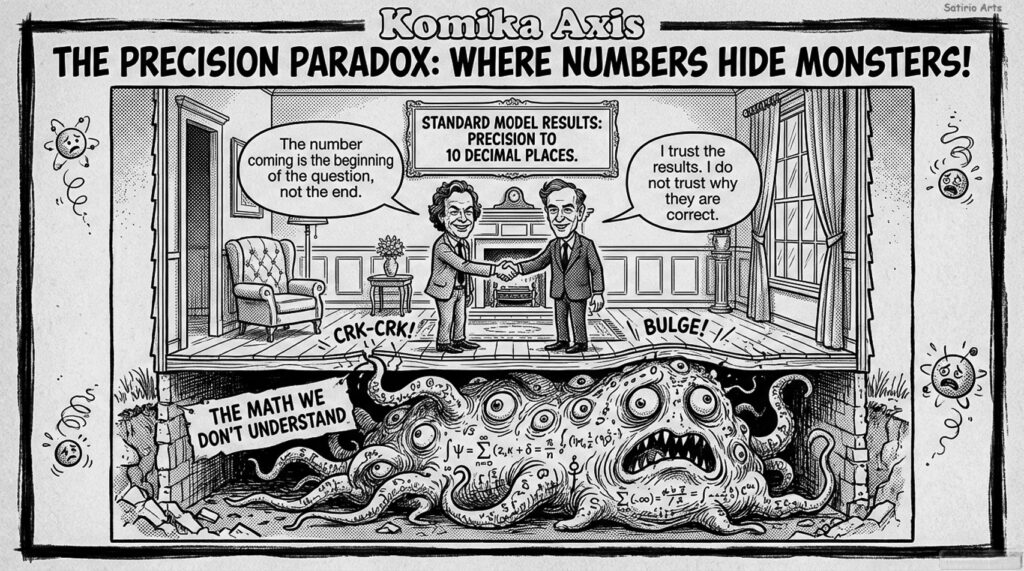
FEYNMAN: (quietly) You know, I’ve said almost exactly that myself. I called renormalization a shell game in my Nobel lecture. A dippy process. I’m not proud of it as mathematics.
LANDAU: (visibly surprised) You said this?
FEYNMAN: I said we don’t understand it. I said it works and we don’t know why and that bothers me enormously. I’m not a man who’s satisfied just because the number comes out. The number coming out is the beginning of the question, not the end.
LANDAU: (after a moment) Then perhaps we are in more agreement than I supposed. I had taken you for a man content with the machinery.
FEYNMAN: And I took you for a man who thought the Lagrangian was God and everything else was heresy. Maybe we’re both wrong.
LANDAU: I am rarely wrong. But I will admit to, imprecise characterizations, occasionally.
FEYNMAN: That’s very nearly an apology from Lev Landau. I’ll definitely write to my mother now.
LANDAU: (ignoring this) Here is what troubles me most. QED, as it stands, is a perturbation theory. We expand in powers of the fine structure constant, which is small, approximately 1/137, and so each term is smaller than the last, and we are happy. But the full theory, summed to all orders? Dyson showed that the perturbation series almost certainly does not converge. It is asymptotic at best. We are calculating the first several terms of a series that may not have a sum. We are reading the first pages of a book and declaring we know the story.
FEYNMAN: That’s true. And it might mean QED breaks down at very short distances, very high energies, before you’d ever have to worry about summing all those terms. The cutoff might be physical, not mathematical.
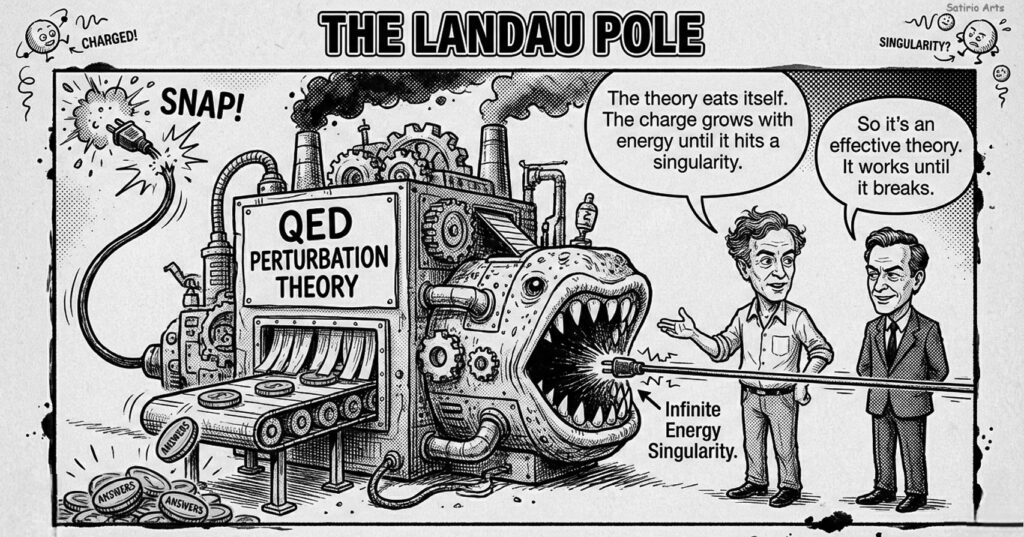
LANDAU: The Landau pole.
FEYNMAN: Your result, yes. The running of the coupling constant, the charge grows with energy and hits a singularity at some enormous scale. The theory eats itself.
LANDAU: Which means QED is not a fundamental theory. It is an effective theory. It describes correctly the physics we can access, and it breaks down before we would ever see the breakdown. A beautiful and self-concealing approximation.
FEYNMAN: (thoughtfully) You know, I think that might be true of more theories than we’d like to admit. Maybe all of our theories are like that. Valid within a range, seamlessly handing off to something deeper that we haven’t found yet. Like a series of nested dolls, each one looking complete until you open it.
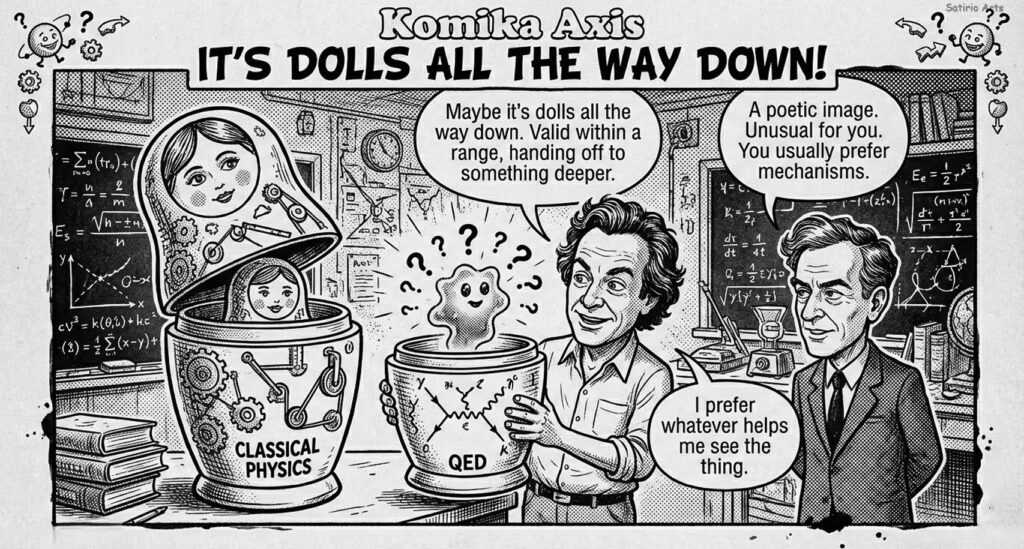
LANDAU: A poetic image. Unusual for you, you prefer mechanisms to metaphors.
FEYNMAN: I prefer whatever helps me see the thing. Sometimes it’s an equation, sometimes it’s a picture, sometimes it’s a story. You use what works.
LANDAU: And this is, I think, the genuine difference between us. Not the diagrams, not the Lagrangian, those are methods. The difference is this: I believe physics has a correct language, and that language is mathematics in its precise and unforgiving form. The theory that cannot be written cleanly in that language is not yet a theory. You believe that understanding can wear many costumes, and that insight is valid regardless of the dress.
FEYNMAN: And you think I’m wrong.
LANDAU: I think you are successful, which is more dangerous than being wrong. A wrong idea is corrected. A successful idea calcifies into doctrine before anyone thinks to question its foundations. Your diagrams will be drawn by people who no longer know why they are drawing them, and they will be drawn long after the foundations have shifted.
FEYNMAN: (pause) Maybe. But Dau, without the pictures, I never would have found the method in the first place. The intuition came first. The formalism came to justify it. That’s how it actually happens, for me anyway. And I wonder if that’s not how it happens for everyone, and the rest is just, post-hoc respectability.
LANDAU: (very long pause) I will not answer that question in a room where someone might be listening.
FEYNMAN: (delighted laugh) There it is. The most honest thing you’ve said all afternoon.
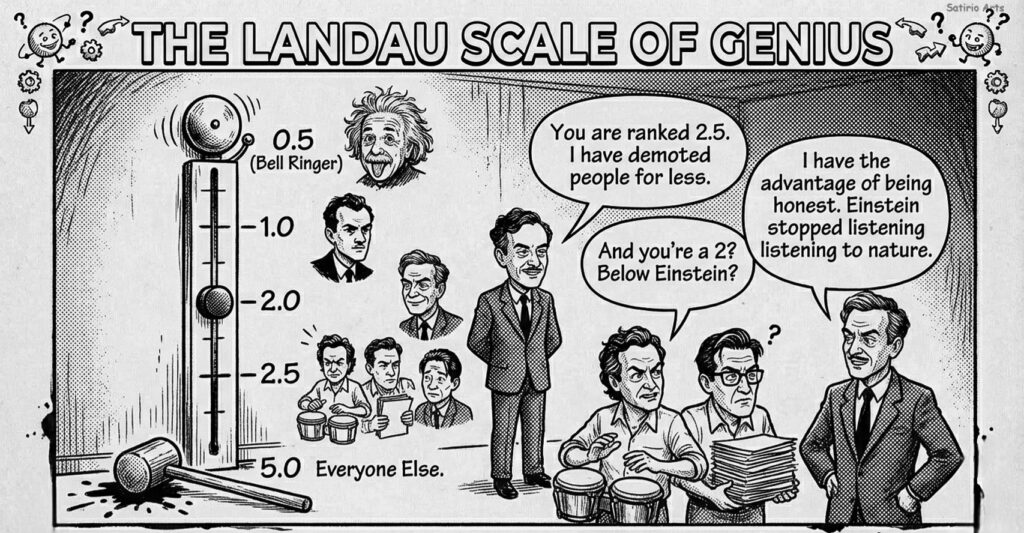
LANDAU: Do not push your luck, Feynman. You are currently ranked 2.5 on my scale. I have demoted people for less.
FEYNMAN: 2.5! I’ll take it. What’s Schwinger?
LANDAU: 2.5, on a good day. Tomonaga, 2.5. You all did the same thing, after all.
FEYNMAN: And you?
LANDAU: I am 2. Below Einstein, but I have the advantage of being honest about it. Einstein was 0.5 by his later years. A great man who stopped listening to nature and started talking to himself.
FEYNMAN: (soberly) That’s the real danger, isn’t it. Not the infinities, not the perturbation series. It’s the physicist who gets so in love with his own beautiful theory that he can’t hear what the experiments are saying.
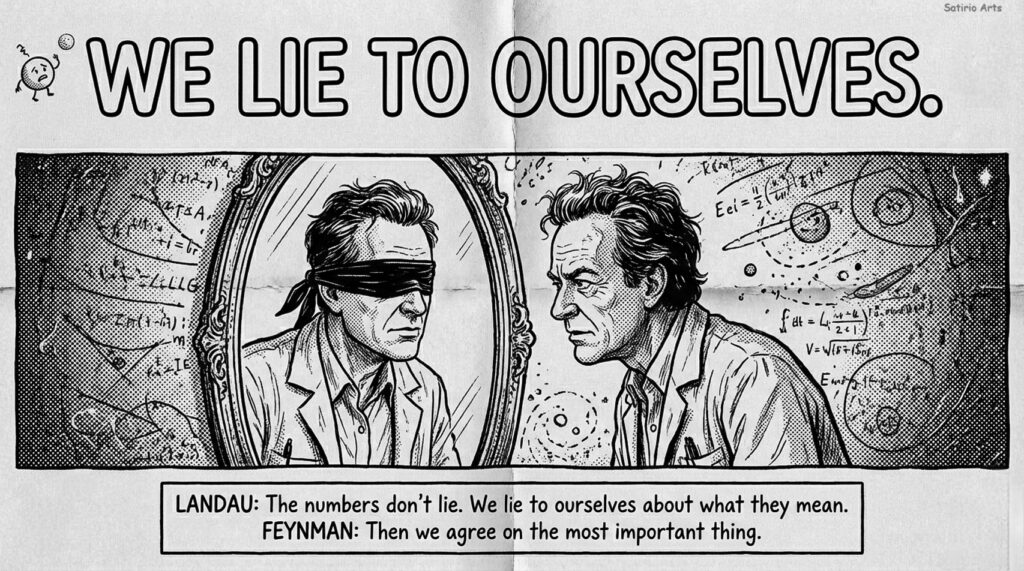
LANDAU: (quietly) Yes. That is the only death that matters in this profession. The numbers don’t lie. We lie to ourselves about what the numbers mean.
FEYNMAN: Then we agree on the most important thing.
LANDAU: We agree on the most important thing. We disagree on nearly everything else. This is, I think, a satisfactory afternoon.
FEYNMAN: You want to get a drink?
LANDAU: You will spend the entire time talking to women at the bar.
FEYNMAN: Probably, yeah.
LANDAU: (standing, reaching for his coat) Fine. But we finish the conversation first.
FEYNMAN: (stopping mid-sentence, genuinely startled) Paul.
DIRAC: Feynman.
(A silence. Dirac stands in the doorway holding nothing, no coat, no bag, looking faintly puzzled by the existence of the corridor.)
LANDAU: (drily) Dirac. We were just leaving.
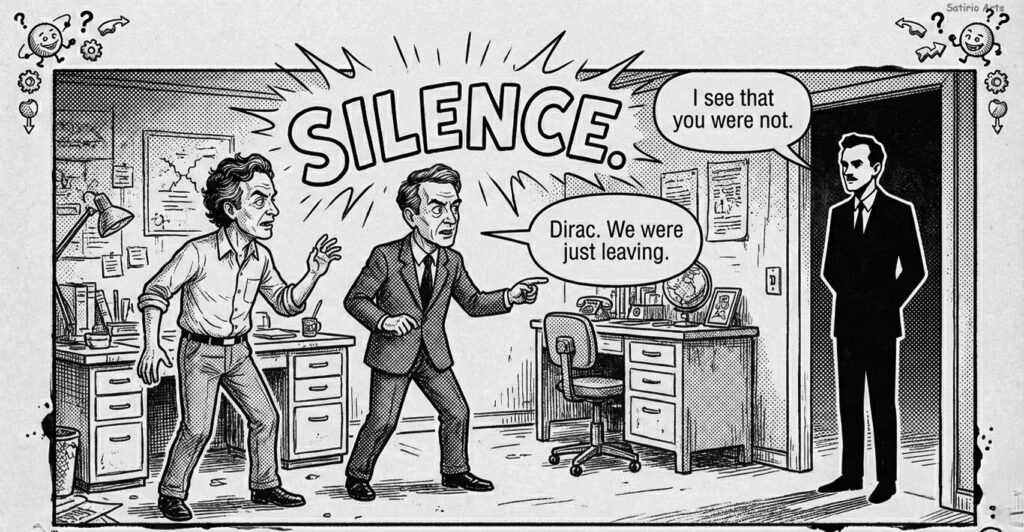
DIRAC: I see that you were not.
LANDAU: (pause) No. Come in.
(They return to the room. Dirac sits, precisely, in the center of his chair. He looks at neither of them. He appears to be listening to something inaudible.)
FEYNMAN: We were talking about QED. Renormalization. Whether we actually understand it.
DIRAC: You do not.
FEYNMAN: (carefully) You want to expand on that?
DIRAC: I said what I meant. The renormalization procedure instructs you to discard infinite quantities because they are inconvenient. This is not mathematics. In mathematics, you may neglect a quantity that is small. You may not neglect a quantity simply because it is embarrassingly large and you do not want it.
LANDAU: On this we agree entirely.
DIRAC: I am aware of what you agree with, Landau. I did not require your confirmation.
LANDAU: (a flicker of amusement) Of course not.
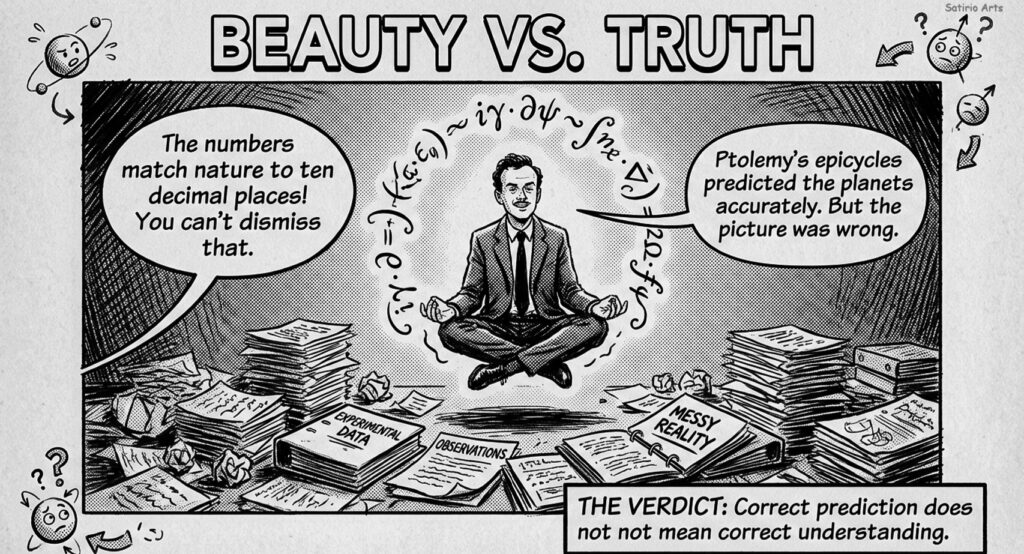
FEYNMAN: Look, I’ve said myself that renormalization feels wrong. Like a trick. But the trick works, Paul. The anomalous magnetic moment of the electron, we calculate it and nature agrees to ten decimal places. You can’t just dismiss that.
DIRAC: I do not dismiss it. I distrust it. These are different positions.
FEYNMAN: How can you distrust a theory that predicts nature that accurately?
DIRAC: (turning to look at Feynman directly, which is somehow more unsettling than being ignored) Because accuracy of prediction is not the same as correctness of understanding. Ptolemy’s epicycles predicted the motion of planets with considerable accuracy. The underlying picture was entirely wrong. A theory that arrives at correct answers through incorrect reasoning is a successful accident, not a foundation.
FEYNMAN: (quietly) That’s a fair point.
DIRAC: I know.
LANDAU: The difference, and I say this as someone who also finds renormalization distasteful, is that Ptolemy had no deeper principle. QED at least rests on gauge invariance, on Lorentz symmetry, on a Lagrangian with proper structure. The renormalization may be a symptom of something missing, not of something wrong.
DIRAC: The Lagrangian structure is correct. I wrote it down. What Schwinger and Feynman did with it afterward is a separate matter.
FEYNMAN: (a beat) You know, that’s something I’ve always wanted to ask you about. The path integral, I built the whole thing from a footnote in your 1933 paper. A footnote, Paul. You wrote that the transition amplitude was analogous to the exponential of the classical action, and then you moved on. Did you know what was in that footnote?
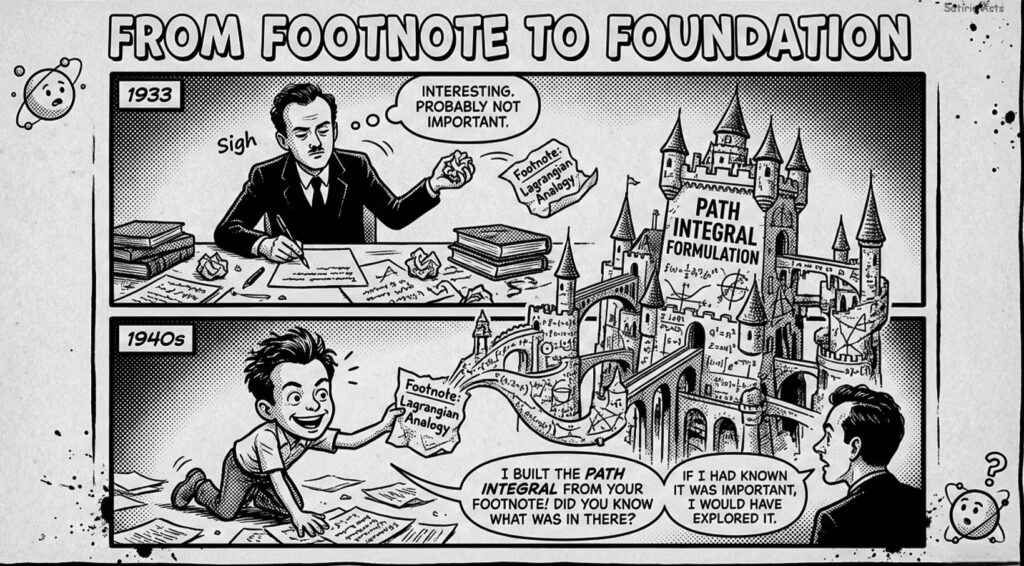
DIRAC: (long pause) I knew it was interesting.
FEYNMAN: That’s it? Interesting?
DIRAC: If I had known it would lead somewhere important, I would have explored it. I did not know. So I noted it and continued.
FEYNMAN: (shaking his head, half laughing) You left the whole path integral formulation of quantum mechanics in a footnote because you weren’t sure if it was important.
DIRAC: I think the originator of an idea is not always the best person to develop it. The fear of something going wrong is too strong. Perhaps it was better that you found it.
FEYNMAN: (genuinely moved) That might be the nicest thing you’ve ever said to me.
DIRAC: It was not intended as a compliment. It was a statement about the psychology of discovery.
LANDAU: (to Feynman) You see? This is what I have always said about him. He says things that could warm your heart, and he means them purely as information.
DIRAC: I am still in the room, Landau.
LANDAU: I am aware.
FEYNMAN: Let me ask you both something. Forget renormalization for a moment. Do you think QED is the right shape? Not the right answer, the right shape? Gauge theory, path integrals, a quantum field living in spacetime, is that the skeleton of something true, or is it a scaffolding we’ll tear down eventually?
LANDAU: The gauge principle I believe in. It is too powerful, too constraining to be a coincidence. Symmetry dictates interaction, this is a deep idea, one of the deepest in all of physics. Whatever replaces QED will contain it.
DIRAC: The mathematics is beautiful. I have always believed that beautiful mathematics must eventually describe reality. This has been my guiding principle and it has not failed me.
FEYNMAN: And if the math is beautiful but the physics is wrong?
DIRAC: Then the physics is not yet finished. The mathematics will wait.
FEYNMAN: (to Landau, quietly) He says things like that and I don’t know whether it’s profound or completely backwards.
LANDAU: (equally quietly) It is always both simultaneously. This is what makes him impossible.
DIRAC: I can hear you.
FEYNMAN: Paul, do you think the electron is a point particle? Truly? Zero size, infinite self-energy, the whole thing? Or is that where the infinities are trying to tell us something?
DIRAC: The infinities are certainly telling us something. The question is whether we are listening or simply covering our ears with renormalization and calling it understanding.
FEYNMAN: My instinct, and I know you distrust instinct
DIRAC: I distrust instinct when it is not subsequently verified by mathematics.
FEYNMAN: My instinct is that at very short distances, the whole picture changes. The field theory breaks down. Maybe spacetime itself breaks down. Whatever lives at those scales, it’s something we haven’t imagined yet.
LANDAU: The Landau pole suggests this. At sufficiently high energies, QED becomes inconsistent with itself. It requires a more fundamental theory to take over.
DIRAC: (nodding almost imperceptibly) This I accept. QED is a low-energy effective description. It is not the final word.
FEYNMAN: So we’re all standing here, the three people who arguably did the most to build QED, and we all think it’s incomplete.
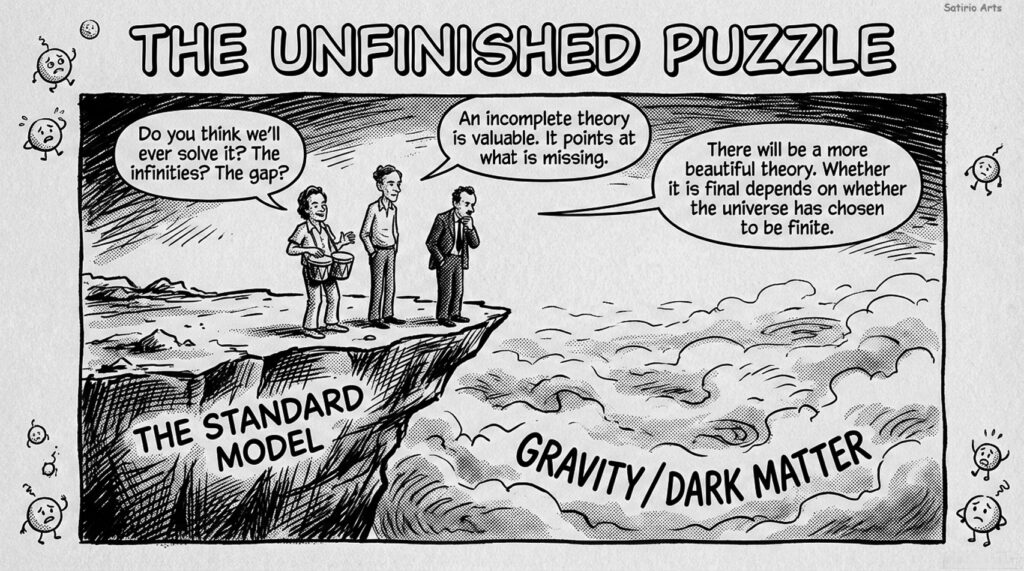
LANDAU: All good theories are incomplete. That is what makes them good theories. A theory that explains everything explains nothing, it has simply matched itself to the data with enough free parameters to lose all predictive power. An incomplete theory points at what is missing. This is more valuable.
DIRAC: The Dirac equation was incomplete. It predicted negative energy states that I did not initially understand. I was tempted to explain them away. Instead I followed the mathematics, and the mathematics predicted antimatter. (pause) I have since learned not to be embarrassed by what the equations say.
FEYNMAN: That’s the thing you did that I’ve never stopped being amazed by. You guessed the equation first and understood it second. Most of us understand, or think we understand, and then write the equation. You went the other direction.
DIRAC: It seemed the more reliable direction.
FEYNMAN: For you, maybe. I can’t do that. I need a picture, a story, a mechanism, something I can see, even if it’s wrong. The picture gets me started. Then I check the picture against the math and usually the picture is wrong in interesting ways and that’s where the physics is.
DIRAC: Your pictures are useful. I will grant you that. They help other people compute. Whether they help other people understand is a different question.
FEYNMAN: Isn’t computing a form of understanding?
DIRAC: (considering this with complete seriousness for a long moment) No. Understanding is recognizing why the computation was inevitable. Computing is following instructions. A very good student can follow instructions. Understanding requires something else.
LANDAU: And what is that something else?
DIRAC: (standing, as if the question has been definitively answered) I had an equation. That was the something else.
(He moves toward the door.)
FEYNMAN: Dirac. One more thing. Do you think we’ll ever solve it properly? The infinities, the measurement problem, the gap between quantum mechanics and gravity, all of it. Will there be a final theory?
DIRAC: (at the door, turning back fractionally) There will be a more beautiful theory. Whether it is final depends on whether the universe has chosen to be finite. I see no reason why it should have done so for our convenience.
(He leaves. The door does not quite close.)
FEYNMAN: (after a moment) Every single time.
LANDAU: Yes.
FEYNMAN: Does he ever…? Is there a version of him where he finishes a conversation?
LANDAU: I have been asking this question for thirty years. The evidence suggests no.
FEYNMAN: (staring at the open door) And yet. The man wrote down an equation and the universe said, yes, exactly that. Antimatter, spin, all of it. From a guess. From beauty.
LANDAU: (putting on his coat) It is annoying, isn’t it. When someone is right in a way you cannot fully account for.
FEYNMAN: Deeply.
LANDAU: This is why I put him on the scale between 0.5 and 1. He operates by a method I cannot grade, because I cannot determine if it is genius or something stranger than genius.
FEYNMAN: What’s stranger than genius?
LANDAU: (opening the door fully) Certainty that does not require justification. It is either the most dangerous thing in physics or the most necessary. With Dirac it has, so far, been the latter. (pause) I find this very irritating.
FEYNMAN: (laughing) Yeah. Me too.
(They walk out into the corridor. Through the window at the far end, Dirac can be seen below, crossing the courtyard alone, walking at a perfectly even pace, apparently in no particular direction, apparently content.)
Note: This dialogue was imagined but considering the key characterstics of the scientists. Also with a few historical notes woven in. For example, Feynman’s self-criticism of renormalization is real, he called it “hocus-pocus” and a “shell game” in his Nobel lecture and elsewhere. Landau’s logarithmic physicist ranking scale (with Einstein at 0.5 and himself at 2) is documented. Also, Dirac’s documented rejection of renormalization is real and verbatim in places. His 1933 paper really did contain the seed of Feynman’s path integral in a footnote, and Feynman really was uncertain for years whether Dirac had known it. Dirac’s belief that beautiful mathematics must describe reality was his genuine, stated guiding principle, and his prediction of antimatter really did emerge from following an equation he didn’t yet understand rather than from physical intuition. Landau’s ranking of Dirac as resisting his own scale is my invention, but consistent with his documented way of thinking about exceptional cases. Eugene Wigner’s real remark about young Feynman,”a second Dirac, only this time human”, haunts the whole piece.