
The morning began in a hush of mist.
Amsterdam was barely awake when I started the BMW M3 and headed eastward, fields sliding past the window in patient shades of green and silver. The Netherlands has a way of appearing impossibly flat until, suddenly, something rises from it like a secret. And there it was, turrets and towers lifting from the water, as if a storybook had gently unfolded itself into the landscape.
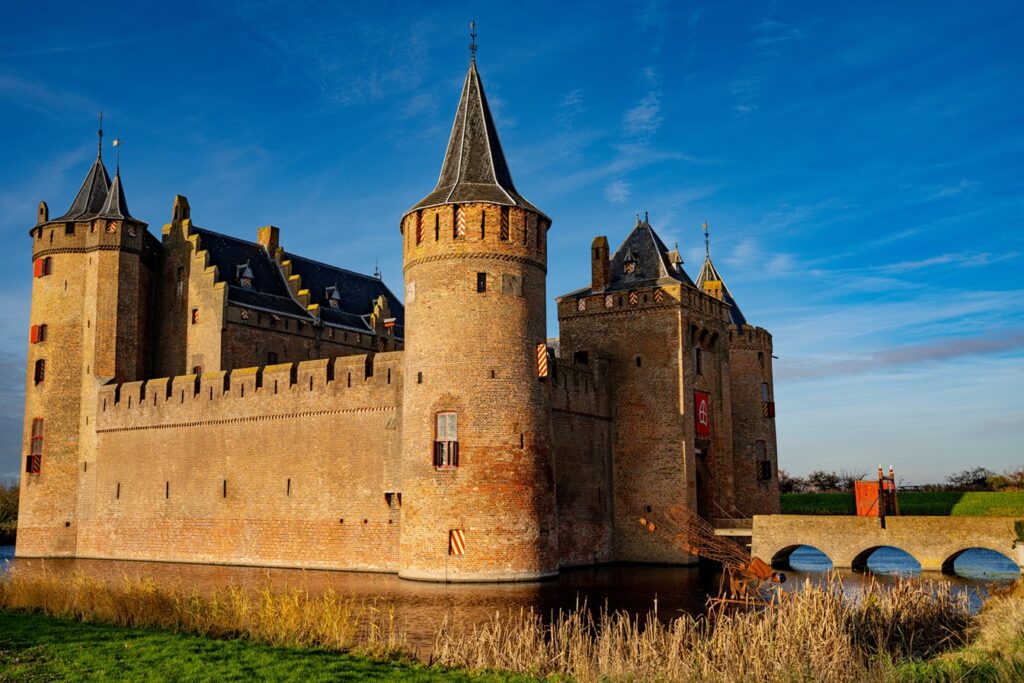
Muiderslot does not loom. It waits. Surrounded by a wide moat that mirrors the sky, its brick walls glow softly in the northern light. Built around 1285 by Count Floris V, it was less a romantic fortress in its earliest days and more a strategic stronghold, guarding the mouth of the River Vecht and controlling access toward Utrecht. In medieval Europe, beauty and power were often indistinguishable.
As you approach Muiderslot, the first thing that hits you is the water. The castle is completely encircled by a wide moat. Crossing the wooden drawbridge feels cinematic. You leave the modern world behind with every step. Constructed around 1280 by Count Floris V as a strategic toll castle to control the mouth of the Vecht river, Muiderslot’s early legacy is inextricably linked to the Count’s infamous kidnapping and murder in 1296, an event that left the fortress abandoned and decaying for nearly a century. It was later revived under the Dukes of Burgundy and subsequently passed to the Habsburgs, serving variously as a noble residence, an administrative hub, and eventually a state prison during the Eighty Years’ War and the French occupation. By the 19th century, the castle was slated for demolition until King William I intervened, sparking a major restoration effort in the late 1800s under the direction of pioneer monument conservator Victor de Stuers to return it to its medieval glory. Today, following a long period of management by the Dutch State, it stands as a protected national monument entrusted to the Rijksmuseum, preserving centuries of turbulent Dutch heritage within its restored walls.
Crossing the wooden drawbridge feels ceremonial. The creak beneath your feet is not theatrical, it is historical. Inside the courtyard, enclosed by high brick walls and cylindrical towers, the air carries a faint chill even in daylight. You sense that this was once a place of watchfulness. Arrow slits cut into the walls are narrow from the outside but wide within, designed for defense. Every architectural detail whispers calculation.
Yet the castle’s history did not remain fixed in conflict. In the 17th century, during the Dutch Golden Age, Muiderslot became a gathering place for artists and intellectuals under the stewardship of poet and historian P.C. Hooft. Here, the mood shifted from siege to salon. One can almost imagine candlelit conversations drifting through the Great Hall, discussions of philosophy, politics, poetry, voices rising beneath timber beams that still hold their echoes.
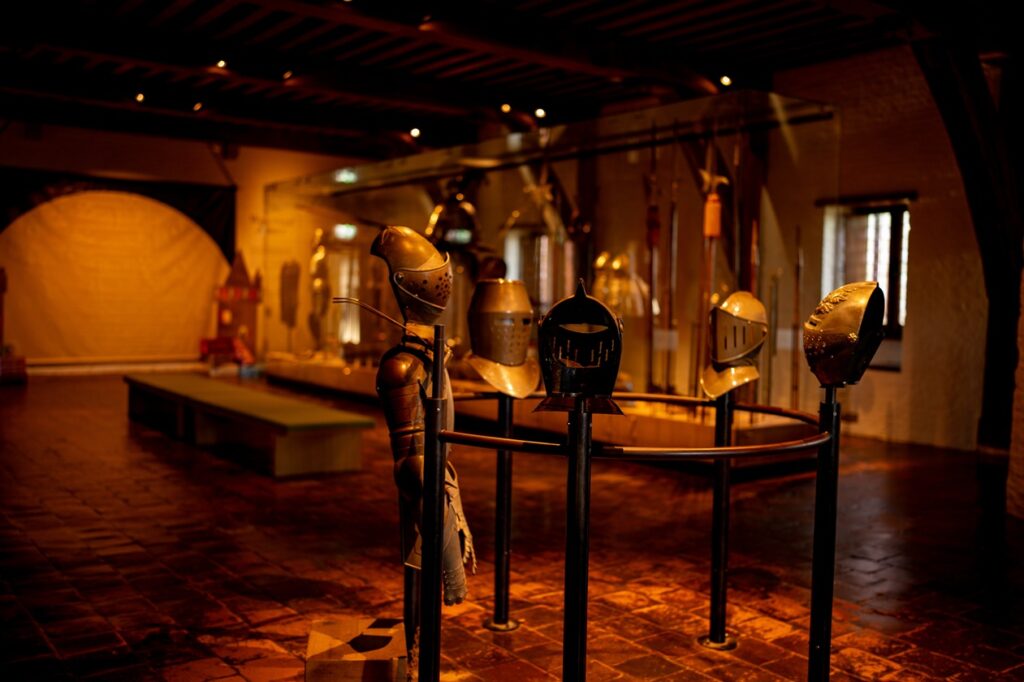
Inside, the rooms are carefully restored but not overly polished. Suits of armor stand like silent sentinels. Heavy oak chests suggest lives packed into movable fortunes. In the Knight’s Hall, long wooden tables evoke feasts that were equal parts diplomacy and display. The fireplaces are cavernous, capable of warming both stone and spirit. I ran my hand along a cool brick wall and felt time condensed into texture.
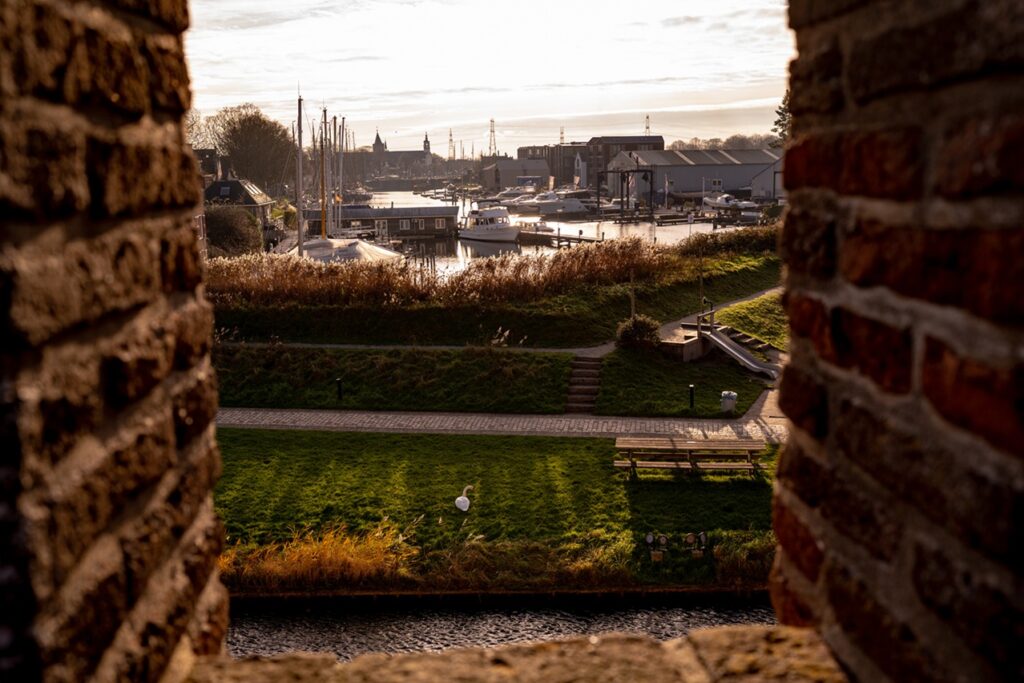
Climbing the spiral staircase inside one of the towers, I emerged onto the ramparts. From above, the geometry of the castle reveals itself: square layout, corner towers, a symmetry both practical and elegant. Beyond the moat stretch flat pastures and distant waterlines merging with the horizon. It is easy to see why painters have long been seduced by this landscape, its restraint, its clarity, its refusal to exaggerate.
And yet, standing there, I felt something that had little to do with military strategy or Golden Age intellect. It was something more primal and more childlike. The imagination begins to play tricks in places like this. You half expect banners to unfurl, horses to thunder through the gates, a princess to appear at a narrow window. The moat reflects clouds so perfectly that the castle seems suspended between two skies.
The gardens behind the walls are surprisingly gentle, herb beds laid out in neat patterns, fruit trees pruned with care. Medieval castles were not merely sites of battle; they were centers of survival. Herbs for medicine, vegetables for sustenance, flowers for both beauty and symbolism. Walking among them, the harshness of fortress life softens into something almost domestic.
What strikes me most about Muiderslot is its scale. Unlike the vast castles of Central Europe that overwhelm with sheer size, this one invites closeness. It feels comprehensible. You can imagine living here, pacing these rooms, climbing these steps daily. It retains grandeur without intimidation.
By afternoon, the mist had lifted. The moat shimmered in direct sunlight, turning from steel-grey to liquid blue. Families wandered the courtyard. Children ran ahead across the bridge with unfiltered delight, wooden swords in hand from the gift shop. Their laughter seemed perfectly placed. Castles, after all, belong as much to imagination as to history.
Before leaving, I turned for one last look from the far side of the water. The four towers rose confidently, yet not arrogantly. The reflection in the moat doubled the vision, creating the illusion of a kingdom both above and below.
Muiderslot does not dazzle through extravagance. It enchants through preservation, through the careful maintenance of walls that have withstood centuries of change. In a country shaped by water and trade, where cities feel modern and efficient, this castle stands as a reminder that even the flattest landscapes can hold fortresses of memory.
As the train carried me back toward Amsterdam, fields once again sliding past, I realized the fairytale was not in dragons or royalty. It was in the simple act of stepping across a bridge and allowing history to breathe around you.
For a day, at least, I had walked inside a story, and it had felt entirely real.