
剑影乾坤
太平和战
Translation:
The sword casts its shadow across the universe,
a fragile equilibrium sways between peace and war.
山巍巍兮天下立,静默道恒深,
河川流兮幽影里,魂断此中吟。
和谐诉于智者境,明德为其根,
纷争起兮火燎原,剑鸣毁乾坤。
心静如磐守正道,风浪亦无忧,
机巧妙谋因时动,风雨未曾休。
胜非在兵力之强,智韬可转机,
智者策谋化干戈,疮痕渐减稀。
使命呼唤如星恒,律动贯长空。
无欲无私施己行,战火不持功。
弓弦响兮矢既出,义道仍留伤,
火中求和步难稳,灰烬化苍茫。
智慧慎谋安众生,碎土待重合,
信念炽烈掀狂澜,反成天下惑。
信若成刃削公义,正道难平持,
和声灭兮乱中丧,众生久为失。
月升起兮清辉洒,战地染霜寒,
不叹争兮不为胜,盈亏本自然。
心清若溪淌淌流,化乱安四方,
唯此平和长相伴,纵风雨何妨。
—吴禅龙
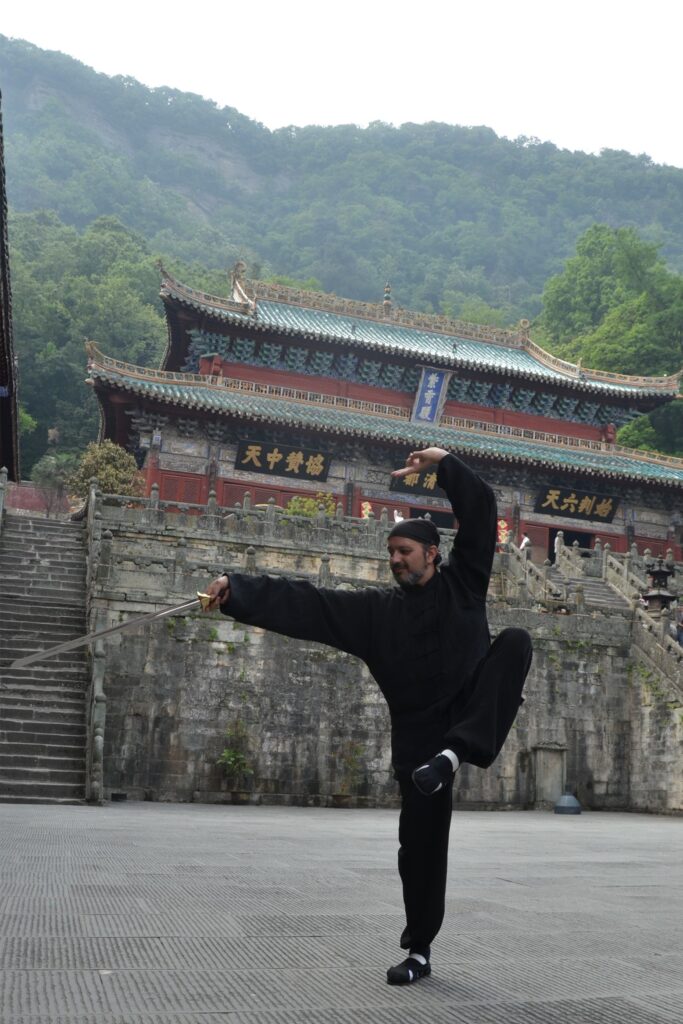
Mountains rise high, and thus the world stands firm;
In stillness, the eternal Way runs deep.
Rivers flow through shadowed valleys dim;
Here the spirit breaks, and chants in grief.
Harmony speaks within the sage’s realm,
Bright virtue forms its living root.
When strife ignites like wildfire’s helm,
Sword cries resound, heaven and earth laid mute.
A heart as still as stone guards the righteous Way;
Through wind and waves it stands unshaken.
Subtle stratagems move with the times at play;
Storm and rain are never forsaken.
Victory lies not in armies strong
Wisdom can turn the tide.
The wise transform the clash of arms;
Scars fade, though once they cried.
A calling endures like steadfast stars,
Its rhythm spanning sky.
Desireless, selfless in one’s own acts
War wins no lasting prize.
The bowstring sounds, the arrow flies;
Yet justice still bears scars.
Seeking peace amid the flames,
One walks through drifting char.
With prudent thought, the wise secure the people;
Broken lands await their seam.
Fervent faith may stir great waves,
Yet turn the world to dream.
If trust becomes a blade for gain,
Public good is torn apart.
When harmony’s voice is drowned in chaos,
Long are the losses of the heart.
The moon ascends and spills clear light;
Frost chills the field of war.
No sigh for strife, no boast of gain
Loss and profit are as before.
A mind as lucid as a flowing stream
Brings order to the four directions.
Only this abiding peace endures
Let storms come without objection.
.
Interpretation:

Original: 山巍巍兮天下立,静默道恒深,河川流兮幽影里,魂断此中吟。
Translation: The mountains stand tall, established under heaven, in silent stillness, the Dao is eternally deep. Rivers flow through the shadowy valleys, where souls are lost and sing their songs.

Dialogue on Meaning:

Q: The mountain is majestic, but it's also silent and still. How is that related to life?

A: The mountain represents the fundamental, unchanging truths of the world, like the need for integrity, love, or the laws of cause and effect. They are always there, solid and supporting, whether we notice them or not. The "deep Dao" is this underlying order.

Q: And the river? Why are souls "lost" and "singing" in its shadowy paths?

A: The river is our life's journey: constantly moving, changing, cutting new paths through the shadows of hardship, uncertainty, and emotion. The "souls lost" here are not just the dead, but the living who feel adrift in the current of daily struggle. Their "song" is the expression of their experience, the poetry of their pain, joy, and confusion. Life is the interplay between the permanent mountain (our core values) and the transient river (our daily experience).

Reality & Examples:

The Mountain: Think of someone with a strong moral compass. During a corporate scandal, they remain silent but steadfast, refusing to participate in the fraud. Their integrity is the "mountain" that stands firm while chaos (the river) flows around them.

The River: Consider a single mother working two jobs. She is constantly in motion, flowing through the "shadowy valleys" of exhaustion and financial worry. Late at night, when she finally sits down, she might feel a sense of loss for her old life, but also a deep, quiet resolve, that is the "soul's song" rising from the depths.

Stanza 2
Original: 和谐诉于智者境,明德为其根,纷争起兮火燎原,剑鸣毁乾坤。
Translation: Harmony speaks to the realm of the wise, with illustrious virtue as its root. Conflict rises like a wildfire sweeping the plains, the clang of swords destroys the universe.

Dialogue on Meaning:

Q: So harmony isn't just the absence of noise? It requires wisdom?

A: Exactly. True harmony in a family, a team, or a society isn't accidental. It's a conscious creation built on a foundation of "illustrious virtue": things like mutual respect, empathy, fairness, and a shared commitment to the common good.

Q: And the wildfire is conflict. What does "destroys the universe" mean in a real-life sense?

A: It means that unchecked conflict doesn't just ruin a single relationship or day; it can destroy a person's entire world—their "乾坤" (universe). A bitter divorce can poison a person's view of love forever. A tribal war can erase centuries of culture and history. The "clang of swords" is the sound of that total destruction.

Reality & Examples:

Harmony's Root: A successful community garden. It's not just about plants growing. Its "root" is the "illustrious virtue" of the neighbors who organize it, they share tools, resolve disputes over water peacefully, and celebrate each other's harvests. The harmony they experience is a direct result of that shared virtue.

Wildfire Conflict: A single, nasty comment on social media ("剑鸣") can escalate into a "wildfire" of online harassment, doxxing, and public shaming. It can destroy a person's reputation, mental health, and career, effectively demolishing their personal "universe."

Stanza 3
Original: 心静如磐守正道,风浪亦无忧,机巧妙谋因时动,风雨未曾休。
Translation: A heart as still as a boulder, guarding the right path, is not troubled by wind and waves. Clever strategies move according to the time, for the wind and rain never cease.

Dialogue on Meaning:

Q: This seems like two different ideas. Be still like a rock, but also use clever strategies?

A: They are two sides of the same coin. The "still heart" is your inner core: your principles, your sense of self. That must be unshakable, like a boulder in a river. The "clever strategies" are your outer actions, your ability to adapt and navigate the currents. Life's storms ("wind and rain") are constant. To survive, you need a steady keel (the still heart) and the skill to adjust your sails (timely action).

Reality & Examples:

The Still Heart: A doctor in a chaotic emergency room. The alarms are shrieking, family members are crying, and staff are rushing. Amidst this "wind and rain," the doctor's heart must be "still as a boulder," focused solely on the principles of saving a life and doing no harm.

Timely Action: That same doctor uses "clever strategies" by quickly diagnosing the problem, delegating tasks to the team, and deciding on the precise moment to administer a drug or perform a procedure. They are adapting their skills ("因时动") to the specific, chaotic moment.

Stanza 4
Original: 胜非在兵力之强,智韬可转机,智者策谋化干戈,疮痕渐减稀。
Translation: Victory does not lie in the strength of military force; wisdom and strategy can turn the tide. The wise one uses plans to turn weapons into peace, and the scars gradually fade.

Dialogue on Meaning:

Q: This directly challenges the idea that "might makes right." How does wisdom "turn the tide"?

A: True victory isn't about crushing your opponent; it's about resolving the situation so that you don't have to keep fighting the same battle forever. Wisdom sees the bigger picture. It understands the other side's motivations and finds a path where everyone can get something they need.

Q: What does it mean for "scars to gradually fade"?

A: When you win through brute force, you create deep wounds: resentment, trauma, a desire for revenge. These scars fester. When you resolve conflict through wisdom and negotiation, the resolution allows for genuine healing. The scars are still there, but they can slowly fade because the underlying injury has been properly treated, not just bandaged over.

Reality & Examples:

Wisdom over Force: The Truth and Reconciliation Commission in South Africa. Instead of a bloody civil war (military force) to overthrow apartheid, a process of testimony, amnesty, and acknowledgment was chosen. This was a "stratagem" to "turn weapons into peace." It didn't erase the pain, but it allowed the nation's "scars" to begin healing in a way that pure military victory never could have.

Personal Example: A couple in a heated argument. One person "winning" by shouting louder or storming out (force) only deepens the wound. A "wise" victory is when they both sit down, listen to understand, and find a compromise. The hurt ("scar") is addressed and can begin to fade.

Stanza 5
Original: 使命呼唤如星恒,律动贯长空。无欲无私施己行,战火不持功。
Translation: Mission calls, constant as a star, its rhythm penetrating the vast sky. Acting without desire or selfishness, one does not claim credit amidst the flames of war.

Dialogue on Meaning:

Q: This "mission" sounds like a calling. How is it like a star?

A: A star is a constant, reliable point of light in the darkness. A true calling, whether it's for justice, art, or healing, is something that guides you unwaveringly. It's not a fleeting impulse; its "rhythm" or pattern is woven into the fabric of your life.

Q: "Not claiming credit" is the opposite of modern culture. Why is that important?

A: Because if your primary motivation is personal glory ("desire"), your actions become about serving yourself, not the mission. When you act selflessly in the midst of crisis ("battlefield"), your focus is entirely on the good you can do. The lack of desire for reward makes your actions purer and more effective. The peace you help create is its own reward.

Reality & Examples:

The Star: Think of a scientist like Marie Curie. Her mission was the pursuit of knowledge. It was a constant "star" that guided her through immense personal and professional hardship. The "rhythm" was her dedication to research.

No Credit: A volunteer who spends every weekend for years tutoring underprivileged children. They aren't doing it for a medal or a news story. They are acting "without desire or selfishness." When those children grow up and succeed, the volunteer doesn't stand in the "flames of war" (the systemic inequality they fought against) and claim the victory. The children's success is the victory.

Stanza 6
Original: 弓弦响兮矢既出,义道仍留伤,火中求和步难稳,灰烬化苍茫。
Translation: The bowstring twangs, the arrow is loosed; even on the path of righteousness, wounds remain. Seeking peace in fire makes for unsteady steps; all turns to desolate ash.

Dialogue on Meaning:

Q: This is a tough lesson. Even when you're right, you still get hurt?

A: Yes. The arrow represents any decisive action taken in a conflict, even one justified by a noble cause ("righteous path"). The act of fighting, defending yourself, or standing up for truth has a cost. The "wound" is the trauma, the lost time, the broken trust that results from the conflict itself, regardless of who was "right."

Q: And "seeking peace in fire"? That sounds like an impossible task.

A: It is. It's the image of trying to negotiate a truce while the bombs are still falling. It means trying to build a lasting solution on a foundation of ongoing violence, anger, and injustice. The steps are "unsteady" because the ground is literally burning beneath you. The result isn't peace; it's just a pause before everything turns to ash.

Reality & Examples:

Righteous Wounds: A whistleblower who exposes corruption at their company. They are on the "path of righteousness," but they still suffer. They may lose their job, be ostracized by former colleagues, and endure years of legal battles. The "wound" is real, even though they were right.

Peace in Fire: An immediate ceasefire agreement that forces two warring ethnic groups to live together without addressing the underlying issues of land theft or historical massacres. They are trying to build peace "in the fire" of their hatred. The steps are unsteady, and the agreement will likely collapse, leaving only the "ash" of a failed peace and renewed violence.

Stanza 7
Original: 智慧慎谋安众生,碎土待重合,信念炽烈掀狂澜,反成天下惑。
Translation: Wisdom and careful planning bring peace to all beings; the shattered soil waits to be rejoined. But a blazing faith stirs up a storm, and instead becomes the world's confusion.

Dialogue on Meaning:

Q: So wisdom is careful and patient? It's about putting broken pieces back together?

A: Precisely. After any conflict or disaster ("shattered soil"), the work of rebuilding requires slow, deliberate, wise action. It's about carefully listening to all sides, creating fair systems, and nurturing trust so the broken pieces of a community can "rejoin."

Q: This is interesting: "blazing faith" is portrayed as dangerous. Why?

A: Because when belief becomes too intense ("blazing"), it loses its humility. It stops being a guiding light and becomes a blinding fire. It refuses to compromise, see other perspectives, or question itself. This kind of fanaticism doesn't heal a broken world; it creates new storms, leading to more confusion and conflict. It thinks it has all the answers, which makes it the most dangerous source of questions.

Reality & Examples:

Wisdom Rejoins: After a natural disaster, a community leader doesn't just hand out supplies. They use "wisdom and careful planning" to organize a meeting where everyone, the wealthy and the poor, the old and the young, has a voice in how to rebuild. They are patiently helping the "shattered soil" of their town "rejoin."

Blazing Faith: A political or religious leader with a "blazing" conviction that their ideology is the only truth. They are unwilling to engage in dialogue. Their "faith" becomes a justification for purges, censorship, and violence. They claim to be bringing order but instead "stir up a storm" of division and "confusion," destabilizing the very society they claim to save.

Stanza 8
Original: 信若成刃削公义,正道难平持,和声灭兮乱中丧,众生久为失。
Translation: If belief becomes a blade, it cuts away at justice; the right path is difficult to hold level. The sound of harmony is extinguished, lost in the chaos; the people are lost for a long time.

Dialogue on Meaning:

Q: This takes the last idea even further. A "belief that becomes a blade" is a powerful and terrifying image.

A: It is. It's when your ideology is no longer a personal guide but a weapon to attack, judge, and exclude others. You start using your beliefs to "cut away" at the very concept of fairness for anyone who doesn't think like you.

Q: What is the ultimate consequence of this for a society?

A: The "sound of harmony", the possibility of productive disagreement, mutual respect, and peaceful coexistence, is completely drowned out by the noise of conflict. When that happens, the people ("众生") are plunged into a long, dark age of confusion and suffering. They lose their way, because the path of balanced, fair justice ("正道") has been destroyed.

Reality & Examples:

Belief as a Blade: In the era of McCarthyism in the US, a rigid anti-communist "belief" became a blade. It was used to destroy the careers and lives of innocent people, "cutting away" at the fundamental "justice" of due process and free speech.

The People Lost: This describes any society trapped in a cycle of ideological warfare, like a country caught in a permanent state of partisan gridlock. The "sound of harmony" is gone, replaced by shouting heads on TV. The "people" are the ones who suffer, as nothing gets done to help them, and they are left "lost" in the chaos, struggling to find common ground with their own neighbors.

Stanza 9
Original: 月升起兮清辉洒,战地染霜寒,不叹争兮不为胜,盈亏本自然。
Translation: The moon rises, casting its clear light, dyeing the battlefield with a cold frost. It does not sigh for the conflict, nor does it seek victory; its waxing and waning is simply its nature.

Dialogue on Meaning:

Q: After so much chaos, this stanza feels like a breath of fresh air. Why the moon?

A: The moon is the ultimate observer. It represents a higher, natural perspective. It shines its "clear light" equally on a beautiful garden and a horrific battlefield. It doesn't judge the conflict below; it simply illuminates it, revealing the "cold frost" of reality.

Q: "It does not sigh... nor seek victory." What can we learn from that?

A: It teaches us the power of detachment and acceptance. The moon doesn't get caught up in the drama of human struggle. It follows its own eternal cycle, indifferent to our wins and losses. This implies that we can find a place of peace within ourselves by recognizing that many of our struggles are temporary and small in the grand scheme of the natural order. Life has its own cycles of gain and loss ("waxing and waning") that are beyond our control.

Reality & Examples:

The Observer: Imagine a paramedic who has worked a 24-hour shift during a terrible riot. At the end of the night, they step outside, look up at the moon, and feel a moment of profound calm. The moon is indifferent to the chaos they just left. It offers a perspective that is bigger than the immediate tragedy. It reminds them that the world, and its natural cycles, continues.

Natural Cycles: A business owner who loses everything in a market crash. They can either be consumed by the "battle" of their loss, or they can adopt the perspective of the moon. They can acknowledge that "loss" and "gain" are part of a natural cycle. This detachment allows them to clear the "frost," accept their new reality, and begin again.

Stanza 10
Original: 心清若溪淌淌流,化乱安四方,唯此平和长相伴,纵风雨何妨。
Translation: A clear heart flows like a babbling brook, transforming chaos, bringing peace to all directions. Only this lasting peace is a true companion; what matter if wind and rain come?

Dialogue on Meaning:

Q: The poem ends with water again, but this time it's a clear stream. What's the difference from the river in the first stanza?

A: The first stanza's river was the powerful, often sorrowful current of life itself. This stream is different. It's the inner state you cultivate. It's not powerful or destructive; it's clear, gentle, and persistent. Its clarity represents wisdom and purity of intention. It flows not to conquer, but to nourish.

Q: How does a "clear heart" transform chaos and bring peace?

A: By its very nature. A person with a clear, peaceful heart doesn't add to the chaos. They respond to conflict with calm, to anger with understanding. Like a stream that slowly carves through rock, their steady presence can soften hard hearts and soothe turbulent situations. Their peace is infectious; it "flows" outwards, calming those around them.

Q: The final line: "纵风雨何妨." It sounds defiant, but not aggressive.

A: It's the ultimate statement of resilience. When you have cultivated this deep, internal peace ("心清") as your constant companion, the external storms of life lose their power to destroy you. You will still feel the wind and rain, you will experience loss, pain, and conflict, but they will not uproot you. Your inner peace is a shelter that goes with you everywhere.

Reality & Examples:

The Clear Heart: Think of someone like Nelson Mandela after 27 years in prison. He emerged not with a heart full of bitterness (which would have been a raging river), but with a "clear heart," focused on reconciliation. His gentle but persistent presence, his willingness to have tea with his former enemies, was the "stream" that "transformed the chaos" of a nation on the brink of civil war and brought a fragile "peace to all directions."

Personal Companion: A parent dealing with a teenager's tantrum. Instead of yelling back (adding to the chaos), they take a breath, center themselves, and respond with a calm, quiet voice. Their own inner peace is their "companion." They are the "clear stream" that can soothe the "storm" of their child's emotions. And because they have this peace inside them, they know they can handle whatever "wind and rain" their child or life throws at them next.